AC Coupled Inverter: Do You Really Need to Replace Your Solar Inverter?
Table of Contents
Not necessarily. Adding battery storage does not necessarily mean you have to replace your existing PV inverter. If the original unit is operating well, you can first evaluate a retrofit solution using an AC-coupled inverter, which adds storage on the AC side while retaining the original power generation equipment.
If the original unit needs to be replaced anyway, or if you plan to install both PV and energy storage at the same time, you should include compatible DC-coupled solutions in your comparison. If your primary goal is to provide backup power during outages or to limit power fed into the grid, you’ll need to verify that these functions are supported; simply installing a battery does not automatically guarantee these capabilities.
What Does an AC Coupled Inverter Actually Do?
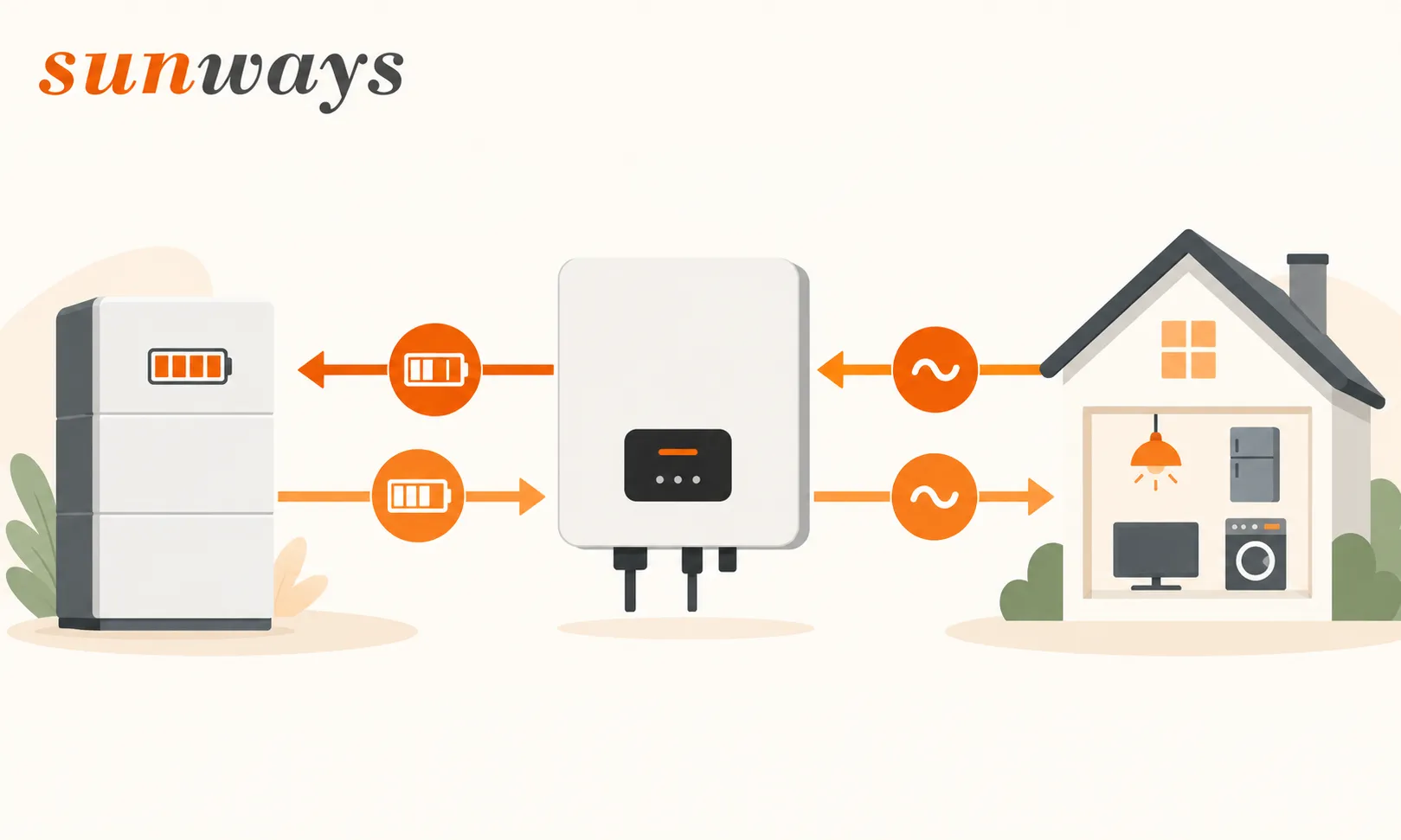
In the energy storage applications discussed in this article, the AC-coupled inverter is responsible for bidirectional power conversion between the battery and the AC side: during charging, it converts AC power to DC power for storage in the battery; during discharging, it converts the DC power from the battery back to AC power to supply the load.
“AC-coupled” describes the system’s connection configuration. The PV system and energy storage are connected on the AC side, while the battery itself remains connected to the energy storage system via the DC side; this does not mean the battery is transformed into an “AC battery.”
Know What Each Device Does
| Device | Role in the System |
|---|---|
| Existing PV Inverter | Converts the DC power generated by PV modules into AC power and feeds it into the AC busbar—the line where all AC branches converge |
| Energy Storage-Side Inverter | Manages battery charging and discharging; this can be a battery inverter or a hybrid inverter supporting the corresponding AC coupling application |
| Electricity Meter, CT, and Communications | Provides measurement and communication data for system monitoring and corresponding control functions; CT stands for current transformer, which measures current |
| Regular Loads and Emergency Power Loads | Regular loads are connected to the corresponding AC circuits; loads requiring power during outages should be connected to independent emergency power circuits according to supported solutions |
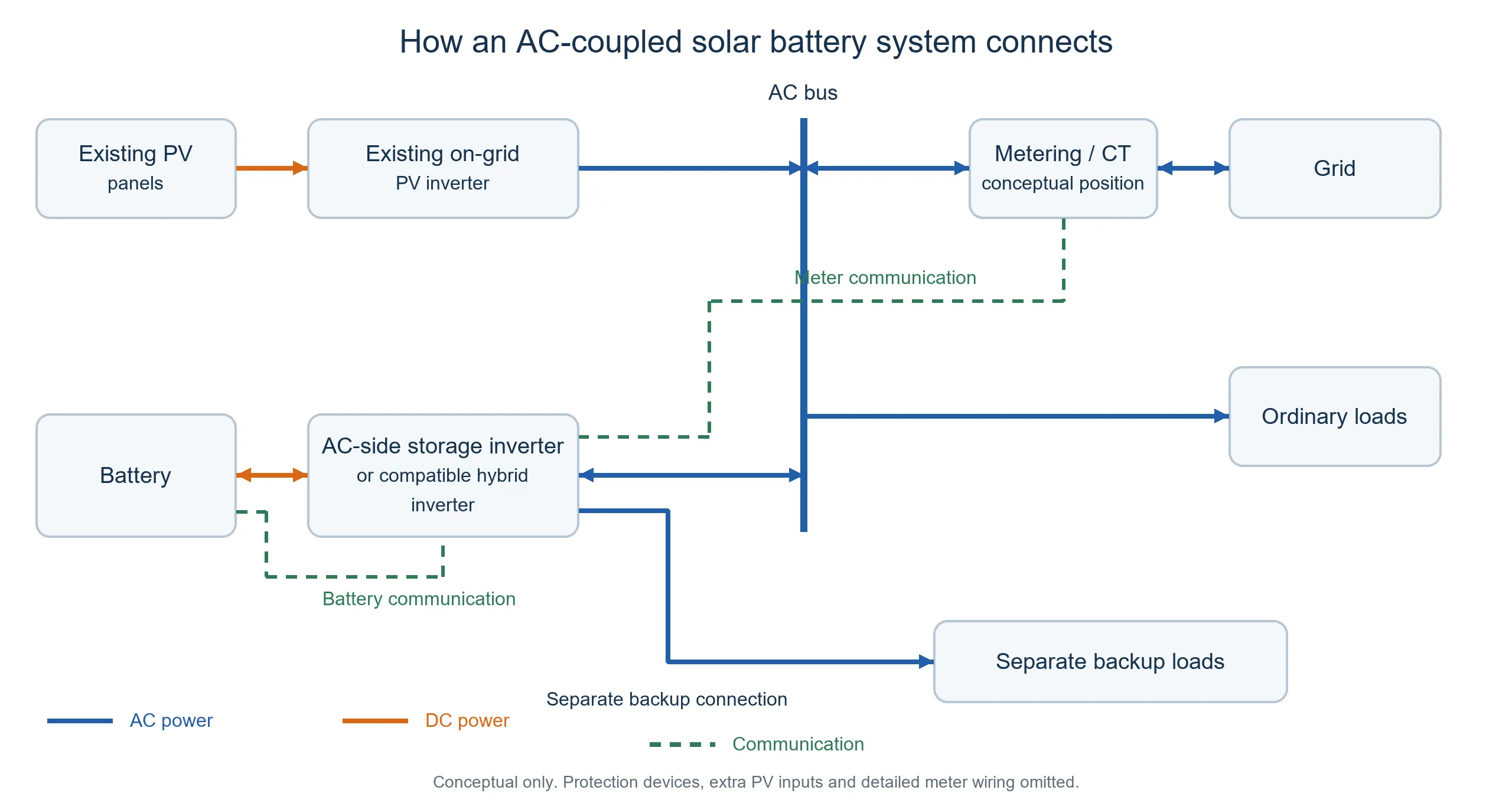
Figure 1|Simplified diagram based on the official Sunways solution. Blue lines represent AC circuits, orange lines represent DC circuits, and green dashed lines represent communication. Protective devices, potential new direct PV inputs, and detailed metering wiring are omitted from the figure; it is intended solely to illustrate the roles of the equipment. The backup power branch must be supported by specific equipment and wiring configurations; this diagram should not be used as a substitute for an installation diagram.
Tracking Energy Flow in Two Grid-Connected Scenarios
| Normal Grid-Connected State | Energy Path in Example Mode |
|---|---|
| Sufficient PV generation | Supply the load first; use the surplus to charge the battery; if there is still excess, feed it into the grid |
| Insufficient or no PV generation | The battery supplements load power when discharge is permitted; if there is still a shortfall, the grid supplements it |
AC vs DC Coupling: Should You Keep or Replace Your Inverter?
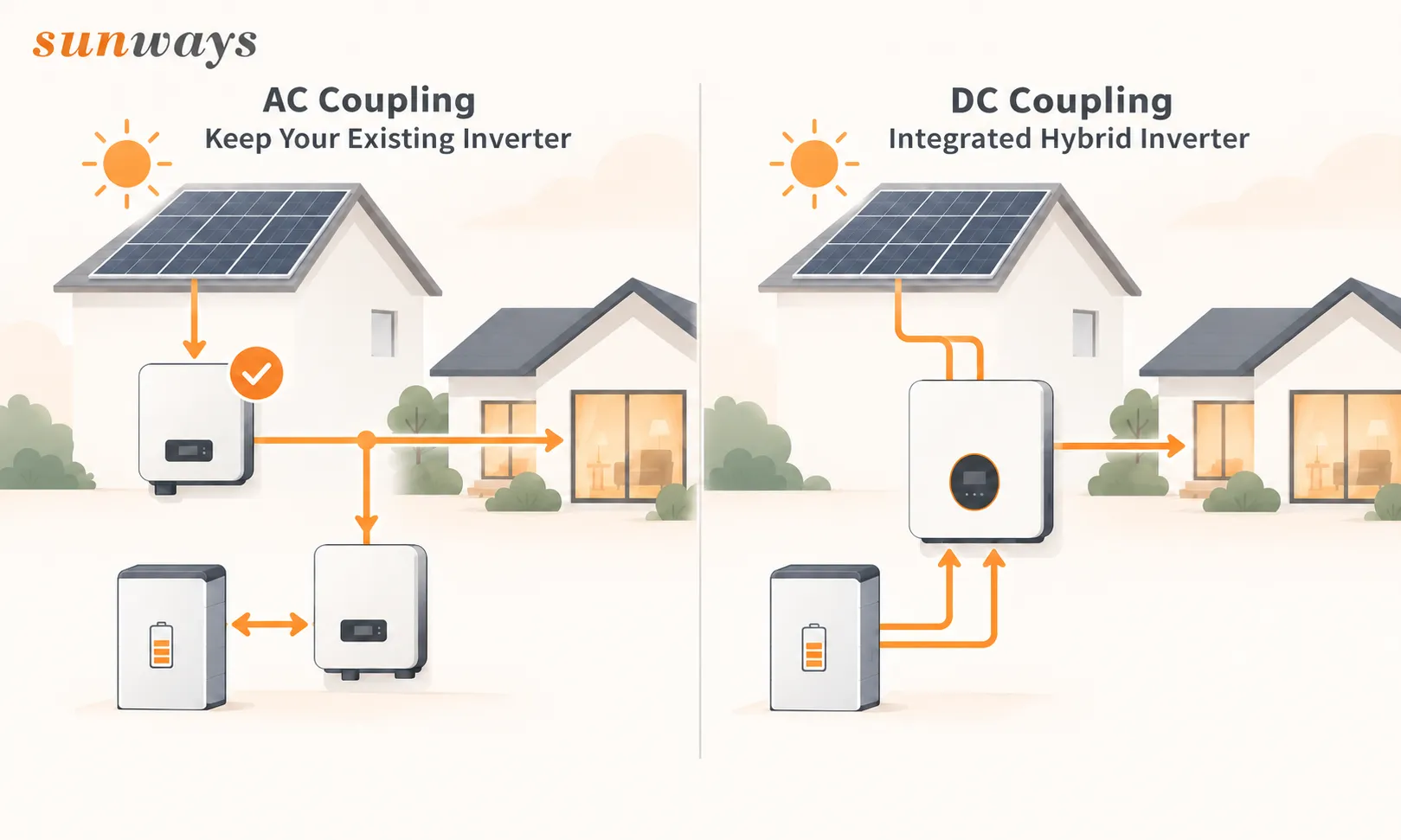
AC (alternating current) and DC (direct current) coupling refer to which side of the system the PV and energy storage systems are connected to. A hybrid inverter is a type of device that integrates PV and battery management functions. Therefore, an AC-coupled inverter and a hybrid inverter are not simply mutually exclusive options: a hybrid inverter that supports the corresponding functions can also be used in an AC-coupled configuration.
Compare the Retrofit You Actually Need
| Comparison Item | AC Coupling: Adding Energy Storage on the AC Side | DC Coupling: Compatible DC-Side PV-Storage Solution |
|---|---|---|
| Retention of Original Inverter | Consider retaining the original PV inverter and adding energy storage equipment | If the original equipment already supports approved battery connection, consider adding the battery directly; otherwise, an upgrade or replacement may be required |
| Surplus PV Power to Battery | PV DC power is first converted to AC, then converted back to DC by the energy storage equipment | PV charges the battery via compatible DC-side equipment; DC voltage conversion may still be required |
| Scope of Retrofit | Energy storage equipment, batteries, metering, and necessary power distribution modifications | Batteries and necessary ancillary equipment; if the inverter is replaced, this also involves removal, replacement, and wiring adjustments |
| Total Cost | Calculate costs for new equipment, power distribution modifications, installation, and commissioning | If equipment replacement is involved, include costs for removal, replacement, and wiring adjustments; if the original equipment can be directly connected to the battery, provide a separate quote |
| Standby Power and Output Limitations | Determined based on specific topology, ports, and control configurations | Must also be assessed based on the entire system configuration |
Turn the Checks into a Decision
| Conditions You Have Confirmed | Next Steps |
|---|---|
| Existing system is operating well with no immediate replacement plans; the supplier can provide a supported equipment configuration and wiring scheme that covers the required functions | Obtain quotes for an AC retrofit while retaining the existing system, and list the new equipment and power distribution scope |
| The existing unit requires repair or replacement, or you plan to install new PV and energy storage simultaneously | Obtain a complete quote for a compatible DC PV-storage solution and compare the cost and functionality of a one-time retrofit |
| The existing hybrid inverter has an approved battery connection path | First, evaluate the configuration and quote based on this path, then determine whether additional AC energy storage equipment is needed |
| There is still no basis for determining necessary backup power, cross-brand compatibility, or output control capabilities | Do not finalize the procurement configuration yet; first, gather complete information on the corresponding equipment combinations, wiring configurations, and functional specifications |
How Do You Size the Inverter and Battery Without Overbuying?
Separate Power, Energy and Recharge Conditions
kW (kilowatts) represents power, which indicates how quickly a device consumes electricity; kWh (kilowatt-hours) represents the amount of electricity used or stored over a period of time. The inverter must be capable of handling the simultaneous load of the target circuits, while the battery must provide the necessary amount of usable energy for the corresponding duration. The startup requirements of equipment such as air conditioners and water pumps should be accounted for separately; average power should not be used as a substitute for maximum simultaneous load, nor should short-term peaks be treated as sustained output.
The following is a hypothetical example for educational purposes; it does not represent Sunways product specifications, typical household data, or actual test results.
| Assumptions | Calculated Results | How to Use in System Selection |
|---|---|---|
| Target load averages 1.5 kW, operating for 4 hours |
Electricity demand on the load side =
1.5 × 4 = 6 kWh |
Use this as the load-side energy requirement to calculate available energy, losses, reserve margin, and charge/discharge limits; do not directly select a “6 kWh battery” or a “1.5 kW inverter” |
When reviewing battery specifications, distinguish between rated capacity and usable capacity. For example, the Sunways STE-NS16 has a rated capacity of 16.4 kWh and a usable capacity of 14.8 kWh. Available capacity should also not be directly equated with the final amount of electricity delivered to AC loads; conversion losses and actual operating settings must also be considered. This section merely explains the difference between the two types of capacity and is not intended to recommend this specific battery for the 6 kWh example mentioned above.
Next, verify whether the battery can be recharged in a timely manner. If you plan to use surplus daytime PV power to cover nighttime electricity consumption, subtract the daytime load and then examine the remaining generation, allowable charging power, and available time. Total daily power generation does not equal the amount of electricity that can be charged into the battery; simply increasing the battery capacity does not necessarily result in more stored energy.
When delegating calculations to an installer, please provide a list of loads, which devices will operate simultaneously, the target runtime, and the conditions available for recharging. Only then can you move from determining “how much electricity is needed” to a specific equipment configuration.
Check Each Phase in a Three-Phase System
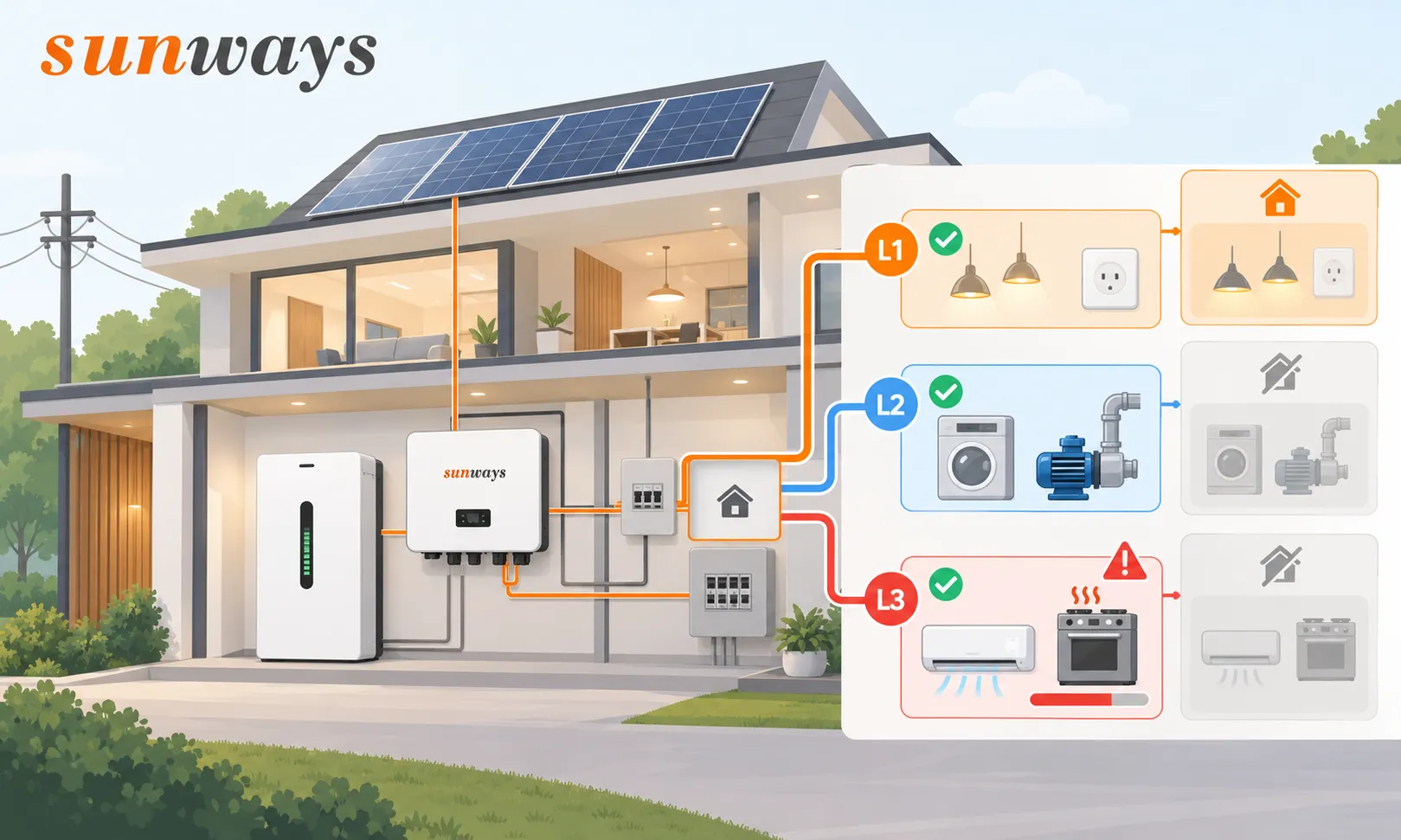
A three-phase system has three AC power supply lines. When selecting three-phase AC-coupled energy storage equipment, list the loads by phase and verify the output limits for each phase, the conditions for supporting unbalanced loads, and the circuits covered by the emergency power ports. Do not assume that the total power rated on the inverter is concentrated entirely on a single phase.
The battery’s continuous discharge capacity must also align with output requirements. Sunways product data sheets list parameters separately for the battery, grid-connected output, and backup power output; these should be reviewed accordingly during selection—do not rely solely on the total power rating.
Compare the Total Installation Cost
| Quote Item | Scope to Be Specified |
|---|---|
| Battery | Model, quantity, rated and usable capacity, and necessary accessories |
| Inverter | New installation or replacement; if the existing unit needs to be removed, whether removal and disposal are billed |
| Metering and Communication | Electricity meter, CTs, and required communication accessories |
| Power Distribution and Backup Power Retrofit | Cables, protection devices, switching mechanisms, and modifications to backup power circuits |
| Installation and Commissioning | Construction, configuration, functional verification, handover, and taxes |
| After-Sales Service | Who is responsible for fault diagnosis, labor, transportation, and equipment replacement |
The price of the equipment alone cannot be directly compared to the price of a complete delivery. Omissions in the quote regarding power distribution, commissioning, and after-sales responsibilities may alter your assessment of the two options.
Will Your Solar Still Work When the Grid Goes Down?
Check the Backup Path
| Operating State | Behavior of This Example Topology | What This Means for You |
|---|---|---|
| Normal Grid-Connected Operation | PV, loads, batteries, and the utility grid operate in coordination according to the settings | Normal charging and discharging occurs, but this does not confirm that the original PV system will continue to generate power during a power outage |
| Utility Grid Outage | The original grid-tied inverter stops generating power, and the hybrid inverter supplies power to the “Back-up” loads | Standard circuits do not automatically receive backup power as a result; nor does the original PV system continue to charge the batteries |
This behavior is specific to the topology described and cannot be generalized to all AC-coupled systems. The original diagram also shows a direct PV input to the hybrid inverter; therefore, “supplying power only to backup loads” cannot be rephrased as “only the battery can be used during a power outage.”
State Your Outage Requirements Separately
Assuming you connect only the refrigerator and lighting to the backup power circuit, you cannot conclude from this that the air conditioner on the regular circuit also has power. The fact that the refrigerator is running does not prove that the existing PV system is generating power. This is a hypothetical scenario for understanding the scope of the wiring and is not a real-world project example.
Have the installer clearly indicate on the system diagram: which circuits have power during a power outage, whether the existing PV system continues to generate power, and which energy paths can charge the battery. The switching and isolation methods should also align with the operating modes supported by the equipment. If you must continue to utilize the existing PV system during a power outage, specify this as a separate requirement; a solution that merely demonstrates the battery’s ability to supply power does not yet meet this objective.
What Must Match: Inverters, Batteries, Meters and Controls
Just because devices can be connected to the same AC system does not mean they can perform the energy storage, backup power, and control tasks you require. Equipment selection must be based on specific model numbers, wiring configurations, and functional specifications; conclusions should not be drawn solely on the basis of “same brand,” “similar voltage,” or “data visible on the platform.”
Ask for Evidence That Changes the Decision
| Item to Check | Required Documentation | What to Do If Not Met |
|---|---|---|
| Inverter Combination | Model, relevant hardware/firmware, ports used, and supported system diagrams | First confirm available connection methods; do not determine the combination based solely on product names |
| Battery | Manufacturer-approved model, electrical range, BMS communication, and charge/discharge limits | Select a supported battery combination and recalculate output and energy capacity |
| Metering and Communication | Meter and CT models, measurement points, phase, direction, and communication scheme | Confirm energy management and control functions only after the scheme has been completed or corrected |
| Output Limits | Control targets, supported combinations, operating conditions, and verification methods | If this is a project-critical function, resolve the control scheme first, then finalize the procurement configuration |
Check the Metering Before Trusting the Control
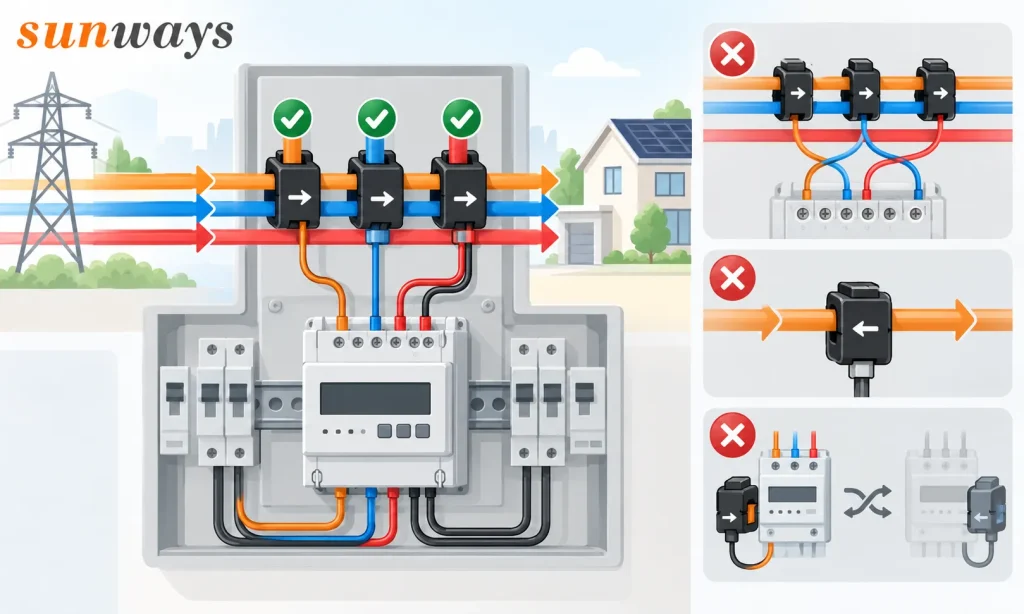
For factory-matched and calibrated STM meters and CTs, maintain the original combination; do not interchange them arbitrarily. In a three-phase system, the voltage measurement for each phase must correspond to the CT for that phase. The CT orientation must be distinguished between the utility side and the load side according to the wiring diagram of the corresponding equipment; do not apply orientation labels from other equipment.
These checks determine whether the measurement data corresponds to the correct circuit. Only when the measurement points, phase, orientation, and communication configuration comply with the specified scheme can you proceed to verify the control functions that rely on this information.
Monitoring Does Not Mean Export Control
Monitoring is responsible for displaying data; export limit control involves the system feeding power into the grid according to set limits. The fact that the platform displays the power generation of the original grid-connected inverter does not prove that the energy storage system can regulate the output of that inverter. The solution cited by Sunways also distinguishes between monitoring and active export limit control capabilities; the two are not equivalent.
If the project requires zero backflow—that is, an operational goal of not feeding power into the grid—ask the supplier to specify: which devices are involved in the control, how the system responds to sudden load reductions, how power delivery is limited when the battery is fully charged or cannot be charged further, and what conditions are used for verification. An increase in the number of devices does not, in and of itself, constitute evidence that the control functions are effective.
If the other party can only provide monitoring screenshots, this does not prove that your output limitation requirements have been met. What is required is a control description and verification basis for the corresponding configuration.
AC Coupled Inverter FAQs: The Questions to Settle Before Ordering
Can AC coupling work with a different-brand solar inverter?
This can be evaluated as a retrofit option, but not every brand is plug-and-play. Provide the model number of your existing unit and specify whether you need to add energy storage, continue generating power during a power outage, or control the output; the supplier should confirm the appropriate configuration based on these objectives, rather than simply replying, “It can be connected.”
Do I need a three-phase AC-coupled inverter for a three-phase property?
The phase configuration should not be determined solely by the property’s three-phase power supply. The design should consider the connection circuit, the load on each phase, the equipment’s support range, and the connection and control conditions permitted by the project. Have the installer clarify which phases the solution covers; in particular, do not assume that single-phase equipment can provide backup power for the entire three-phase system.
Does AC coupling automatically provide zero export?
No. This requires support from both measurement and control solutions. Before placing an order, obtain documentation specific to the equipment combination and operating conditions—particularly regarding how excess power is handled when the battery cannot continue charging; simply being able to view data does not substitute for this verification.
What if my existing hybrid inverter already supports a battery?
First, check its approved batteries, communication protocols, firmware, and activation requirements. If the original configuration can meet the required charging, discharging, and backup power objectives, evaluate it based on the existing grid connection path first; do not automatically assume you need to purchase a new AC energy storage system simply because you “want to add a battery.”
Keep, Replace or Verify First: Choose Your Next Step
Your next step should follow a specific path:
- Retain: If the existing system is in good condition and the AC retrofit configuration meets the objectives, proceed to a full retrofit quote.
- Compare Replacement: If the existing system needs to be replaced anyway or if a new solar-storage system is being built, include a compatible DC solution in the same round of quotes; if a battery connection path has already been approved, evaluate the existing configuration first.
- Verify First: If essential backup power or output control requirements remain unconfirmed, complete the configuration documentation before placing an order.
When preparing for a consultation, simply gather the following information. If a battery has not yet been selected, you may note this directly.
- The country where the project is located, and whether the power supply is single-phase or three-phase.
- Existing inverter model, operating status, and known faults.
- Existing or planned battery system.
- Primary loads, simultaneous operation conditions, and target runtime.
- Whether backup power during power outages is required, whether the existing PV system should continue generating power during outages, and whether there is a need to limit power feed-in to the grid.
Armed with this information, you can explore Sunways’ residential energy solutions. Subsequent discussions can then focus on system compatibility and the scope of retrofitting, rather than merely comparing the prices of individual devices.
Start Your Project