What Is a Hybrid Inverter? How It Works, Cost and Selection Guide
A hybrid inverter is a photovoltaic storage inverter that integrates solar photovoltaic panels, battery storage, the mains grid and backup loads into a single system. Not only does it convert the direct current (DC) generated by photovoltaic modules into the alternating current (AC) required for domestic or commercial use, but it also manages battery charging and discharging. It provides backup power to critical loads in the event of a mains power cut. For users searching for what is a hybrid inverter, the core value of a hybrid inverter lies in its ability to provide integrated energy management combining ‘PV power generation, battery storage, grid-connected operation and backup power during power cuts’. Therefore, when selecting a hybrid inverter, you should make a comprehensive assessment based on your actual electricity consumption patterns, PV capacity, battery configuration and long-term operation and maintenance requirements.
What Is a Hybrid Inverter?
A hybrid inverter is the central component of a solar energy storage system. It connects the photovoltaic modules, the battery, the grid and the backup loads. You can think of it as the ‘brain’ of the entire solar-storage system.
A standard solar inverter is primarily responsible for one thing: converting the direct current (DC) generated by the solar panels into alternating current (AC). A hybrid inverter, however, not only converts electrical energy but also manages battery charging and discharging, whilst supplying power to critical loads during a power cut.
This is why it is often referred to as a hybrid solar inverter, solar inverter hybrid or PV inverter hybrid. These terms essentially all refer to the same type of product: an energy storage inverter that supports the coordinated operation of photovoltaic panels, batteries, the grid and backup power sources.
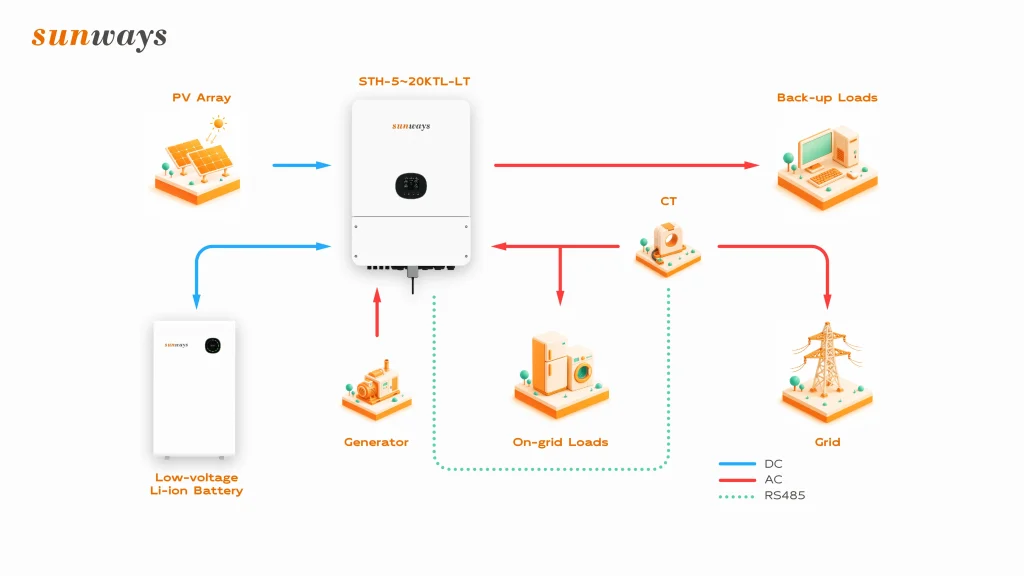
In terms of actual system architecture, a typical hybrid inverter connects to PV arrays, batteries, the grid, on-grid loads and backup loads. The Sunways STH series also employs this system architecture, and some hybrid inverters can switch to off-grid mode within 10 ms to provide backup power to critical loads.
Why a Hybrid Inverter Is Different from a Standard Solar Inverter?
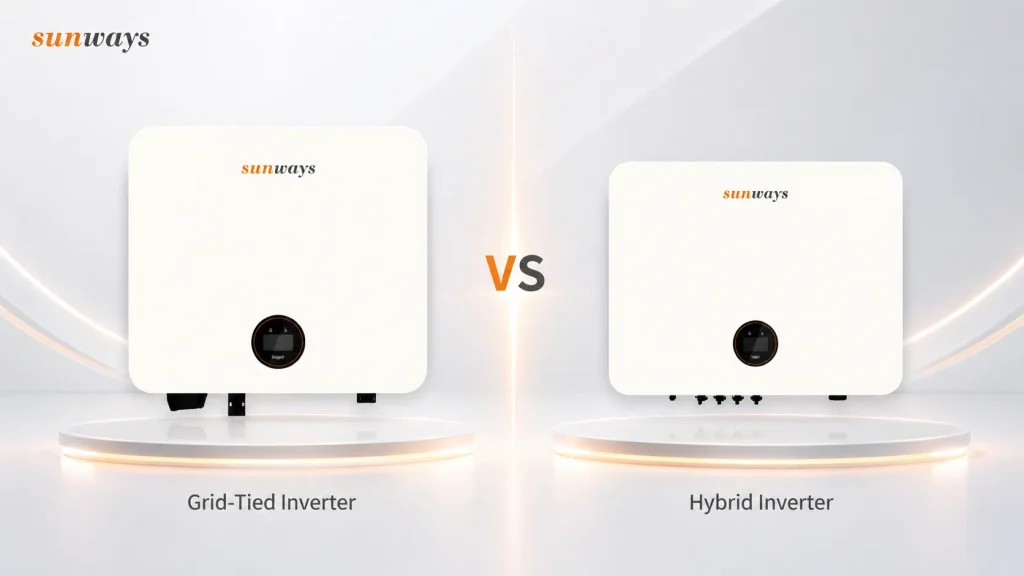
The difference between a hybrid inverter and a standard grid-tied inverter is that, in addition to simply feeding electricity into the grid, a hybrid inverter system also offers energy storage and backup power capabilities.
| Item | Standard Solar Inverter | Hybrid Inverter |
|---|---|---|
| PV power conversion | Supported | Supported |
| Battery connection | Not usually supported | Supported |
| Battery charge/discharge management | Not supported or limited | Supported |
| Emergency power supply during power cuts | Not usually supported | Supported |
| Suitable applications | Standard grid-connected solar | Solar + energy storage + emergency power system |
A standard grid-connected inverter feeds solar power into the grid, whilst a hybrid inverter can help you increase your self-consumption rate, reduce your electricity bills and provide protection during power cuts.
Key Functions of a Hybrid Inverter
1. Convert Solar DC Power into AC Power
Photovoltaic modules generate direct current (DC). The electrical loads in your home, shop or factory operate on alternating current (AC). A hybrid inverter converts solar DC power into usable AC power. This is the fundamental function of all solar inverters.
2. Manage Battery Charging and Discharging
This is the key difference between a hybrid inverter and a standard solar inverter. During the day, when there is ample solar power generation, the system can store surplus electricity in the battery. At night, or when electricity prices are higher, the battery can discharge to power the loads. This offers two direct benefits: firstly, it reduces the amount of electricity purchased from the grid; secondly, it increases the rate of self-consumption of solar-generated electricity.
This is important for installers and distributors, as customers are not simply purchasing a single unit, but a more energy-efficient and stable energy system.

3. Connect to the Grid
Hybrid inverters can be connected to the grid. When solar and battery power are insufficient, the system can draw electricity from the grid. When solar generation exceeds the demands of the loads and the battery, the system can also feed surplus electricity into the grid in accordance with local policies. This makes the system more flexible. You do not need to choose between ‘grid-connected’ and ‘off-grid’ modes.
4. Supply Backup Loads During Grid Outages
During power cuts, the hybrid inverter can switch to backup power mode. It can supply power to critical loads, such as lighting, fridges, routers, water pumps, security equipment or certain business-critical devices.
In markets where the grid is unstable, electricity prices are high or there are requirements for continuous power supply, backup power capability often directly influences customers’ purchasing decisions.
Who Should Consider a Hybrid Inverter?
If you are a residential user, a hybrid inverter can help you increase the proportion of solar energy you consume yourself and provide backup power during power cuts.
If you are an installer, a hybrid inverter allows you to design more flexible solar-plus-storage solutions to meet the requirements of different roof types, loads and battery configurations.
If you are a distributor or EPC contractor, a hybrid inverter is a product that makes it easier to create project value. This is because you are not just selling ‘power generation’, but ‘power generation + energy storage + backup power + smart management’.
How Does a Hybrid Inverter Work?
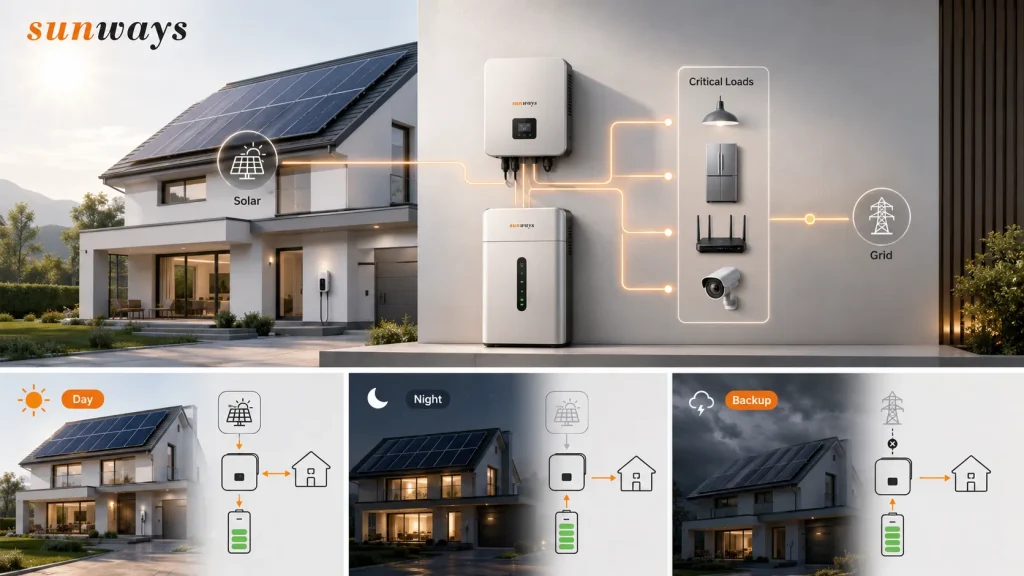
A hybrid inverter works by managing the flow of power between solar panels, battery storage, the grid and backup loads.
The core of the hybrid inverter’s operating principle is as follows: during the day, solar power is used as a priority, with any surplus electricity stored in the battery; at night or when electricity prices are high, power is drawn from the battery; and during a power cut, it supplies power to critical loads.
Solar Power Supply During the Day
During the day, when sunlight is abundant, solar panels generate direct current (DC). The hybrid inverter converts this DC into alternating current (AC), prioritising supply to your domestic or commercial loads. This is because the ideal scenario for a solar system is not to sell electricity to the grid as soon as it is generated, but to use it yourself first.
If you are a domestic user, your fridge, air conditioning, lighting and office equipment can prioritise the use of solar power during the day. If you are an installer or EPC contractor, the system can also help clients reduce their daytime electricity costs. It is recommended that, provided the feed-in tariff at the project site is lower than the purchase price of electricity, priority should be given to increasing the self-consumption rate.
Battery Discharging at Night or During Peak Hours
There is no solar generation at night. At this time, the battery can discharge electricity via the battery storage inverter to power the loads. The benefits are even more pronounced in areas with time-of-use electricity tariffs. The system can store energy when electricity prices are low or when there is ample solar generation, and discharge it when prices are high.
Suitable for the following users:
- Households with high electricity bills
- Retail premises with night-time electricity requirements
- Projects utilising heat pumps, air conditioning or refrigerated cabinets
- Customers wishing to enhance their energy independence
- Installers of residential energy storage solutions
Backup Power During Grid Outages
When the mains supply fails, the hybrid inverter backup power function kicks in. The inverter switches to backup mode to supply power to designated backup loads. These critical loads typically include lighting, fridges, routers and other small-scale, business-critical equipment.
It is important to note that backup power does not equate to ‘unlimited power supply for the entire house’. It depends on the inverter’s power rating, battery capacity and load configuration. In regions with an unstable grid, the hybrid inverter UPS function is in high demand. If you are marketing products in South Asia, South-East Asia, Africa, Latin America or certain rural markets, backup power capability is often more important than power generation efficiency.
Hybrid Inverter Operating Modes
| Operating Mode | Power Flow | User Benefit |
|---|---|---|
| Daytime solar use | PV → Loads | Reduces grid electricity consumption, lowering daytime electricity bills |
| Battery charging | PV → Battery | Stores surplus solar energy, increasing the rate of self-consumption |
| Night use | Battery → Loads | Continues to use solar power after sunset |
| Power outage | PV / Battery → Backup loads | Ensures critical loads remain operational during power cuts |
Hybrid Inverter vs On-Grid Inverter vs Off-Grid Inverter
| Type | Battery Support | Grid Connection | Backup Power | Best For |
|---|---|---|---|---|
| On-grid inverter | Usually no | Yes | Usually no | Photovoltaic systems with a stable grid where the sole aim is to generate electricity for the grid |
| Off-grid inverter | Yes | No / limited | Yes | Stand-alone power supply systems in remote areas without a stable grid |
| Hybrid inverter | Yes | Yes | Yes | PV + battery storage + grid-connected + backup power systems |
On-Grid Inverter
On-grid inverters are suitable for projects in areas with a stable grid where there is no need for backup power. They primarily convert solar power into alternating current (AC) and feed it into the grid. If your client simply wishes to reduce daytime electricity bills and does not require a battery, an on-grid inverter is the simpler option. However, its drawback is also clear: in most cases, it cannot continue to supply power during a grid outage.
Off-Grid Inverter
Off-grid inverters are suitable for areas without a stable grid. They rely on a combination of solar panels, batteries or diesel generators to form a self-contained power supply system. If your project is located on a remote farm, in mountainous terrain, on an island or in an area not covered by the grid, an off-grid inverter is the more appropriate choice. However, they are generally not suitable for standard grid-connected residential properties, as they require more complex system design and battery configuration.
Hybrid Inverter
A hybrid inverter offers a more flexible solution. It can connect to solar panels, batteries, the mains grid and backup loads. This allows you to maximise the proportion of solar energy you consume yourself, whilst also providing backup power during power cuts.
Recommendations:
- If your project only requires grid-connected power generation, choose an on-grid inverter.
- If your project is completely off-grid, choose an off-grid inverter.
- If you need solar power generation, battery storage and backup power integrated into a single system, a hybrid inverter is worth prioritising.
What Are the Benefits of a Hybrid Inverter?
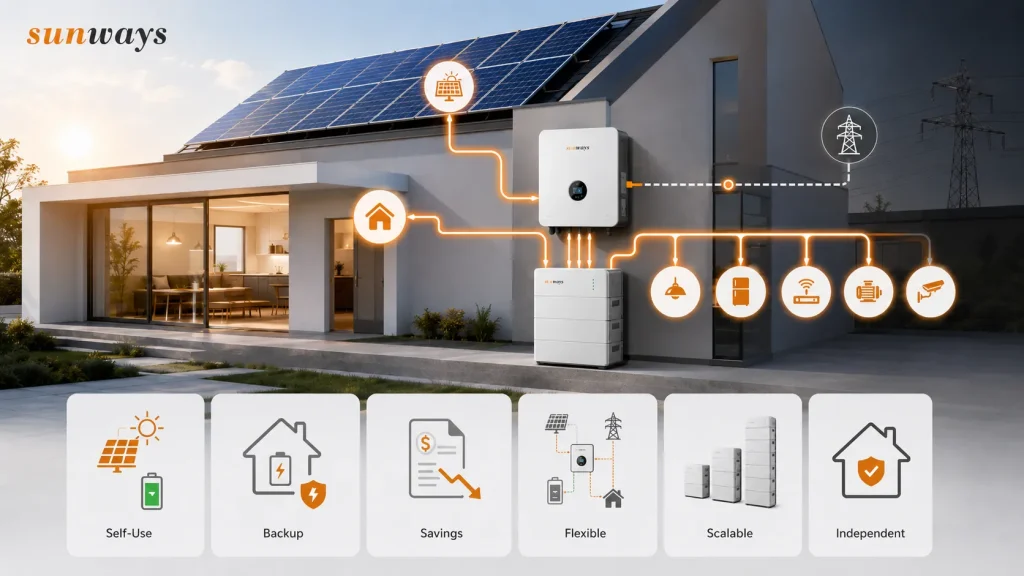
- A hybrid inverter helps you make better use of your own solar power. Excess solar power generated during the day can be stored in the
battery and used at night, thereby increasing solar self-consumption. - Reduces dependence on the grid. You do not have to feed all your surplus electricity into the grid; instead, you can prioritise using it yourself, thereby reducing the amount of electricity you purchase from the grid.
- Provides backup power during power cuts. In the event of a power cut, the hybrid inverter can supply power to essential loads such as lighting, fridges, routers, water pumps and security equipment.
- Helps lower electricity bills. In markets with high electricity prices or time-of-use tariffs, you can store energy during the day and draw on the battery during peak-price periods.
- Makes solar system design more flexible. You can configure the solar panels, batteries, grid connection and backup loads according to your project’s requirements, rather than simply generating electricity for the grid.
- Supports future battery expansion. For domestic users or small commercial projects, it is more flexible to install the solar system first and add batteries later.
- Improves energy independence. If electricity prices are high or the grid is unstable in your area, a hybrid solar inverter can make your energy system more proactive and reliable.
- Supports smarter monitoring and maintenance. Via an app, web portal or local display, you can view power generation, battery status, load consumption and system alerts.
How Much Is a Hybrid Inverter?
A hybrid solar inverter typically costs between $1,000 and $5,000+ USD. This range primarily applies to the reference prices of inverters for residential or small-scale projects and does not represent the total cost of a complete solar-storage system. The cost of a complete system must also take into account photovoltaic modules, batteries, installation, grid connection, cabling, protective equipment and operation and maintenance costs. The price of a hybrid inverter varies significantly depending on its power rating, system configuration and application scenario.
| Cost Factor | Why It Matters |
|---|---|
| Power rating | Significant price differences exist between 3kW, 5kW, 10kW, 20kW and higher power ratings |
| Single-phase or three-phase | Three-phase systems are typically used for large residential properties, small commercial premises or projects with high-power loads |
| Low-voltage or high-voltage battery | Battery voltage affects inverter configuration, system efficiency and application scenarios |
| MPPT design | Multiple MPPT channels are better suited to multi-aspect roofs and complex PV string designs |
| Backup power requirement | The higher the backup power requirement, the more demanding the requirements for inverter and battery configuration |
| Certification | Different markets require different grid-connection certifications and safety standards |
| Order quantity | Bulk purchase prices for distributors, installers and projects typically vary |
Low-cost products that do not match the battery, grid connection certification, backup load or after-sales requirements may result in higher costs in the long run.
For an accurate hybrid inverter quotation, it is best to confirm your PV capacity, battery type, grid type, backup load requirement and project location.
Would you like to know the exact price of a Hybrid Inverter?
Please contact a Sunways engineer; we can provide selection and quotation recommendations based on your project capacity, battery configuration and application scenario.
Why Choose Sunways Hybrid Inverters?
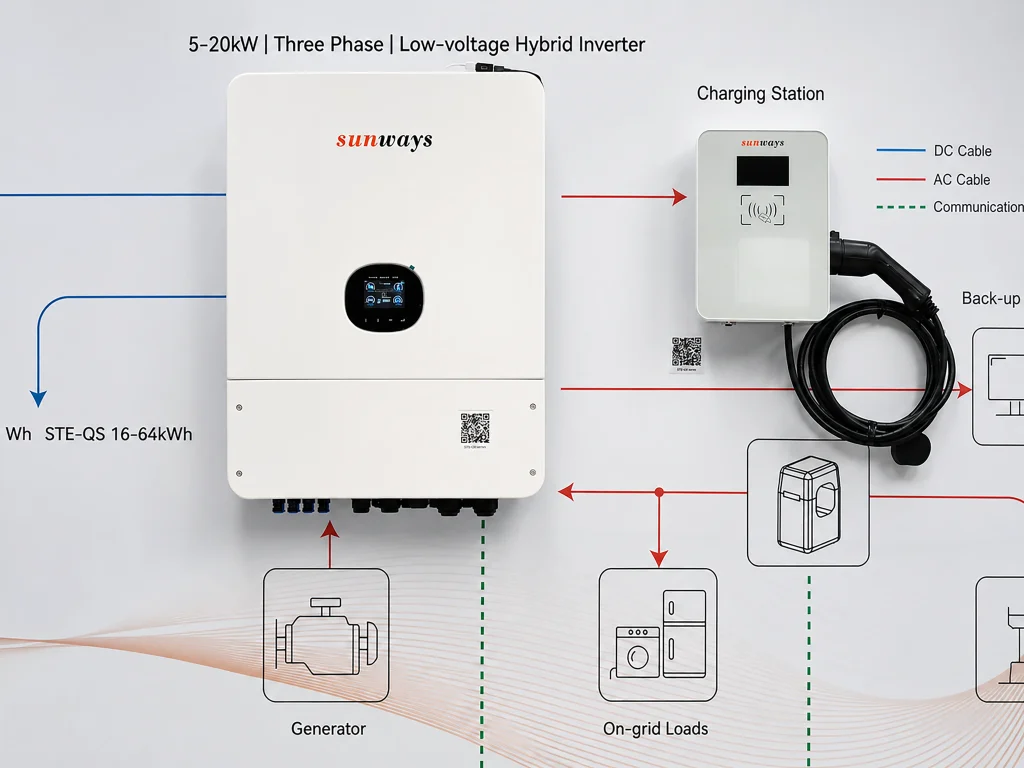
When you choose a Sunways hybrid inverter, you are not simply choosing an inverter. You are selecting a core component for a photovoltaic-storage system capable of catering to residential, villa, small commercial, and industrial and commercial energy storage applications. We focus on whether the product meets project requirements, minimises installation risks, and supports long-term operation and maintenance.
a. Complete Hybrid Inverter Product Range
Sunways’ hybrid inverter product range covers low-voltage, high-voltage, single-phase and three-phase models across various power ratings. Our Storage Series includes the STH-3K–8KTL-LS-LV, STH-8–20KTL-LT, STH-3K–8KTL-HS-HV, STH-4K–12KTL-HT-P, STH-15K–33KTL-HT, STH-40K–80KTL-HT and other series, covering applications ranging from residential to small and medium-sized commercial and industrial energy storage.
If you are an installer, distributor or EPC contractor, you can select the most suitable Sunways hybrid solar inverter based on different markets, grid types, battery solutions and project scales.
| Project Need | Sunways Solution Direction |
|---|---|
| Standard residential energy storage | Single-phase low-voltage or high-voltage hybrid inverter |
| Large residential properties / villas | Three-phase hybrid inverter |
| Small-scale commercial energy storage | High-power three-phase hybrid inverter |
| Areas with unstable grids | Energy storage solutions with backup power |
| Future expansion projects | Product ranges supporting flexible battery and system configurations |
b. Designed for Solar Storage and Backup Power
A high-quality hybrid inverter should not merely generate electricity for the grid. It must be capable of managing PV, batteries, the grid and backup loads.
The Sunways STH series demonstrates typical solar-storage connection logic for PV arrays, Li-ion batteries, the grid, on-grid loads, backup loads, CTs/meters and more; certain models also emphasise the ability to switch to off-grid mode within 10 ms, providing backup power for critical loads.
c. Flexible System Design for Different Applications
No two projects will have exactly the same roof, load and battery configurations. Therefore, product flexibility from a solar inverter manufacturer is crucial.
Sunways hybrid inverters can be tailored to suit systems across various dimensions. These include single-phase or three-phase grids, low-voltage or high-voltage batteries, different power range requirements, various MPPT configurations, backup load requirements and different energy storage scenarios.
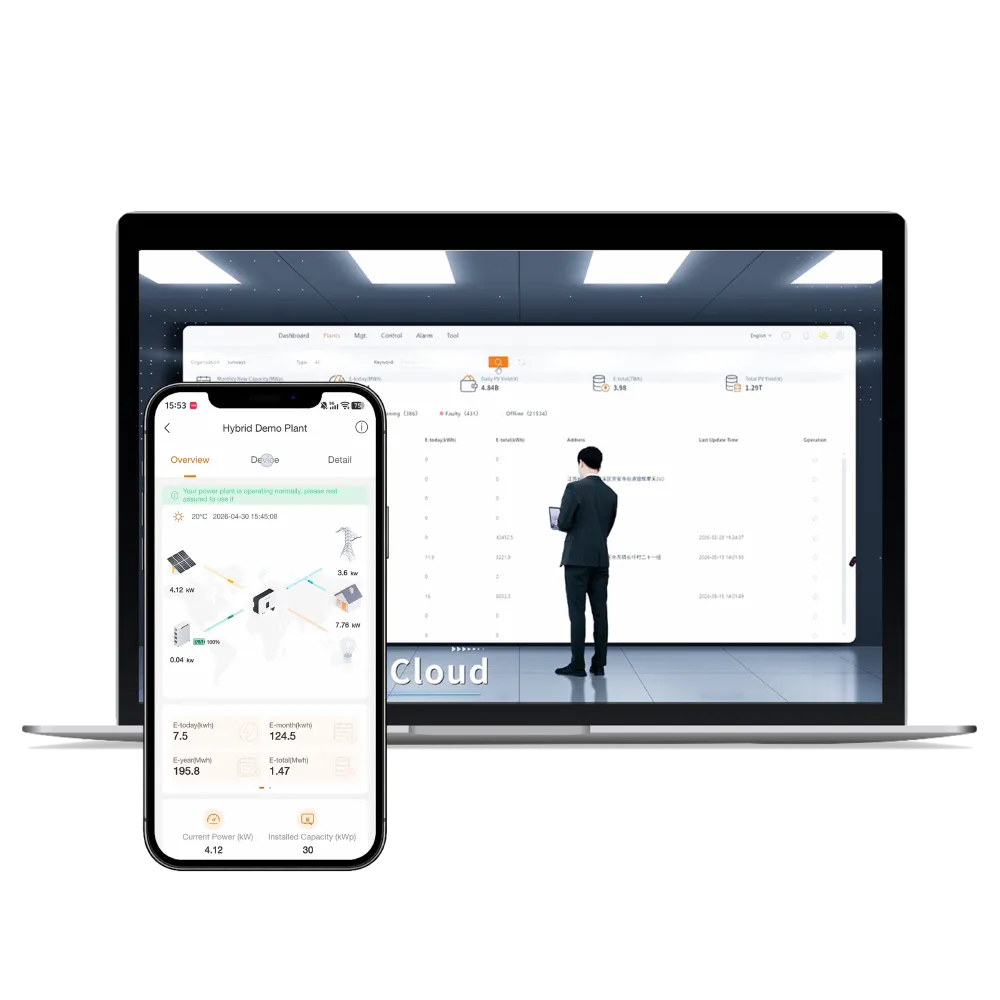
d. Smart Monitoring and Easy Commissioning
The competitiveness of a hybrid inverter lies not only in its hardware. Commissioning, monitoring and remote operation and maintenance also impact project delivery efficiency. Sunways products support rapid configuration via an app or OLED display, as well as remote updates and wired/wireless communication methods. This allows for faster commissioning, easier data viewing and more convenient ongoing maintenance.
e. Global Project Experience
Project experience is crucial when selecting a hybrid inverter supplier. Sunways’ project portfolio spans Europe, Asia and other regions. Energy storage projects include markets such as Germany, Italy, the Netherlands, Poland, Sweden, India, Sri Lanka, Vietnam and South Africa, with project capacities ranging from a few kilowatts to tens of kilowatts. Sunways is not merely a hybrid inverter manufacturer, but a provider of PV-storage solutions with extensive experience in delivering projects across a wide range of scenarios.
FAQs About Hybrid Inverters
Q1: Single-phase vs Three-phase Hybrid Inverter: Which One Should You Choose?
For standard residential rooftop solar projects, a single-phase hybrid inverter can usually meet the power requirements of standard loads such as lighting, household appliances, fridges and routers. However, if you have a detached house, a farm or a small commercial project, or if you need to power high-power equipment such as heat pumps, EV chargers, water pumps or air conditioning units, we recommend opting for a three-phase hybrid inverter. When making your choice, do not focus solely on the solar capacity; you should also consider the grid type, load power and backup power requirements.
Q2: Low-Voltage vs High-Voltage Hybrid Inverters: What Is the Difference?
Low-voltage hybrid inverters are better suited to residential properties, retrofit projects and areas with unstable grid supply, offering greater flexibility in battery configuration.
High-voltage hybrid inverters are better suited to large residential properties, small commercial premises and high-power systems; they are generally more efficient and better suited to larger energy storage capacities.
Q3: Can a Hybrid Inverter Work Without a Battery?
Some hybrid inverters can operate without a battery, but this depends on the specific product design and system configuration.
If you are on a tight budget, you can install a hybrid inverter and solar panels first, then add a battery at a later stage. However, if your area experiences frequent power cuts, it is advisable to install a battery as soon as possible. Without a battery, the system will struggle to deliver its full potential in terms of backup power and energy storage.
Q4: Hybrid Inverter vs Solar Inverter: What Is the Difference?
A standard solar inverter is primarily responsible for feeding solar-generated electricity into the grid. A hybrid inverter not only converts electrical energy but also connects to a battery, manages charging and discharging, and supplies power to critical loads during power cuts.
A solar inverter handles ‘power generation and grid connection’; a hybrid inverter handles ‘power generation + energy storage + backup power + energy management’. If you are installing a solar-storage system, we recommend choosing a hybrid inverter.
Q5: Do You Need a Hybrid Inverter with a Battery?
If you wish to increase your self-consumption rate of solar power, or would like a backup power supply during power cuts, we recommend choosing a hybrid inverter with a battery. The battery can store surplus solar power generated during the day. At night or during periods of high electricity tariffs, you can prioritise power from the battery. For the sake of backup power, energy independence and long-term electricity cost optimisation, we recommend installing a battery.
Q6: Is a Hybrid Inverter Suitable for Domestic Solar Systems?
Yes, a hybrid inverter for the home is ideal for residential solar-plus-storage systems. It is suitable for households wishing to reduce electricity bills, increase the proportion of solar energy consumed on-site, secure backup power during power cuts, or those planning to add a battery in the future.
Q7: What Size Hybrid Inverter Do You Need?
The power rating of a hybrid inverter depends on the load power, PV capacity, battery capacity, grid type and backup load requirements. Common choices for standard households are 3kW, 5kW, 6kW or 8kW. Larger homes, small commercial premises or three-phase systems may require 10kW, 15kW, 20kW or higher power ratings. You will need to confirm which loads require power supply and which require backup power during a power cut.
Start Your Project