Home Solar System Cost: Is a Battery Worth the Extra Cost?
Table of Contents
How much does a domestic solar PV system cost? Taking the 2026 reference prices published by installers in southern Spain as an example, a 5 kWp domestic solar PV system without a battery costs approximately €5,300–7,500, whilst one with a 5 kWh battery costs approximately €8,800–12,500. These prices include equipment, installation and associated administrative procedures, and do not take into account any applicable tax incentives. This is a reference range provided by a local service provider; it does not represent prices in other countries, nor is it a quotation from Sunways.
Your actual budget will depend primarily on your location, system capacity, battery configuration and installation conditions. When comparing quotations, in addition to the price, you should also confirm: What is the capacity of the battery included? Is installation included? Does it include the emergency power supply functionality you require?
If you use a significant amount of electricity during the day and have no need for backup power, you may wish to consider a battery-free solution first. If you mainly use electricity at night, or wish to keep critical equipment running during a power cut, it is worth comparing the costs and configurations of battery-included solutions in more detail.
What Are You Actually Paying For?
A comprehensive quote for a domestic solar installation should specify the equipment, installation and commissioning, as well as any applicable taxes, fees and administrative charges. Once you have received a quote, first check whether it is a ‘package price for the equipment’ or a ‘total price for a fully installed and operational system’. If the scope of delivery is not clearly stated, do not rush into signing the contract, no matter how low the price may be.
What Should Your Solar Quote Include?
Ask the installer to list the following six items separately so that you can see exactly where your budget is being spent:
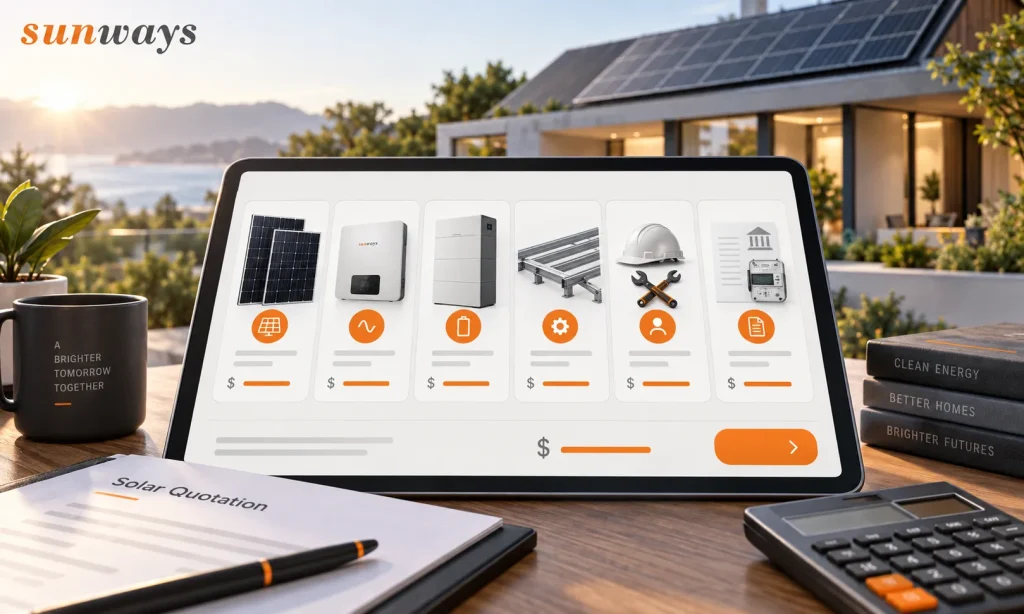
- Solar panels: Specify the brand, model, quantity, power output per panel and total capacity. Verify the figures by multiplying the quantity by the power output per panel; do not simply accept a description such as ‘5kW package’.
- Inverter: Confirm the model, rated AC power, whether single-phase or three-phase, and whether it is grid-connected or hybrid. If you require backup power in the event of a power cut, ask for the backup power output capacity to be specified separately.
- Batteries: If included, list the model, quantity, nominal capacity and usable capacity, expressed in kWh. Also confirm whether the necessary connection cables, mounting bases or battery cabinets are included.
- Mounting structures and protective equipment: Request details of the suitable roof type, mounting materials, and the scope of supply for cables, switches, surge protection and earthing.
- Installation and Commissioning: Confirm whether transport, hoisting, roof installation, cabling, system commissioning and user training are included.
- Taxes, Fees and Local Formalities: Request a separate breakdown specifying whether taxes, application fees, electricity meter charges and grid connection fees apply and whether they are included. List any subsidies or tax incentives separately; do not mix them with the original total price.
Why Do Two 5kW Quotes Vary So Much?
‘The same 5kW’ does not necessarily mean you are buying the same system. First, confirm whether this figure refers to the capacity of the modules or the power output of the inverter, then compare the batteries and the scope of work. I would recommend providing the same list of requirements to different installers: the same PV capacity, the same usable battery capacity, the same backup power load and the same scope of supply. Align the specifications first, then discuss which price is more reasonable.
Which Additional Costs Should You Check?
Before signing the contract, send the following four questions to the installer and request a written reply:
- Back-up power circuits: Which appliances need to remain operational during a power cut? Have circuit splitting, transfer switches and related installation work been included in the quote?
- Electrical distribution upgrades: Do the existing distribution boards, cabling or earthing require modification? Could additional charges arise following a site survey?
- Transport and roof installation: Are there separate charges for remote transport, hoisting, scaffolding and specialised roof installations?
- Monitoring accessories: Are electricity meters, current transformers (CTs), data loggers and communication accessories included? Are there any subsequent service charges?
Before You Accept the Quote
Ensure the final quote clearly specifies at least these five items before confirming the order:
- Equipment models and quantities; avoid vague descriptions such as ‘equivalent brands’.
- Component, inverter and battery capacities; list these separately.
- Scope of installation and emergency power provision; specify which equipment will remain operational during power cuts.
- Equipment and installation warranty: specify the duration, the party responsible and whether labour costs are covered.
- Exclusions and rules regarding additional charges: stipulate that any additional work must be approved by you.
Do not simply choose the quote with the lowest total price. Prioritise quotes with clearly defined specifications, a comprehensive scope of delivery and clearly stated after-sales responsibilities. If the supplier only provides an ‘all-inclusive price’, ask for a detailed breakdown first.
The Same 5kW Solar Array, Three Different Budgets
If your main aim is to reduce daytime electricity bills, prioritise comparing grid-connected solutions; if you already have a clear plan to upgrade your energy storage system, then consider a hybrid inverter without a battery for the time being; if you require night-time energy storage or backup power during power cuts right now, you should directly evaluate a complete configuration comprising a hybrid inverter and a battery.
To ensure a fair comparison, please ask the same local installer to provide three quotations based on 5 kWp modules, 5 kW rated AC output, and identical roof and groundwork conditions. The budget breakdown below compares these quotations without combining prices from different regions or assuming fixed price differentials.
On-Grid: Start Here If Your Priority Is Lower Upfront Cost
Installation Budget: Use this comprehensive installation quotation as a benchmark for comparison. The equipment includes 5 kWp modules, a 5 kW grid-tied inverter, as well as mounting structures, protective equipment and groundworks; batteries are not included.
You can use the solar power directly as it is generated, with the grid supplementing any shortfall. How surplus electricity is handled must be confirmed in accordance with local grid connection and settlement rules. If you use a significant amount of electricity during the day and have no need for backup power, we recommend calculating this option first.
It is also important to clarify the limitations: a standard grid-connected system will cease supplying power to your home in the event of a mains power cut. Before signing a contract, ensure the installer clearly states that the system has ‘no backup power function in the event of a power cut’; do not assume that having solar panels on your roof means you will still have electricity during a power cut.
Hybrid Without a Battery: Pay More Only for a Clear Upgrade Plan
Installation Budget: Using the grid-connected solution as a baseline, list separately the cost difference for replacing the hybrid inverter, as well as the necessary electricity meters, control systems and provision for installation costs. Do not accept a vague ‘upgrade fee’ without a detailed breakdown of the equipment.
This solution still utilises 5 kWp modules, but replaces the inverter with a 5 kW hybrid inverter supporting the relevant operating mode, whilst postponing the installation of a battery for the time being. This upfront investment is only worth serious consideration if you genuinely plan to add energy storage at a later date. Request that the installer also provide the cost of adding a battery in the future, along with compatible models, to avoid focusing solely on how much you save today.
Before purchasing, you must confirm whether the specific model can operate on the grid without a battery and whether any additional configuration is required. ‘Can operate without a battery’ does not equate to ‘can provide continuous backup power after a power cut’. If the seller promises battery-free backup power, please request official documentation and verify the sunlight requirements, output power and load limits.
Hybrid System with a Battery: Budgeting for Storage and the Backup You Need
Installation Budget: For a battery-free hybrid system, factor in the costs of adding a compatible battery, connection and protection equipment, energy storage commissioning, as well as the costs of switching to backup power and circuit modifications should they be required. Request separate quotations for these additional items so that you can assess whether the expenditure is worthwhile.
To ensure a consistent basis for comparison, you may specify a configuration of 5 kWp modules + 5 kW hybrid inverter + 5 kWh usable battery capacity. This is a specification for the quotation, not the parameters of a specific product; the installer should provide specific models that meet these requirements. Do not assume that ‘rated 5 kWh’ equates directly to ‘usable 5 kWh’.
If you have surplus electricity during the day that you need to use at night, or if you must keep your fridge, lighting and internet running during a power cut, this configuration is worth prioritising. However, you must first list your emergency power equipment and target duration before confirming the battery discharge power, the inverter’s emergency power output and the wiring configuration. Having a battery does not automatically equate to whole-house emergency power.
Compare What the Extra Money Actually Buys
Ask the installer to break down the price difference between the three quotes into two parts: which upgrades you are paying for when switching from grid-tied to hybrid; and from a hybrid system to a battery storage system, what amount of available electricity and which backup loads you are paying for.
If you do not have a clear plan to add a battery at a later date, there is no need to pay the premium for a hybrid system simply because you ‘might need it in the future’. If backup power is already an essential requirement, compare complete solutions that include a battery directly; do not treat low-cost quotes that exclude backup power installation as your final budget.
3kW or 5kW: Are You Paying for More Than You Need?
If a 3kWp system already covers most of your daytime electricity consumption, there is no need to rush into upgrading to 5kWp. If you have a high daytime load, or have already decided to add air conditioning, a heat pump or an electric vehicle, then you should consider a larger capacity. Before making a decision, gather your electricity consumption data for the last 12 months, along with a rough breakdown of your daytime and evening usage. Relying solely on the monthly electricity bill can easily lead to the wrong choice.
Start with When You Use Electricity
Even with the same monthly electricity consumption of 450 kWh, two households may require different configurations. Below is a hypothetical calculation scenario:
Assume that both households are located in the same area, have identical roof conditions, and consume 5,400 kWh of electricity per year. Assuming an annual electricity generation of 1,400 kWh/kWp, a 3 kWp system would generate approximately 4,200 kWh, whilst a 5 kWp system would generate approximately 7,000 kWh. These figures are for illustrative purposes only; your actual plan should be based on local estimates.
- Household A: 70 per cent of electricity consumption occurs during the day. Annual daytime consumption is approximately 3,780 kWh, so a 3 kWp system can be used as a starting point for comparison. If the main loads coincide with the periods of electricity generation, there may be no need to allocate extra budget for a 5 kWp system. Ask the installer to verify the hourly generation and load profiles in more detail; do not simply assume that the entire 4,200 kWh will be consumed on-site.
- Household B: Only 30 per cent of electricity consumption occurs during the day. Annual daytime consumption is approximately 1,620 kWh. Even with a 5 kWp system, night-time consumption will not automatically be covered by surplus daytime electricity. You should first compare the value of adjusting your electricity usage times, installing energy storage and the local surplus electricity settlement scheme before deciding whether to increase capacity.
- Even if annual electricity generation exceeds annual consumption, this does not mean your electricity bills will be reduced to zero. Ask the installer to list the projected generation, self-consumption, feed-in to the grid and electricity purchased from the grid separately, so that you can clearly see the actual changes resulting from upgrading from 3 kWp to 5 kWp.
Check Your Roof—not Just the System Size
Ask your installer to provide separate estimates of monthly electricity generation for 3 kWp and 5 kWp systems, based on your address, roof orientation, pitch and shading conditions. The European Commission’s Joint Research Centre’s PVGIS tool can be used to assess local PV generation potential and seasonal variations; however, specific roof conditions still require on-site verification.
Reference: European Commission Joint Research Centre PVGIS
You should also request a module layout plan. If new modules can only be installed in areas subject to significant shading, request a separate calculation of their power contribution. Just because the total roof area is large does not mean every spot is worth covering.
Keep These Three Numbers Separate
When reviewing the configuration list, check these three figures separately:
- PV capacity: kWp. This represents the rated power of the modules under standard test conditions, not continuous output throughout the day.
- Inverter power: kW. This indicates the rated output capacity under the relevant operating conditions. Do not assume that ‘5 kWp modules’ necessarily require a ‘5 kW inverter’; the installer should verify the voltage, current and power matching.
- Battery capacity: kWh. This indicates the amount of electricity stored. When selecting a battery, you must also consider the usable capacity and discharge power; you cannot simply match it one-to-one with the PV capacity.
Expand for a Real Plan, Not a Possibility
If you have decided to add equipment, include the additional electricity consumption in your calculations. For example, assuming an electric vehicle travels 10,000 kilometres per year with an energy consumption of 15 kWh per 100 kilometres, the vehicle’s annual electricity consumption will increase by approximately 1,500 kWh, not including charging losses. However, if you can only charge at night, you will also need to assess energy storage options or electricity usage arrangements; you cannot simply count all the additional solar power generated as savings on charging costs.
Ultimately, ask your installer to provide two proposals and to answer a specific question: if you increase your system from 3 kWp to 5 kWp, how much more will it cost, how much of the additional electricity will you be able to utilise, and how will the surplus electricity be settled? If these issues have not been clearly calculated, do not commit to ‘greater capacity’ just yet.
When Is a Battery Worth the Extra Cost?
If you have surplus solar power during the day, sufficient electricity demand at night, and the price of purchased electricity is significantly higher than the settlement price for surplus electricity, a battery is well worth considering. If your primary need is for backup power during power cuts, you should first determine which appliances must remain operational and for how long, before deciding on your budget.
These two calculations should be treated separately: one is how much you can save on electricity bills with a battery, and the other is how much you are willing to pay for a backup power supply. When assessing the savings on electricity bills, you must take into account both the installation costs and the battery’s service life; you cannot simply look at the ‘annual savings’ stated in the sales proposal.
Calculate the Additional Savings—not the Savings of the Entire System
The payback period for the battery should be calculated based on ‘the additional savings achieved by adding the battery’, rather than applying the savings from the entire PV system. The following is a set of hypothetical examples, provided solely to demonstrate the calculation method; they do not represent local quotations, electricity tariffs or the performance of Sunways products:
- Additional installation investment: €3,000, including the battery, associated equipment, installation and commissioning.
- Battery usable capacity: 5 kWh.
- Annual surplus PV electricity diverted to the storage path: 1,500 kWh, assuming all of this would otherwise have been sold back to the grid.
- Round-trip efficiency: 90 per cent, corresponding to 1,350 kWh delivered to the household load, fully replacing electricity purchased from the grid.
- Price of electricity replaced: €0.30/kWh; feed-in tariff for surplus electricity: €0.06/kWh.
- Annual provision for additional maintenance and other operating costs: €30; excluding subsidies, financing and changes to fixed electricity charges.
Based on the above conditions, the electricity cost savings in the first year are:
Reduction in electricity purchase expenditure: 1,350 × 0.30 = €405.
Forgoing surplus electricity revenue: 1,500 × 0.06 = €90.
Annual net incremental revenue: 405 – 90 – 30 = €285.
Simple payback period: 3,000 ÷ 285 ≈ 10.5 years.
This result does not yet take into account capacity degradation, future changes in electricity prices or replacement costs. You should recalculate based on your actual load and billing rules, and ensure that conversion losses and standby power consumption have not been overlooked. If your local area uses electricity credit schemes or tiered electricity pricing, this unit price model cannot be applied directly.
The less the battery is utilised, the longer it takes to recoup the investment. If the annual energy storage volume mentioned above were halved, with all other assumptions remaining unchanged, the annual net profit would be approximately 127.5 euros, and the simple payback period would be approximately 23.5 years. Therefore, do not calculate the annual return on the basis of ‘charging to full capacity every day and using it all up every day’ simply because there is occasionally surplus electricity during the day.
Keep Backup Value Separate
If you are purchasing a battery primarily to keep your lighting, fridge and internet running during a power cut, first list these loads, then check the backup power output, available capacity and target duration. Do not arbitrarily include the amount for ‘avoiding power cut losses’ simply to make the payback period look more favourable.
You should also ask the installer to specify how much capacity is reserved for backup power. The more capacity set aside, the less may be available for optimising your daily electricity bills; the same amount of energy cannot be counted both as a daily saving on electricity bills and as standby capacity that is always reserved.
Install Now or Add a Battery Later?
Install both now: If your evening electricity consumption or backup power requirements are already clear, ask for an additional quote for the combined installation of the solar panel system and energy storage. A single installation may reduce duplicate cabling and commissioning work; however, whether this results in savings—and, if so, how much—should be confirmed by the quotation.
Add Later: If your requirements are not yet clear, you can start by collecting data on power generation, surplus electricity and consumption. Before making a decision, ask the installer to list the costs of any batteries, control components, installation work and necessary inverter upgrades that may be required in the future; do not simply compare today’s battery unit prices.
Existing PV systems: First, verify the inverter model, the official battery compatibility list and the installation conditions, then compare the option of retrofitting whilst retaining the original equipment with the option of replacing the inverter. ‘Support for energy storage upgrades’ must correspond to specific equipment and conditions; it cannot be merely a promise.
When Should You Buy?
- Prioritise installation now: If your backup power needs are clear, or if calculations based on actual data show that the benefits of a battery system justify your budget, confirm the configuration and warranty terms before placing an order.
- Suitable for postponement: If you have little surplus electricity during the day, low evening loads, or if the value of selling surplus electricity is already close to the value of using it yourself after storage, adjust your electricity consumption patterns first, then reassess whether a battery is still necessary.
- Assess retrofitting first: If you already have a solar PV system but compatibility with existing equipment is unclear, or if extensive retrofitting of the backup power and distribution systems is required. Obtain a comprehensive retrofitting quote first, then decide whether it is worthwhile.
You are purchasing energy storage capacity that you will actually use. Before signing the contract, ask the supplier to clearly set out the basis for the annual charge and discharge volumes, the net incremental returns, and any costs not yet factored into the payback period.
Similar Electricity Bills, Different Solar Choices
Two households with similar electricity bills may require completely different set-ups. You should first establish: is your electricity consumption concentrated during the day or at night? Which appliances must remain operational during a power cut? The following three hypothetical scenarios will help you determine where your budget should be prioritised.
① Daytime Use: Don’t Pay to Store Electricity You Already Use
If you work from home during the day and your air conditioning, washing machine and other appliances can operate whilst solar power is being generated, first check how much surplus electricity remains at midday. Solar power that has already been consumed directly cannot be counted as electricity available for storage in the battery.
Suppose that on a given day, 20 kWh of solar power is generated, of which 16 kWh has already been used by the household; this leaves only 4 kWh available for storage or feeding into the grid. This single day’s data alone does not prove that you need a 10 kWh battery; you should further examine surplus electricity levels across different seasons.
Your options: Prioritise evaluating a grid-connected solution and schedule adjustable electricity consumption to coincide with generation periods. This reduces the initial investment, but you must accept the limitation that a standard grid-connected system cannot provide backup power during power cuts.
② Evening Use: Match the Battery to the Energy You Can Shift
If you are out during the day and concentrate your electricity use in the evening, you should examine two sets of data simultaneously: how much surplus electricity can be stored during the day, and how much stored electricity can be consumed in the evening. Purchasing a battery based solely on night-time consumption may result in a system with sufficient capacity that frequently fails to charge fully.
For example, suppose that on a given day, 8 kWh of surplus electricity is available to be fed into the storage system; assuming a round-trip efficiency of 90 per cent, approximately 7.2 kWh would ultimately be available for household use. If electricity consumption that evening is 12 kWh, approximately 4.8 kWh will still need to be supplemented by other power sources. This is merely an illustrative example; actual calculations should be based on hourly data and equipment parameters.
Your choice: Compare battery configurations that can cover your main evening loads; there is no need to purchase the maximum capacity simply to achieve ‘no grid use all night’. As you will bear the additional cost of the battery and conversion losses, first confirm whether the additional available electricity is worth the investment.
③ Backup Requirements: Select the Loads Before Choosing the Battery
If your primary concern is power cuts, first divide your appliances into two groups: ‘must be powered’ and ‘can be paused’. Fridges, lighting and internet connections should be prioritised; as for air conditioning and water pumps, you should check their power consumption, start-up requirements and budget on a case-by-case basis.
Assuming the average power consumption of critical loads is 500W and they need to be maintained for 4 hours, the battery capacity required is at least:
0.5 kW × 4 hours = 2 kWh of electricity.
This does not account for conversion losses, the remaining battery charge at the time of the power cut, or capacity degradation. Ask your installer to calculate the required battery capacity based on this, and verify the power requirements should all devices start up simultaneously. Sufficient electricity does not necessarily mean the inverter and battery can handle all devices.
Your choice: When working within a limited budget, prioritise backup power for critical loads. You will need to accept that some high-power appliances will be taken off the grid, and include the necessary modifications to the backup power circuits in the quotation, to avoid paying the cost of whole-house backup power simply to meet the needs of a few appliances.
A Sunways Project: What the Configuration Tells You
Sunways’ Low-Voltage Hybrid Inverter Project Reference documents a project completed in May 2026 in Gujarat, India, with a stated project capacity of 5 kW, configured with an STH-5KTL-LS inverter and STE MS batteries. You can use this as a reference for local applications combining hybrid inverters and batteries. When referring to real-world projects, ask the installer to explain how your load differs from the case study before finalising the configuration; do not simply copy the model numbers.
Before You Sign: Four Questions That Can Change Your Quote
Will my solar system work during a power cut?
Not necessarily. Conventional grid-connected systems cease to supply power during a power cut, and having a battery does not automatically mean the system has backup power capability. You need to confirm that your specific inverter supports backup power, and configure compatible batteries, the necessary switching and isolation equipment, and backup power circuits in accordance with the installation manual.
Ask the installer to specify: which devices can continue to operate, what the maximum simultaneous load is, and how long power is expected to last. Backup power for critical loads is not the same as whole-house backup power; do not simply accept a promise that the system ‘supports use during a power cut’.
How does the inverter affect the total cost of the solar system?
The inverter affects not only the cost of the equipment itself, but also the costs of energy storage integration, backup power distribution and any subsequent modification work. When comparing grid-tied and hybrid inverters, you should check the power rating, whether they are single-phase or three-phase, battery compatibility and any necessary accessories.
If you only require grid-connected generation, request a quote based on this requirement first; if you require energy storage or emergency power, ask for a comprehensive additional quote to implement these functions. Do not simply compare the unit price of the inverter whilst overlooking accessories and installation costs.
Can I add a battery later?
Retrofitting is usually possible, but there is no guarantee that your existing inverter will be able to connect directly to a battery. You may require a compatible hybrid inverter, or you may need to opt for a solution involving the addition of a standalone energy storage inverter, depending on your existing equipment and local grid connection conditions.
Before purchasing, ask the installer to provide the official battery compatibility list for the relevant model, specifying firmware requirements, necessary accessories and the scope of any retrofitting work. ‘Reserved energy storage capacity’ must be specified in terms of specific models and conditions; current compatibility lists do not guarantee that all future batteries will be compatible.
What should I check before accepting a quote?
Before signing the contract, ensure that the equipment, scope of supply and after-sales responsibilities are set out in an annex to the quote. You should confirm at least the following six points:
- Model and quantity: modules, inverters, batteries and key accessories.
- Capacity: PV kWp, inverter kW, and battery nominal and usable kWh.
- Scope of installation: Wiring, protection, earthing, commissioning and applicable grid connection procedures.
- Back-up power scope: Power supply circuits, power limitations, estimated duration and underlying assumptions.
- Warranty responsibilities: Who is responsible for the equipment and the installation respectively; whether labour and transport are covered.
- Additional costs: Taxes, power distribution upgrades and other excluded items; how additional works are to be confirmed.
Commitments relating to energy storage and backup power should be substantiated by the official datasheets, installation manuals and compatibility lists for the relevant models. Should there be any discrepancies between the documentation and the quotation, these must be clarified before signing the contract.
Choose the Setup That Fits Your Home—and Your Budget
Before deciding on your domestic solar budget, first identify the key issue you need to address: reducing electricity bills, increasing self-consumption at night, or safeguarding critical loads during power cuts. Choose according to your actual needs:
- High daytime electricity consumption, no need for backup power: Prioritise evaluating a grid-connected solution without a battery, and allocate your budget to suitable solar capacity and a reliable installation.
- If you use more electricity at night and have surplus power during the day: Request two sets of calculations—one with a battery and one without. Focus on comparing the additional investment against the annual net incremental return before deciding whether to include energy storage.
- Critical equipment requires continuous power supply: First, list the equipment, power ratings and required backup duration, then confirm the inverter, battery and switching solution. For equipment that cannot tolerate even brief interruptions, separately verify the power continuity requirements.
- Existing PV system, or planning to add a battery in the future: First, verify the existing system model, compatible batteries and the full retrofit costs before purchasing equipment.
Next, you can prepare details of your country/region, monthly electricity consumption, the model of your existing system, and the equipment requiring backup power along with the duration of that backup, and submit a specification enquiry to Sunways. With this information, we can translate the preliminary quote into a configuration that suits your home.
Start Your Project