Choosing a Three-Phase String Inverter: What Really Matters for Your Solar Project?
Table of Contents
What Is a String Inverter and How Does It Work?
A string inverter connects one or more PV strings formed by photovoltaic modules connected in series. It uses MPPT to find the optimal operating point for the array, converts the direct current generated by the modules into alternating current that meets grid requirements, and handles grid connection control, operational monitoring and safety protection.
① Why Is It Called a String Inverter?
The term ‘string’ here does not refer to a product model, but rather to the way in which the modules are connected.
| Term | Meaning |
|---|---|
| PV module | A single photovoltaic module, commonly known as a solar panel |
| PV string | A DC circuit formed by connecting multiple modules in series |
| PV array | An array comprising all the modules in a project or multiple PV strings |
When modules are connected in series, the voltages add up, but the current does not add up in proportion to the number of modules. For example, when 20 modules with an operating voltage of approximately 40 V are connected in series, the operating voltage of the string is approximately 800 V. Assuming that the operating current of a single module is approximately 13 A, the current of the entire string remains approximately 13 A, rather than 260 A.
② How Does a String Inverter Convert Solar Power?
PV strings are first connected to the inverter’s DC inputs. The inverter then performs three key functions.
1. MPPT Tracks the Best Operating Point
Module output fluctuates constantly in response to sunlight, temperature and shading. MPPT adjusts the array’s operating voltage and current to find the point at which maximum power is generated.
If a string solar inverter has multiple independent MPPT trackers, you can manage arrays with different orientations or lighting conditions separately. However, please note: two DC inputs do not necessarily mean two independent MPPT trackers.
Taking some models from Sunways’ three-phase STT series as an example, MPPT efficiency can reach 99.9 per cent. This refers to the MPPT tracking capability and is not equivalent to the inverter’s overall DC-to-AC conversion efficiency or the project’s annual power generation efficiency.
2. DC Power Is Converted into AC Power
Photovoltaic modules generate direct current (DC), but building loads and the public grid use alternating current (AC). String inverters convert DC to AC via power electronic circuits. Modern three-phase models typically employ a two-stage conversion process: the DC-DC stage handles MPPT and DC voltage regulation, whilst the DC-AC stage is responsible for outputting AC power for grid connection. The power range of three-phase string inverters extends from several kilowatts up to approximately 350 kW, making them suitable for residential applications as well as commercial, industrial and some large-scale photovoltaic projects.
3. The Inverter Synchronises with the Grid
Before supplying power, the inverter must detect and match the grid voltage, grid frequency and local grid connection parameters. Only when these conditions are met will the inverter supply power to the building’s loads and feed surplus electricity into the public grid. If the grid voltage or frequency exceeds the permissible range, the inverter will limit power output or cease output altogether.
③ Is a String Inverter the Same as an On-Grid Solar Inverter?
Not exactly. The term ‘string inverter’ describes how modules are organised into strings and connected to the inverter; On-grid solar inverter describes how the inverter operates in parallel with the public grid.
Most standard string inverters fall under the category of on-grid solar inverters, which is why the two terms are often used interchangeably in the market. However, from a technical classification perspective, they are not strictly synonymous. Some hybrid inverters also connect to modules via PV strings and MPPT, whilst incorporating battery management and backup power functions. Therefore, you should not judge a system’s capabilities based solely on the product name.
④ Can a String Inverter Connect Directly to a Battery?
Standard grid-connected string inverters generally cannot be connected directly to a battery. The PV input terminals are designed for photovoltaic modules; batteries cannot be connected directly to these ports. If you require energy storage, you may opt for a hybrid inverter with a battery interface; a string inverter combined with an AC-coupled battery inverter; or a standalone PCS or BESS solution. These three systems differ in terms of circuit architecture, conversion losses and backup power capacity.
⑤ Does It Work During a Power Outage?
Standard on-grid string inverters typically cease output during a power cut, even if the photovoltaic modules are still generating electricity. This is due to anti-islanding protection, which prevents the inverter from continuing to feed electricity into the public grid that has already lost power, thereby protecting grid maintenance personnel and equipment. IEC 62116 specifies the test procedures for anti-islanding measures in grid-connected photovoltaic inverters.
When Is a Three-Phase String Inverter the Right Choice?
The primary factor in choosing between single-phase and three-phase systems is the grid connection point. If the site is connected to a three-phase grid and the project involves high power output, multi-zone rooftops or commercial and industrial power distribution requirements (such as factories, warehouses, hotels, shopping centres and large rooftops), a three-phase string inverter is usually the most sensible choice.
Start With the Grid, Not the PV Size
The choice between single-phase and three-phase depends first and foremost on the AC grid to which the inverter is connected. A single unit can be: three-phase + grid-connected + string inverter. When comparing string inverters for solar panels, you need to assess the DC and AC sides separately:
| DC side considerations | AC side considerations |
|---|---|
| PV string voltage | Single-phase or three-phase |
| Module input current | Grid rated voltage |
| Number of MPPT channels | Grid frequency |
| DC/AC ratio | Grid connection capacity |
| Module over-provisioning | Phase imbalance and power factor requirements |
Why Three-Phase Makes Sense at Higher Power
A three-phase system can distribute the output power across three phase lines. For the same active power, the current carried by each phase is typically lower than in a single-phase system.
Taking the ideal conditions of a 30 kW output and a power factor of 1 as an example, when 30 kW is delivered via a 400 V three-phase system, the current per phase is approximately 43 A; if delivered via a 230 V single-phase system, the current is approximately 130 A. This difference explains why three-phase power distribution is commonly used in commercial and industrial buildings.
Can a Home Use a Three-Phase String Inverter?
Yes, provided that the property itself is connected to a three-phase grid and the local grid operator permits the corresponding grid-connection capacity. If the property is connected to a single-phase grid, a single-phase on-grid solar inverter should generally be selected, unless the electricity supplier approves an upgrade to a three-phase connection. Furthermore, some markets permit higher-power single-phase grid connection, whilst others require a three-phase connection even at lower power levels. The final decision is subject to the regulations of the local grid operator and grid connection permits.
The following residential properties may consider a three-phase string inverter:
- Three-phase detached houses;
- Homes with heat pumps;
- Homes with three-phase EV charging equipment;
- Larger rooftop PV systems;
- Homes where local regulations require three-phase grid connection for high-power PV systems.
Why Commercial Projects Commonly Use Three-Phase Inverters
- Compatibility with three-phase distribution: Factories, warehouses, hotels and commercial buildings typically utilise a three-phase grid, with motors, air conditioning units, water pumps and production equipment also connected to the three-phase system.
- Support for larger systems: Commercial and industrial projects have a greater number of PV strings and require higher AC power, necessitating verification of grid connection capacity, transformer and cable design. The power output of three-phase string inverters can range from several kilowatts up to approximately 350 kW.
- Adaptability to complex roof configurations: Multiple roof surfaces, varying orientations, pitches and partial shading require additional MPPT channels and DC inputs. However, the number of MPPT channels is determined by product design and does not necessarily mean that three-phase inverters have more.
- Facilitates centralised O&M: For commercial and industrial projects, key considerations include multi-unit monitoring, MPPT or string-level data, fault logging, remote firmware updates, export limitations, and connectivity options such as RS485, LAN, 4G, EMS or SCADA.
Which Inverter Fits Each Project?
| Project Type | Common Choices | Key Selection Criteria | Sunways Product Examples |
|---|---|---|---|
| Small residential | Single-phase string inverter | Single-phase grid, lower power | STS 1–6kW series |
| Large single-phase residential | Single-phase string inverter | Single-phase connection, larger PV array | STS 7–11kW series |
| Three-phase residential/villas | Three-phase string inverter | Three-phase grid connection and three-phase loads | STT 4–25kW series |
| Shops, schools, small office buildings | Three-phase string inverter | Three-phase grid, higher power | STT 15–30kW series |
| Factories, warehouses, shopping centres | Commercial string inverter | Multiple strings, MPPT and centralised O&M | STT 30–60kW Series |
| Low-voltage C&I projects | Low-voltage three-phase string inverter | Specific low-voltage three-phase grid | STT 55–80kW-SE-LV |
| Large-scale C&I projects | High-power three-phase string inverter | Multiple MPPT channels, multi-unit management | STT 100–150kW-SE |
| Large-scale projects with higher voltages | HV three-phase string inverter | Grid voltage and project scale | STT 130–170kW-SE-HV |
Sunways’ current single-phase STS series covers a range of approximately 1–11 kW, whilst the three-phase STT series covers 4–170 kW. The various series offer 1, 2, 4 or 10 MPPT channels and include standard three-phase, low-voltage three-phase and high-voltage three-phase versions.
How to Choose a String Inverter: The Specifications That Really Matter
When selecting a string inverter, you should check the following in order: grid phase configuration and voltage, rated power, PV string voltage and current, MPPT configuration, and DC/AC ratio.
Check These Specifications First
| Parameter | What you need to confirm | Consequences of incorrect selection |
|---|---|---|
| Grid voltage and phase | Whether the grid is single-phase or three-phase, and what the voltage and frequency are | Inability to connect to the grid correctly |
| Rated AC power | Whether it matches the PV capacity, load and grid connection permit | Insufficient capacity or excessive investment |
| Maximum DC voltage | The Voc of the PV string must not exceed the upper limit at low temperatures | DC overvoltage |
| MPPT voltage range | The PV string’s operating voltage must fall within the range | Failure to track properly or loss of power generation |
| Input current | Are the modules’ Imp, Isc and parallel current compatible? | Current limiting or exceeding input capacity |
| MPPTs and DC inputs | How many independent array zones are required on the roof? | Mutual interference between different orientations |
| DC/AC ratio | How much PV over-provisioning is permitted by the manufacturer | Insufficient over-provisioning or excessive clipping |
| Efficiency | Compare weighted efficiency and efficiency curves | Peak efficiency does not represent annual power generation |
| Protection and IP rating | AFCI, SPD, anti-islanding and outdoor protection | Increased safety and installation risks |
| Communication | Does it support remote monitoring, upgrades and export limitations | Low O&M efficiency |
Confirm PV Module Compatibility
- Under low-temperature conditions, the Voc of the entire string of modules must not exceed the Maximum DC Voltage;
- Under both high- and low-temperature conditions, the string operating voltage must remain within the MPPT voltage range;
- The Imp and Isc of the modules must not exceed the inverter’s input current limit;
- When multiple strings are connected in parallel, the total current entering the same MPPT must be calculated;
- Strings connected to the same MPPT should use identical modules and have similar orientations and tilt angles.
- Maximum DC Voltage is the absolute upper limit, whilst the MPPT Voltage Range is the normal operating range;
- The number of MPPT channels represents the number of independent tracking units, whilst the number of DC inputs refers solely to the number of physical interfaces;
- Rated AC power serves as the selection criterion, whilst maximum AC power may be subject to limitations such as temperature;
- Maximum efficiency represents the optimal test point and does not, on its own, reflect actual annual energy yield.
For commercial string inverters or three-phase string inverters, it is also necessary to verify high-temperature derating, local grid connection certification, remote monitoring and fault logging capabilities.
Why a Multi-MPPT String Inverter Matters on Real-World Roofs
Multi-MPPT string inverters are suitable for roofs with varying orientations, tilt angles or light conditions. More MPPT channels are not necessarily better; they only help to reduce mismatch losses when the PV array can be reasonably partitioned.
a. MPPT Is Not the Same as a String Input
An MPPT is a control unit that independently tracks the maximum power point, whilst a string input is merely a physical interface. For example, four MPPTs, each with two string inputs, represent eight input interfaces but only four independent operating points. Two input ports therefore do not necessarily correspond to two MPPTs.
b. Separate Arrays with Different Conditions
East-facing, west-facing, different tilt angles, different roof types or areas with permanent shading should be connected to different MPPT units, allowing each array to independently find its optimal operating point. Strings connected to the same MPPT unit should ideally consist of identical modules and maintain the same length, orientation and tilt angle.
c. What Multi-MPPT Cannot Fix
Whilst multi-MPPT can isolate different array sections, it cannot resolve issues such as severe shading of a single module within a string, the mixing of different module types, inconsistent string lengths, wiring faults or module-level monitoring requirements. If shading is concentrated on a single module, you will also need to consider optimisers or micro-inverters.
d. Check High-Power Module Compatibility
To determine whether high-power modules can be connected to a string inverter, you need to check Voc, Vmp, Isc and Imp, as well as the maximum input current and short-circuit current permitted for each string and MPPT. Compatibility is ultimately determined by voltage, current and string configuration.
Selected Sunways on-grid inverter models provide 2, 4 or 10 independent MPPTs, suitable for residential and commercial string inverters as well as higher-power three-phase projects; specific configurations are subject to the model datasheet.
How to Size a String Inverter Without Guessing
The key to string inverter sizing is as follows: first, determine the AC grid connection conditions; second, ensure that the PV strings comply with the inverter’s voltage and current limits at various temperatures; and finally, balance power generation, clipping and cost via the DC/AC ratio.
Step 1: Confirm the AC Grid
First, confirm the grid phase configuration, rated voltage, frequency, permitted grid connection capacity, power factor requirements and feed-in limits.
Step 2: Calculate the PV Array Capacity
Formula for calculating the DC capacity of a PV array: PDC = number of modules × rated power per module
For example: 200 modules × 600 W = 120,000 W = 120 kWp
Step 3: Calculate the Maximum String Length
Low temperatures cause the module’s Voc to rise; therefore, the STC value cannot be used directly to calculate the maximum number of modules in series.
Voc,cold = Voc,STC × [1 + |βVoc| × (25 − Tmin)]
Nmax = floor(inverter Maximum DC Voltage ÷ module Voc,cold)
The corrected Voc for the entire string must not exceed the inverter’s maximum DC voltage.
Step 4: Calculate the Minimum String Length
High temperatures cause the module’s Vmp to decrease; therefore, the string operating voltage at high temperatures must be checked.
Vmp,hot = Vmp,STC × [1 − |βVmp| × (Tcell,max − 25)]
Nmin = ceil(inverter’s Minimum MPPT Voltage ÷ module’s Vmp,hot)
If the datasheet provides a full-power MPPT range, a further verification should be carried out using its minimum voltage to prevent a situation where the inverter can start up but is unable to deliver full-power output.
Step 5: Check the Input Current
When modules are connected in series, the current remains essentially unchanged; when multiple strings are connected in parallel, the currents are added together.
The total Imp of paralleled strings must not exceed the Maximum Input Current of each MPPT. After applying the design safety factor specified by local regulations to the total Isc, it must not exceed the Maximum Short-Circuit Current.
Step 6: Set the DC/AC Ratio
Calculation formula: DC/AC Ratio = PV Array DC Capacity ÷ Inverter Rated AC Power
The PV array may be slightly larger than the inverter’s AC power rating to improve utilisation during early morning, late evening and periods of low irradiance. When the available DC power exceeds the inverter’s output limit, the excess instantaneous power is restricted; this is known as clipping.
“Supports 150% PV oversizing” means that the PV capacity is permitted to reach 150 per cent of the rated AC power; it does not mean that the inverter is capable of outputting 150 per cent of the AC power.
A Simplified String Inverter Sizing Example
The following example uses the 100 kW model from the Sunways STT 100–150 kW range and assumes the use of 600 W modules.
| Project Parameters | Example Values |
|---|---|
| Number of modules | 200 |
| Module Voc / Vmp | 52V / 44V |
| Module Isc / Imp | 14.8A / 13.7A |
| Voc temperature coefficient | −0.25%/°C |
| Vmp temperature coefficient | −0.29%/°C |
| Minimum ambient temperature | −10°C |
| Maximum module temperature | 70°C |
| Inverter maximum DC voltage | 1100V |
| MPPT voltage range | 200–1000V |
| MPPT Configuration | 10 MPPTs, 2 inputs each |
| Maximum Input Current per MPPT | 40A |
| Maximum Short-Circuit Current per MPPT | 50A |
At the minimum temperature of −10°C, the Voc of a single module rises from 52V to 56.55V. The inverter’s maximum DC voltage is 1100V, so a maximum of 19 modules can be connected in series per string. At a maximum module temperature of 70°C, the Voc of a single module drops from 44V to 38.26V. Based on the minimum MPPT voltage of 200V, each string requires at least 6 modules. Therefore, the permissible string length is between 6 and 19 modules.
The project comprises a total of 200 600W modules, and the final configuration adopted consists of 10 modules per string, totalling 20 strings. The inverter provides 10 MPPT channels, with each MPPT connected to 2 strings. The operating current for each MPPT is 27.4A, which is below the maximum input current of 40A; after applying a short-circuit current design factor of 1.25, the calculated result is 37A, which is also below the maximum short-circuit current of 50A.
The total DC capacity of the 200 x 600W modules is 120 kWp. When paired with a 100 kW inverter, the DC/AC ratio is 1.20, or 120 per cent. Under the conditions of this example, this configuration meets the requirements for string voltage, input current, MPPT channels and the number of interfaces.
String Inverter vs Central Inverter vs Microinverter: Which Trade-Off Fits Your Project?
| Comparison Criteria | String Inverter | Central Inverter | Microinverter |
|---|---|---|---|
| Conversion Location | Shared by multiple strings | Centralised conversion for large arrays | Individual module level |
| MPPT Level | String level | Large array or sub-array level | Module level |
| Design flexibility | High | Relatively low | Very high |
| Initial cost | Generally lower | Cost per watt advantage for large-scale projects | Generally higher |
| Shading tolerance | Depends on MPPT and array zoning | Weaker | Module-level control |
| Maintenance location | Wall-mounted or equipment area | Centralised equipment station | Beneath roof modules |
| Impact of single-unit failure | Affects PV strings | Affects a large portion of the array capacity | Affects a single module |
| Typical applications | Residential, C&I and ground-mounted power stations | Large, uniform ground-mounted power stations | Residential roofs with severe or complex shading |
| Preferred Conditions | Regular-shaped roofs, commercial and industrial projects, and projects requiring flexible O&M | Selected after comparing BOS, land and centralised O&M costs | Evaluated when module-level MPPT or monitoring is required |
| Further Reading | String Inverter vs Microinverter | — | String Inverter vs Microinverter |
String Inverter FAQs—and How to Get the Right Model for Your Project
Q1. What Is a String Inverter?
A string inverter converts the direct current (DC) generated by one or more sets of photovoltaic modules connected in series into alternating current (AC). These series-connected modules are known as PV strings. The inverter is also responsible for maximum power point tracking (MPPT), grid synchronisation, safety protection and operational monitoring.
Q2. Is a Microinverter Better Than a String Inverter?
A microinverter is not necessarily better than a string inverter. Standard residential and commercial projects are generally better suited to string inverters; however, if the roof suffers from significant module-level shading, has multiple disparate orientations, or requires module-level monitoring, microinverters or optimisers may be worth considering.
Q3. How Many Solar Panels Can Be Connected to a String Inverter?
There is no fixed answer to the number of modules that can be connected to a string inverter. The number of modules per string depends on Voc, Vmp, temperature coefficients, local extreme temperatures, and the inverter’s maximum DC voltage and MPPT voltage range. The total number is also subject to limitations imposed by MPPT, DC inputs and input current.
Q4. What Types of String Inverters Are There?
String inverters can be categorised by phase configuration, functionality and application scale. Common types include single-phase and three-phase, standard on-grid and hybrid string inverters, as well as residential, commercial and utility-scale models. When selecting a model, considerations should include the grid, modules, power output, energy storage requirements and project scale.
Q5. When Should You Choose a Three-Phase String Inverter?
When a project is connected to a three-phase grid and requires three-phase AC output, a three-phase string inverter should be prioritised. It is commonly used in three-phase residential properties, factories, warehouses, hotels and commercial rooftops. One should not simply opt for a three-phase model merely because the PV array capacity is large.
Q6. Why Does the Number of MPPTs Matter?
A greater number of MPPTs allows PV arrays with different orientations, tilt angles or shading conditions to operate independently. For example, east-facing and west-facing strings should generally be connected to different MPPTs. However, more MPPTs are not necessarily better; the actual number should be determined based on the number of independent array zones that can be defined on the roof.
Q7. What Is the Difference Between a Hybrid Inverter and a String Inverter?
‘String’ describes the connection architecture of PV modules, whilst ‘hybrid’ describes the energy management functions of the inverter. A standard string inverter is typically responsible only for grid-connected PV power generation; a hybrid inverter can also connect to a battery and manage charging, discharging and backup loads. Some hybrid inverters also function as string inverters.
Q8. What Is the Difference Between a String Inverter and a Central Inverter?
A string inverter utilises multiple distributed units to manage different PV strings, whilst a central inverter connects a large array to a single high-power unit. The string architecture typically features more MPPT trackers, offers greater design flexibility and minimises the impact of individual unit failures; the central architecture is better suited to large, evenly laid-out ground-mounted power stations.
Find the Right Sunways String Inverter for Your Project
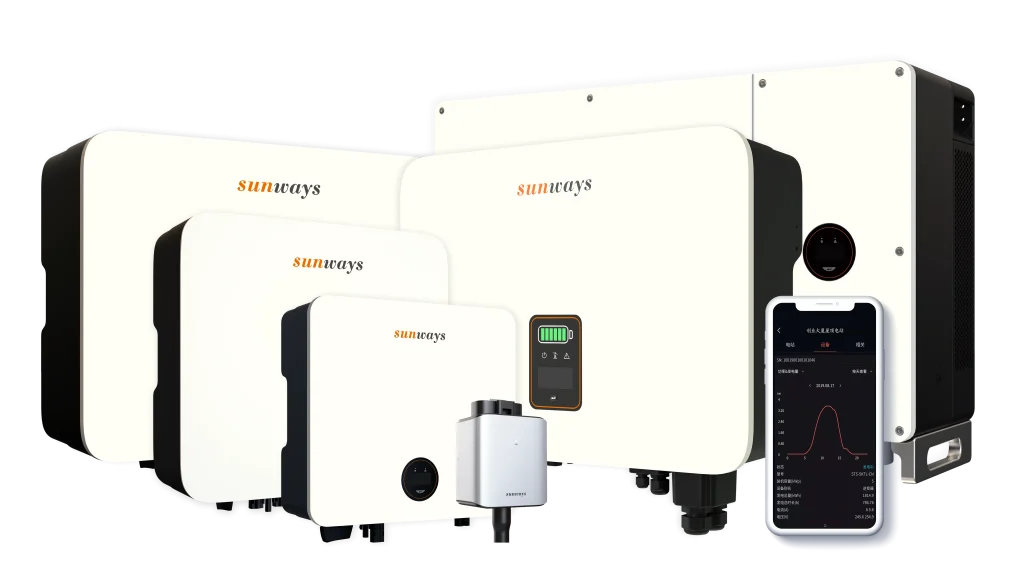
Sunways’ on-grid string inverters cover a power range of 1–170 kW, including solutions for residential single-phase, standard three-phase, low-voltage three-phase and high-voltage three-phase systems.
Single-Phase String Inverters for Residential Projects
If your project utilises a single-phase grid, we recommend considering the Sunways STS series. This series is primarily designed for residential rooftops and small-scale PV projects.
| Product Series | Power Range | MPPT | Main Applications |
|---|---|---|---|
| STS-1K~3.3KTL-S-P | 1–3.3 kW | 1 | Small residential |
| STS-3K~4KTL-M | 3–4 kW | 1 | Residential |
| STS-3K~6KTL-SE | 3–6 kW | 2 | Residential rooftops |
| STS-7.5K~8KTL-SE | 7.5–8 kW | 2 | Large residential |
| STS-7K~11KTL | 7–11 kW | 2 | High-power residential |
Three-Phase String Inverters for Commercial and C&I Projects
If the project is connected to a three-phase grid, the Sunways STT series can be selected based on grid voltage, project power and MPPT requirements.
| Product Series | Power Range | Grid Type | MPPT | Main Applications |
|---|---|---|---|---|
| STT-4K~25KTL-P | 4–25 kW | Standard three-phase | 2 | Large residential/small commercial |
| STT-10K~20KTL-SE-LV | 10–20 kW | Low-voltage three-phase | 2 | Low-voltage three-phase projects |
| STT-15K~30KTL-SE | 15–30 kW | Standard three-phase | 1/2 | Small-scale commercial |
| STT-30K~60KTL | 30–60 kW | Standard three-phase | 4 | Commercial/C&I |
| STT-15K~37.5KTL-LV | 15–37.5 kW | Low-voltage three-phase | 4 | Low-voltage commercial projects |
| STT-55K~80KTL-SE-LV | 55–80 kW | Low-voltage three-phase | 10 | Low-voltage C&I |
| STT-100K~150KTL-SE | 100–150 kW | Standard three-phase | 10 | Large-scale C&I |
| STT-130K~170KTL-SE-HV | 130–170 kW | High-voltage three-phase | 10 | Large-scale C&I/Large-scale PV |
Compare Sunways String Inverters
Explore all Sunways on-grid string inverters by power rating, grid voltage and MPPT configuration.
To further confirm the model, please provide the project country, grid phase configuration and voltage, PV capacity, module model and string configuration; Sunways can assist in verifying product compatibility.
Reference
Start Your Project