String Inverter vs Microinverter: Which Is Better for Your Solar Project?
Table of Contents
Micro-inverters are better suited to small residential properties, systems where module operating conditions vary significantly, or where module-level monitoring is required; string inverters, on the other hand, are generally more suitable for residential rooftops with uniform orientation and minimal shading, as well as commercial and industrial projects with higher requirements for centralised operation and maintenance and larger system scales. String inverters centrally convert the direct current generated by multiple photovoltaic modules into alternating current; they typically involve fewer units, have lower initial costs and offer better centralised maintenance. Micro-inverters, on the other hand, are installed at the module level, providing independent power conversion and MPPT control for individual modules or small groups of modules; they therefore offer greater flexibility in the presence of partial shading, multiple orientations and complex roof conditions.
However, modern multi-MPPT string inverters are also capable of managing arrays of modules with different orientations or tilt angles individually; consequently, the complexity of a roof alone should not be the sole determining factor in deciding that micro-inverters are required.
Overall, micro-inverters offer more precise module-level control, whilst string inverters typically provide lower system costs, a more centralised maintenance approach and better scalability. The following section will draw on these key factors to help you determine which inverter architecture is more suitable for your specific PV project.
What Are String Inverters and Microinverters?
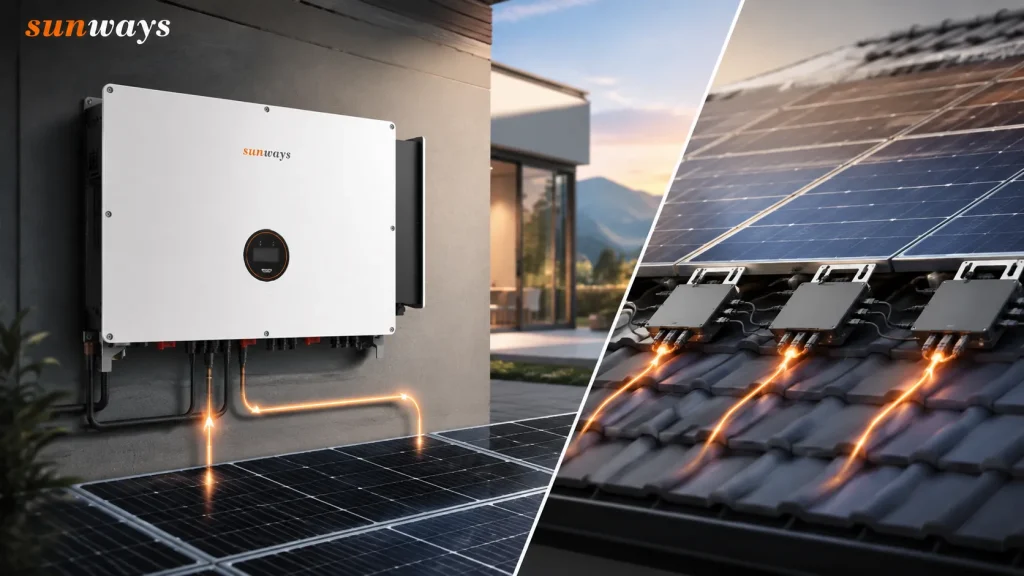
Multiple photovoltaic modules are connected in series to form one or more strings, which are then connected to a single centralised unit for MPPT control and DC-to-AC conversion; this is known as a string inverter. Each photovoltaic module, or a small number of modules, is equipped with its own small unit, which independently performs MPPT control and DC-to-AC conversion at the module level; this is known as a micro-inverter.
The fundamental difference between the two is that string inverters perform power conversion centrally at the system level, whilst micro-inverters perform power conversion distributed at the module level.
What Is a String Inverter?
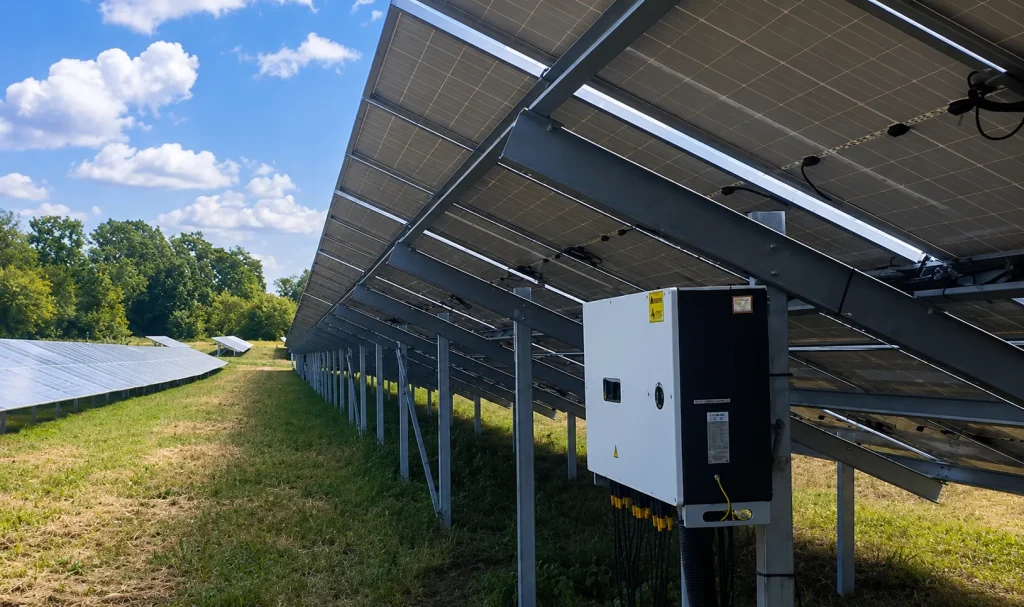
A string inverter is a centralised photovoltaic power conversion device. Multiple photovoltaic modules are first connected in series to form a PV string, and one or more of these strings are then connected to a single inverter.
During system operation, the string inverter continuously tracks the maximum power point of the PV array, ensuring the modules remain in a state of maximum efficiency for power generation. At the same time, it converts the direct current (DC) generated by the modules into alternating current (AC) that meets grid requirements, whilst controlling the output voltage, frequency and power.
String inverters also perform system protection functions, including anti-islanding protection, overvoltage protection, overcurrent protection and insulation monitoring. Should any abnormalities occur in the grid or the PV system, the inverter will promptly limit output or cease operation to minimise risks to equipment and personnel.
Via a communication module, string inverters can also record power generation, operating power and fault information, and upload this data to a monitoring platform. You can view the system status via a web interface or app, and carry out remote diagnostics and operations and maintenance.
Why Multi-MPPT Design Matters
If a project comprises south-facing, east-facing and west-facing roof sections, it is not advisable to connect all these modules to a single MPPT. Their irradiation conditions and optimal operating points differ.
A multi-MPPT string inverter can manage these arrays separately. Therefore, a complex roof does not necessarily mean that micro-inverters must be used. The key is whether the number of MPPTs, input current, operating voltage range and string configuration are suited to your project.
Complex Roofs: Microinverter or Multi-MPPT String Inverter?
If a complex roof can be divided into several independent arrays based on orientation and irradiation conditions, and each array has sufficient modules to form an effective string, a multi-MPPT string inverter will usually meet your needs. Connecting different arrays to different MPPTs allows each to find its optimal operating point, whilst balancing cost and centralised maintenance.
If the modules are scattered across multiple small roof slopes, if there are too few modules in a single orientation, or if chimneys or trees cast significant and uneven shadows on individual modules, micro-inverters are more suitable. They allow each module to operate independently, minimising the impact of localised shading on other modules.
Put simply: If variations across the roof can be categorised by array, give priority to multi-MPPT string inverters; if variations are specific to individual modules, the advantages of micro-inverters are more pronounced. Ultimately, you will need to verify the number of MPPT channels, voltage range, input current and number of strings.
| Roof conditions | Most suitable solution |
|---|---|
| Two to four distinct roof areas, each with sufficient modules | Multi-MPPT string inverter |
| Roof areas face different directions but can each form a complete string | Multi-MPPT string inverter |
| Modules within the same area have similar orientation, tilt angle and irradiance conditions | Multi-MPPT string inverters |
| Modules are scattered across multiple very small roof areas | Micro-inverters |
| Insufficient number of modules in a single orientation to meet the MPPT operating voltage | Micro-inverters |
| Chimneys, trees and other obstacles cast significant, uneven shadows on individual modules | Micro-inverters or power optimisers |
| The customer specifically requires module-level monitoring and fault localisation | Micro-inverters or power optimisers |
| The system has a large capacity, and cost-effectiveness and centralised maintenance are prioritised | Multi-MPPT string inverters |
What Is a Microinverter?
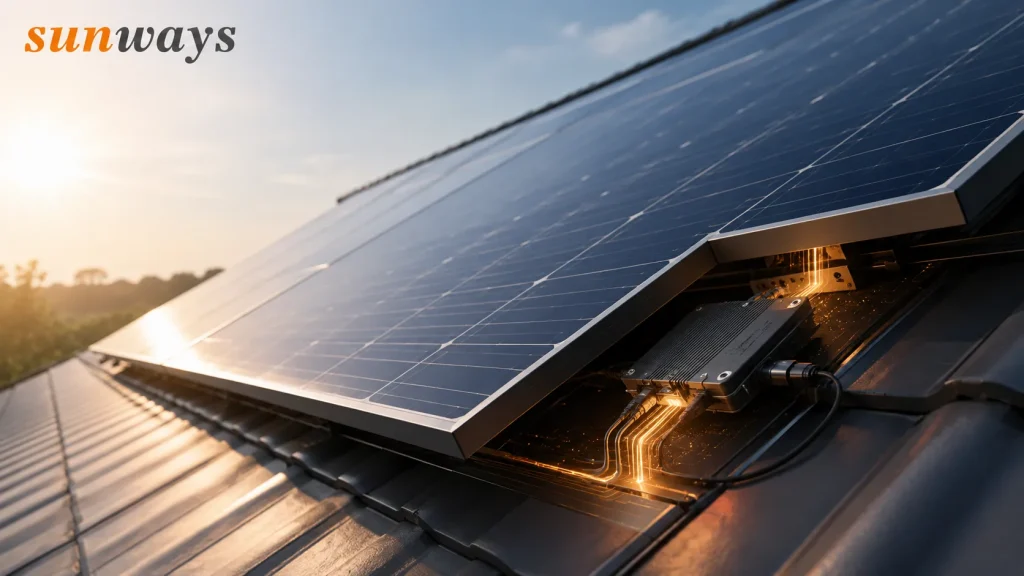
A microinverter is a module-level power conversion device. It is typically installed on the rear of a photovoltaic module, with a single unit capable of connecting to one or a small number of modules, depending on the product design.
Unlike string-type systems, microinverters perform the conversion from direct current (DC) to alternating current (AC) in close proximity to the modules. The AC power generated by each module is then aggregated via an AC branch cable and ultimately fed into the building’s electrical distribution system.
Most microinverters provide independent module-level MPPT for each module. Each module can identify its maximum power point based on its own irradiance, temperature and shading conditions.
Why Module-Level MPPT Matters
When a module is shaded by a chimney, trees or neighbouring buildings, its operating conditions may differ significantly from those of other modules. Module-level MPPT can limit the impact of such variations on other modules.
Micro-inverters typically also support module-level monitoring. You can view the power output, energy generation and operating status of individual modules on the platform. This is very helpful for fault diagnosis.
However, module-level control does not necessarily mean the entire system is simpler. Micro-inverter systems usually involve more rooftop electronics, connection points and communication nodes. Should a fault occur, it may also be necessary to remove modules and access the roof for repairs.
The Main Technical Difference
The most significant technical difference between the two lies primarily in the location of power conversion and MPPT control. Microinverters address the issue of significant variations between modules, whilst string inverters address issues of cost, scale and centralised operation and maintenance.
| Technical Factor | String Inverter | Microinverter |
|---|---|---|
| DC-to-AC conversion | Performed within the central inverter | Performed near the modules |
| MPPT control | String level or MPPT input level | Typically at module level |
| Power collection | DC power is collected first | AC power is converted first, then collected |
| Monitoring granularity | Inverter level, MPPT level or string level | Typically down to module level |
| Impact of failure | May affect one or more strings | Typically affects the corresponding module |
| Maintenance location | Wall-mounted, garage or equipment room | Mostly located beneath the modules |
| Design focus | String voltage, current and MPPT allocation | Module compatibility and AC branch capacity |
String Inverter vs Microinverter: Key Differences
a. Cost and Initial Investment
String inverters are generally less expensive. A single inverter can manage multiple PV strings, resulting in fewer units and a more centralised installation.
Micro-inverters require a separate unit for each module or a small number of modules, and also involve additional connectors, AC branch cables and communication gateways. The more modules there are, the higher the equipment and installation costs tend to be.
However, when making a practical comparison, medium- to large-scale projects with regular layouts and minimal shading are generally better suited to string inverters; for small, complex rooftops, it may be worth considering the higher cost in exchange for module-level control.
b. Shading and Module Mismatch
Micro-inverters generally offer an advantage when individual modules are shaded. As each module performs MPPT independently, a single module generating less power will not directly affect the output of the others.
In string-type systems, modules within the same string influence one another. Shading, soiling or module mismatch can all lead to performance losses, but bypass diodes, multiple MPPT trackers and sensible grouping can mitigate these effects.
c. Reliability and Impact of Failure
Reliability depends on three factors: the likelihood of failure, the extent of the impact of a failure, and the ease of repair.
When a single micro-inverter fails, it typically affects only the corresponding module; however, as there are more devices and connection points on the roof, repairs may require the removal of modules. When a string inverter fails, it may affect one or more strings, but as the equipment is usually installed on walls or in equipment areas, inspection and replacement are more convenient.
d. Maintenance and Replacement
String inverters are usually installed on walls or in equipment areas, making inspection and replacement more convenient and eliminating the need to remove photovoltaic modules.
Micro-inverters are located beneath the modules. Whilst a single failure has a limited impact, repairs often require accessing the roof and removing modules. For steeply pitched, high-rise or large industrial rooftops, labour and safety equipment costs may be higher.
e. Monitoring and Fault Diagnosis
Micro-inverters typically support module-level monitoring, allowing the power output, energy generation and fault status of individual modules to be viewed, enabling faster problem identification.
String inverters mostly provide inverter-level or MPPT-level monitoring. Some commercial and industrial systems also support string-level data, fault logs and remote diagnostics. For large-scale projects, particular attention should be paid to whether multiple inverters can be centrally managed via data loggers, EMS or SCADA systems, and whether alerts, firmware updates and remote O&M can be carried out.
Key Takeaway
The main advantages of micro-inverters are module-level control, minimal impact from localised faults and flexibility for small-scale expansion. The main advantages of string inverters are lower initial costs, centralised equipment, ease of maintenance and greater suitability for medium to large-scale systems.
Microinverter vs String Inverter Efficiency and Energy Yield
- Conversion efficiency: Refers to the efficiency with which an inverter converts direct current (DC) to alternating current (AC). The higher the value, the lower the conversion losses; however, the maximum efficiency applies only under specific operating conditions.
- Weighted efficiency: European efficiency (EN 50530:2010+A1:2013) and CEC efficiency (California Energy Commission Performance Test Protocol) take into account performance under different load conditions, providing a more accurate reflection of actual operating conditions than peak efficiency alone.
- MPPT efficiency: Indicates the inverter’s ability to locate and maintain the maximum power point. Multi-MPPT string inverters are suitable for managing arrays with varying orientations; micro-inverters, on the other hand, can manage individual modules independently.
- Annual energy yield: Actual annual electricity generation is also affected by factors such as shading, module mismatch, temperature, roof orientation, cable losses and equipment downtime.
- Clipping loss: When a module’s output power exceeds the inverter’s maximum output capacity, the excess cannot be converted into alternating current. This loss can occur with both string inverters and micro-inverters.
Which System Produces More Energy?
| Project conditions | Typical power generation performance |
|---|---|
| Uniform orientation, minimal shading | The difference between the two solutions may be negligible; string inverters typically offer good conversion efficiency |
| Roof with a small number of panels facing different directions | Multi-MPPT string inverters can usually manage this effectively |
| Individual modules subject to uneven shading | Micro-inverters may reduce losses through module-level MPPT |
| Significant differences in operating conditions between modules | The advantages of micro-inverters’ independent control are more pronounced |
Which Is Better: A String Inverter or a Microinverter?
If your project involves a regular layout with minimal shading and a large-capacity system, string inverters are generally the more suitable choice. If your project features a fragmented roof layout, significant localised shading, or requires module-level monitoring, micro-inverters are recommended.
The following examples illustrate different project scenarios:
1️⃣For a Simple Residential Roof
Where module orientation, tilt angle and sunlight conditions are similar: choose a string inverter.
It uses fewer power conversion devices, allows for a centralised installation and facilitates easier maintenance. For residential roofs with a regular layout and minimal shading, the module-level control offered by micro-inverters may not sufficiently offset the additional cost.
Recommended choice: Multi-MPPT string inverter.
2️⃣For a Shaded or Complex Roof
Where chimneys, trees or buildings only shade individual modules: choose micro-inverters. Each module performs MPPT independently, so if one module generates less power, it does not directly limit the output of other modules. However, a complex roof does not necessarily mean micro-inverters are the only option. You may also wish to compare:
- Multi-MPPT string inverter: Suitable for roofs with shading and orientations that can be divided into distinct zones.
- String inverter with power optimisers: Suitable for projects requiring module-level optimisation, but where centralised conversion and maintenance are still preferred.
Recommended choice: When shading is specific to individual modules, prioritise micro-inverters or power optimisers.
3️⃣For Multiple Roof Orientations
If the roof has two to three distinct areas—such as east-facing, west-facing and south-facing—and each area has enough modules to form effective strings: choose a multi-MPPT string inverter.
If modules are scattered across many small slopes, with few modules in any single orientation: choose micro-inverters.
4️⃣For Commercial and Industrial Solar
For commercial and industrial solar projects: opt for string inverters. These allow for the centralised connection of multiple strings, resulting in fewer units and making it easier to control the cost per watt.
The multi-MPPT design can manage different roof sections and module arrays, and supports data loggers, EMS or SCADA systems, facilitating centralised monitoring and maintenance of multiple units. String inverters are typically installed on walls or in equipment areas. In the event of a fault, there is no need to frequently access the roof or dismantle modules, making them suitable for the long-term operation and maintenance of large industrial premises.
Recommended choice: string inverters.
5️⃣For Solar Plus Battery Storage
When selecting a solar-plus-storage system, one should not merely compare string inverters and micro-inverters; consideration must also be given to how the battery is connected.
- DC-coupled storage: The PV array and batteries are connected to a hybrid inverter, making this suitable for new solar-plus-storage projects.
- AC-coupled storage: The batteries are connected to the AC side via a dedicated battery inverter, making this suitable for retrofitting existing PV systems.
- Hybrid inverter: Integrates PV, batteries, grid connection and backup load management; the system architecture is typically more centralised.
Micro-inverter systems typically utilise AC-coupled storage. String-inverter systems can utilise either AC coupling or DC coupling via a hybrid inverter.
In standard grid-connected systems, whether using string inverters or micro-inverters, power output typically ceases during a grid outage. To achieve backup power supply, you will also require batteries, a transfer switch, a backup load circuit and the corresponding control system.
When Is a Sunways String Inverter the Better Choice?
Sunways string inverters are suitable for standard residential roofs, commercial and industrial roofs, and projects requiring centralised monitoring of multiple inverters. If individual modules are subject to significant, long-term shading, or if modules are scattered across numerous small roof slopes, micro-inverters or power optimisers may offer greater flexibility.
Modern String Inverter Capabilities
- Multiple independent MPPT trackers, managing arrays with different orientations separately
- Wide MPPT voltage range
- Compatible with high-current, high-power photovoltaic modules
- Remote monitoring, parameter configuration and firmware updates
- AFCI, surge protection and anti-islanding protection
- IP65 or IP66 outdoor protection
- Reverse power flow limitation and centralised management of multiple units
Sunways’ grid-tied products cover residential, commercial and industrial, and higher-power projects. Different series offer 1, 2, 4 or 10 MPPT channels; some commercial and industrial models achieve a maximum efficiency of up to 98.8 per cent and support RS485, Wi-Fi, GPRS or LAN communication. Specific features are subject to the model and region of sale.
Sunways Residential String Inverters
If your residential roof has a relatively uniform orientation and minimal shading, Sunways residential string inverters are generally the more practical choice. With centralised installation, there is no need to install a separate inverter beneath each panel, making both costs and maintenance easier to manage.
Sunways’ residential grid-connected products are available in various power ratings and MPPT configurations. Some single-phase models support dual MPPT and 20A input, making them suitable for panels with higher current ratings; they also support wireless or wired communication, remote firmware updates and app configuration.
- Regularly shaped, detached residential roofs
- Two roof orientations that can be clearly grouped
- Projects with a tight initial budget
- Users who prefer centralised installation and maintenance of inverters
Sunways Commercial String Inverters
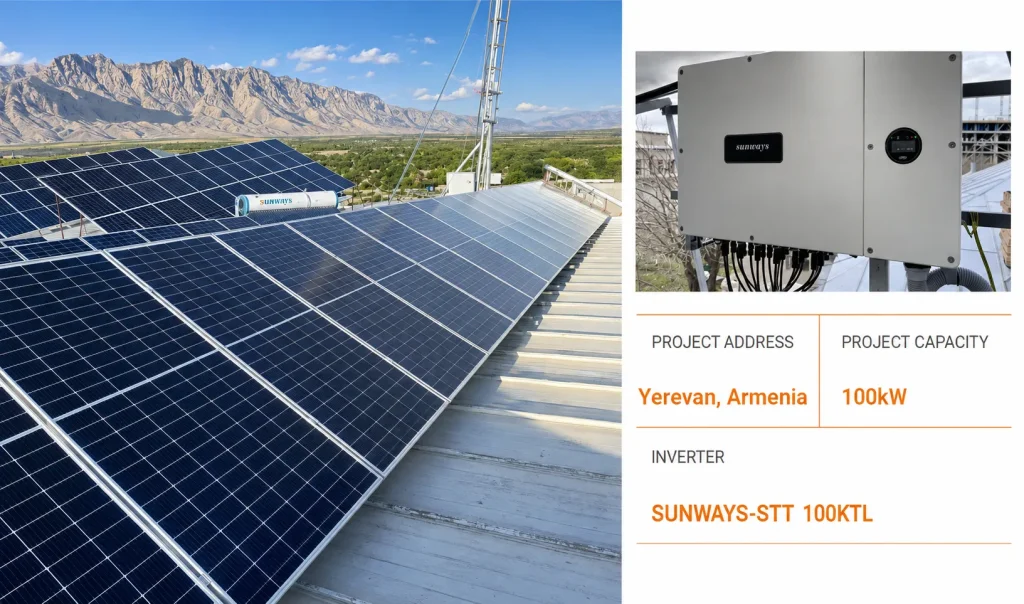
For commercial and industrial projects, the advantages of Sunways string inverters are even more pronounced. With a wider range of power ratings, they allow a large number of PV strings to be managed with fewer units, whilst also facilitating centralised monitoring and maintenance.
Some Sunways commercial and industrial models offer 4 or 10 MPPT channels, IP66 protection, remote firmware updates and fault logging. The STT 55–80kW series features a 10-MPPT design, achieves a maximum efficiency of 98.8 per cent, and supports a variety of wired and wireless communication methods. The STT 130–170kW high-voltage series likewise offers 10 MPPT channels and a maximum efficiency of 98.8 per cent.
Through data loggers, multiple inverters can also be managed and monitored centrally. According to Sunways documentation, a single data logger solution can connect up to 90 inverters, with the exact number depending on the RS485 ports and on-site configuration.
- Factory and warehouse rooftops
- Commercial buildings and agricultural facilities
- Projects ranging from tens of kilowatts to megawatts
- Roofs with multiple orientations but clearly definable strings
- Systems requiring centralised monitoring and remote operation and maintenance
Sunways Hybrid and Storage Solutions
If you are planning to install a battery, simply choosing a standard string-type grid-connected inverter is not sufficient. You will also need to assess the battery voltage, standby loads, switchover times and energy management methods.
The Sunways product portfolio includes low-voltage and high-voltage hybrid inverters, residential batteries and commercial and industrial energy storage systems. Hybrid inverters are available in power ratings ranging from approximately 3–80 kW and can be used in residential and commercial and industrial PV-storage projects. Some models support backup switching in under 10 ms, optional AFCI, surge protection and WiFi or Bluetooth communication.
- New residential PV-storage systems
- Emergency backup power during power cuts
- Increasing the self-consumption rate of PV energy
- Peak shaving and load balancing for commercial and industrial applications
- Centralised management of multiple units
FAQs About String Inverters and Microinverters
Q1. Is a Microinverter Better Than a String Inverter?
Microinverters are not necessarily better than string inverters. They are more suitable for residential projects with uneven shading, irregular roof layouts, or where module-level monitoring is required. For regular-shaped roofs and medium to large-scale systems, string inverters are generally more cost-effective and easier to maintain. You should select the appropriate type based on your roof conditions and the scale of the project, rather than focusing solely on the product type.
Q2. Which Is More Efficient, a String Inverter or a Microinverter?
String inverters generally have a higher peak conversion efficiency, but this does not necessarily mean they will generate more electricity over the course of a year. Microinverters, through module-level MPPT, can minimise losses caused by localised shading and module mismatches. When comparing the two, you should consider weighted efficiency, MPPT configuration and projected annual energy yield, rather than simply comparing the highest efficiency figures.
Q3. Do Microinverters Produce More Electricity?
Microinverters do not necessarily generate more electricity in all projects. Where individual panels are subject to varying degrees of shading, or where panel orientations are more varied, independent MPPT may increase power generation. On roofs with uniform orientations and minimal shading, the difference in annual power generation between the two solutions may be negligible. It is recommended to make a comparison using on-site data or power generation simulations.
Q4. What Happens if One Panel Is Shaded in a String?
When a single panel is shaded, the output of the string to which it belongs may decrease, but this does not usually cause the entire system to stop generating electricity. The actual loss depends on the extent of the shading, bypass diodes, string design and MPPT configuration. Where shading can be segmented by area, multi-MPPT string inverters can usually handle it; where shading is concentrated on a single panel, microinverters or power optimisers may be considered.
Q5. Are Microinverters More Expensive?
The initial cost of microinverters is usually higher, as each or a small number of modules requires a separate unit, along with additional connectors, AC cables and communication equipment. They may offer additional power generation benefits through module-level control, but this does not necessarily offset the full cost. You should compare the equipment, installation, maintenance and long-term power generation benefits, rather than just the purchase price.
Q6. Which Inverter Is Better for Commercial Solar?
String inverters are generally more suitable for most commercial and industrial solar projects. They can manage a large number of strings with fewer units and support multiple MPPT channels, centralised monitoring, and integration with EMS or SCADA systems. The equipment is typically mounted on walls or in equipment rooms, making maintenance more convenient. Unless the project suffers from significant module-level shading, microinverters are not usually the preferred choice.
Q7. Can a String Inverter Monitor Individual Panels?
Standard string inverters generally cannot monitor individual modules directly. They typically provide data at the inverter, MPPT or string level. To obtain module-level power and fault information, it is usually necessary to add power optimisers or other module-level electronics. Before selecting a model, you should first confirm whether individual module monitoring is truly necessary, as this will increase equipment and system costs.
Q8. Can Microinverters Work With Batteries?
Microinverters can be used in conjunction with batteries, but this is usually achieved via AC coupling. Solar power is first converted to alternating current (AC), then charged into the battery via a battery inverter; this is suitable for adding energy storage to existing systems. For new solar-plus-storage projects, however, DC-coupled hybrid inverters may be a better option, as the system architecture and energy conversion pathways are typically more centralised.
Q9. How Long Do String Inverters and Microinverters Last?
The service life of both types of inverter depends on product quality, ambient temperature, heat dissipation conditions and the standard of installation. Microinverters are installed beneath the roof panels and are exposed to high temperatures over the long term; string inverters are typically installed in locations that are easier to access for maintenance. Do not focus solely on the warranty period; you should also check the availability of spare parts, labour costs and local after-sales support.
Need Help Choosing the Right Inverter for Your Solar Project?
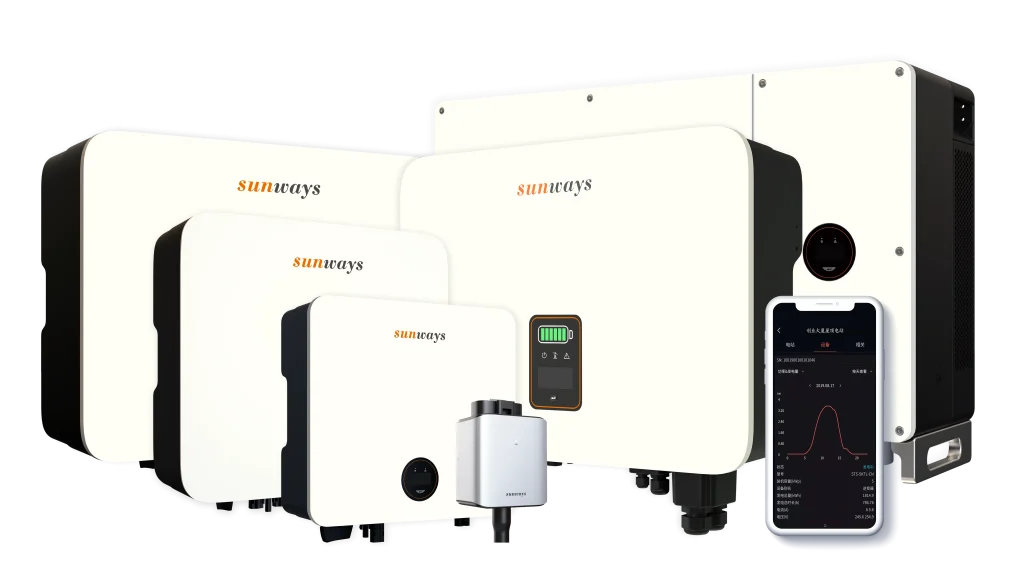
Every solar project has different roof conditions, grid connection requirements and investment objectives. Send Sunways details of your project capacity, module configuration, roof conditions and energy storage requirements, and we will help you select the appropriate inverter type, power rating and system solution.
Start Your Project
Read More
Solar Inverter Price: Is the Cheaper Quote Really Better?
Compare solar inverter prices, battery and installation costs. Learn what a quote includes and which features are worth paying for in your project.
Types of Solar Inverters: Which One Do You Really Need?
Compare solar inverter types for backup, batteries, shading and commercial roofs. Find the right starting point for your project with Sunways.
Types of Energy Storage: What Does Your Solar Project Really Need?
Compare energy storage types, battery options and solar setups. Use practical examples to choose for backup, self-consumption and existing PV systems.