Commercial Solar Inverter: What Really Matters Before You Choose One
Table of Contents
When selecting a commercial solar inverter, you need to comprehensively consider various factors, including the three-phase grid, the number of MPPT channels, PV input current, the DC/AC ratio, and efficiency. From the perspective of real-world commercial projects, this article will explain which parameters are truly important, which ones are often misunderstood, and how to determine whether a commercial solar inverter is suitable for your project.
What Is a Commercial Solar Inverter?
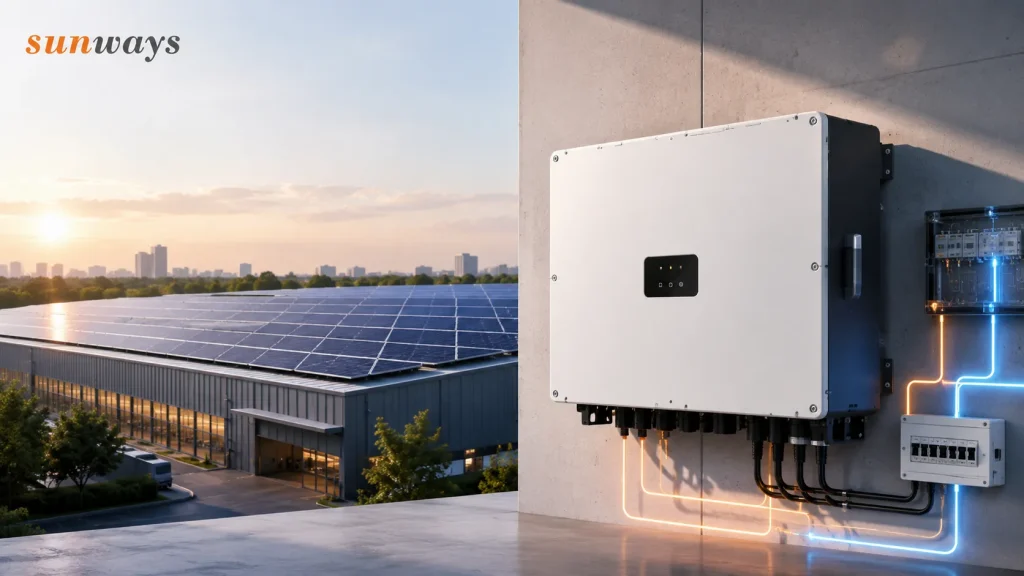
A commercial solar inverter serves as the power-conversion and control center of a commercial PV system. It converts the direct current (DC) generated by photovoltaic modules into alternating current (AC) that can be used by commercial buildings and the public grid. At the same time, it handles MPPT, grid synchronization, safety protection, and operational monitoring.
Commercial projects (factories, warehouses, hotels, office buildings, or commercial rooftops) typically involve three-phase grids, larger PV arrays, more strings and MPPT units, and more complex grid-connection and O&M requirements.
Solar Panels → Commercial Solar Inverter → Business Loads → Grid
How Is It Different from a Residential Inverter?
The key difference lies primarily in system complexity.
- Three-Phase Grid: Three-phase power distribution is widely used in commercial buildings, making a three-phase solar inverter one of the mainstream choices for commercial projects.
- Larger PV Arrays: Larger rooftops and PV capacity mean more PV strings and a more complex DC-side design.
- More MPPTs: When a roof has different orientations, tilt angles, or sections, you need more independent MPPTs to minimize interference between different arrays.
- Stronger Grid Control: Commercial projects are more likely to involve requirements such as power factor, grid connection limits, and zero export.
- More Demanding O&M: The larger the system, the greater the importance of remote monitoring, fault logging, and multi-unit management.
Taking Sunways’ three-phase grid-tied products as an example, the STT 5–30 kW series is configured with 1–2 MPPT channels, the 30–60 kW series increases to 4 MPPT channels, and the 100–150 kW series reaches 10 MPPT channels. This illustrates that as commercial solar systems scale up, inverters need to manage not only “more power” but also more complex PV arrays.
What Does a Commercial Solar Inverter Actually Manage?
| Function | What It Means for Your Project |
|---|---|
| DC to AC Conversion | Converts solar power into AC electricity usable by commercial loads |
| MPPT | Continuously searches for the optimal operating point of the PV array to maximize energy harvest |
| Grid Synchronization | Ensures the inverter’s output matches the voltage and frequency requirements of the local grid |
| Safety Protection | Provides protection against islanding, surges, overheating, overvoltage, and other hazards |
| Monitoring & Communication | Helps you view operational status, power generation trends, and fault information |
Sunways’ current on-grid product lineup ranges from 1–170 kW, with applications extending from residential to commercial, C&I, and utility-scale projects; commercial/C&I products primarily utilize a three-phase string inverter architecture.
Key Points
When selecting a commercial solar inverter, keep in mind: Power rating is only the first consideration. What truly determines whether a commercial solar project is well-designed and operates smoothly is:
Power + Three-Phase Grid + MPPT + PV Compatibility + Safety + Grid Compatibility
When Do You Need a Commercial Solar Inverter?
Commercial solar inverters are typically used in applications such as factories, warehouses, hotels, office buildings, retail facilities, and farms. Commercial projects typically feature larger PV arrays than residential systems and more frequently utilize three-phase power distribution. Therefore, three-phase solar inverters, multi-MPPT designs, and remote monitoring capabilities are essential. Sunways’ current grid-tied product lineup covers Residential, Commercial, C&I, and Utility-Scale applications, and offers a variety of three-phase string inverter solutions.
Factory and Industrial Rooftops
If you are designing a PV system for a factory or manufacturing facility, three-phase solar inverters are usually the first solution to evaluate. Factories often operate three-phase loads such as motors, air compressors, HVAC systems, and production lines simultaneously. Sunways has completed actual C&I PV projects, including a 330 kW project in Bangladesh, a 675 kW project in Pakistan, and a 900 kW project in Sri Lanka.
Warehouses and Logistics Buildings
Warehouses and logistics buildings often feature multiple roof sections, varying orientations, skylights, or partial shading. In such cases, the MPPT configuration of a commercial rooftop solar inverter directly affects your design flexibility for string configurations.
For complex roofs, multi-MPPT typically offers greater practical value than simply increasing the power rating of a single inverter. It allows different roof areas to independently track their respective optimal operating points.
Hotels, Offices, and Retail Buildings
One advantage of hotels, office buildings, supermarkets, and shopping malls is that a significant portion of electricity consumption occurs during the day, while PV systems also generate power primarily during the day.
If the local grid does not allow or restricts net metering, you’ll also need to confirm in advance whether the system supports Zero Export / Export Limitation. Otherwise, even if the inverter power rating is selected correctly, the grid-connected solution may still need to be readjusted.
Farms, Schools, and Public Buildings
The load profiles of farms, schools, and public buildings vary significantly, so a C&I solar inverter should not be selected based solely on building area.
For farms, it is typically necessary to consider the characteristics of loads such as water pumps, motors, and irrigation equipment. For schools and public buildings, attention should be paid to the alignment of daytime loads with PV generation, roof zoning, local grid connection requirements, and long-term operation and maintenance. Inverter specifications must be determined by considering actual loads, PV capacity, and grid connection together.
Which Commercial Application Matches Your Project?
| Application | What Matters Most |
|---|---|
| Factory | Power, three-phase grid, reliability, O&M |
| Warehouse | Roof layout, MPPTs, string design, monitoring |
| Hotel | Daytime self-consumption, efficiency |
| Office / Retail | Load profile, export control, monitoring |
| Farm | Motors, pumps, grid conditions |
| School / Public Building | Roof layout, system sizing, grid requirements |
What Size Commercial Solar Inverter Do You Need?
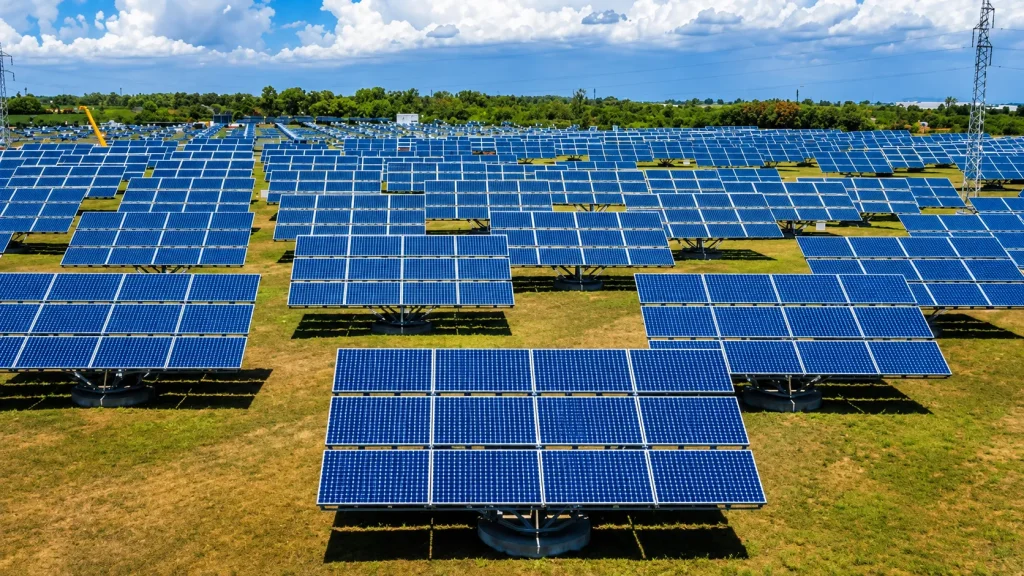
The correct size of a commercial solar inverter should be determined by your PV array, daytime load, grid connection, and permitted DC/AC ratio—not by simply matching one kW figure to another. For commercial projects, a 50 kWp PV system does not necessarily mean a 50 kW inverter. Roof conditions, module parameters, load curves, and local grid connection restrictions will all influence the final selection.
Start with the PV Array
Determine the PV array first, then select a commercial solar inverter. You need to verify the PV array capacity, module Voc/Imp, number of strings, roof orientation, and irradiance conditions. The inverter’s Max. DC Voltage, MPPT Voltage Range, Input Current, and Short-Circuit Current must cover the actual string configuration; otherwise, even if the rated power matches, there may still be DC-side incompatibility.
Take the Sunways STT-100~150KTL-SE as an example: its maximum DC input voltage is 1100V, its MPPT range is 200–1000V, it is configured with 10 MPPT channels, each with 2 DC inputs, and the maximum input current per channel is 40A. This type of Multi-MPPT design is better suited for commercial solar projects with multiple rooftops, varying orientations, or complex string layouts.
Complete the PV string design first, then determine the inverter power and MPPT configuration.
Check Your Commercial Load
Commercial solar inverter sizing cannot be directly matched one-to-one with a building’s peak load. You need to compare the daytime load curve with the PV generation curve to determine how much solar energy can be consumed on-site during generation hours. The U.S. Department of Energy’s commercial building load data even records electricity consumption variations for different building types at 15-minute resolution; PVWatts estimates annual grid-connected PV generation based on hourly simulations.
- Daytime Load: Actual power consumption during the main PV generation hours;
- Peak Load: What the peak value is and when it occurs;
- Load Profile: Daily load curves for factories, hotels, warehouses, and office buildings can vary significantly;
- Self-Consumption Target: The percentage of PV electricity you want to be consumed directly by on-site loads.
Confirm the Grid Connection
Before selecting equipment for a commercial project, first confirm the grid connection conditions, then determine the inverter model:
- Grid Phase: Single-phase or three-phase; for medium- to large-scale commercial projects, three-phase solar inverters are typically the preferred option.
- Grid Voltage: The inverter’s AC output must match the local grid voltage.
- Grid Connection Capacity: Confirm the allowed PV or inverter capacity for the project.
- Export Limitation: If reverse power flow is prohibited, configure Zero Export or Export Control.
Understanding the DC/AC Ratio
The capacity of a PV array in a commercial solar system can exceed the inverter’s rated AC power, but it must remain within the manufacturer’s specified design range.
For example:
60 kWp PV Array + 50 kW Inverter
The corresponding DC/AC ratio is:
60 ÷ 50 = 1.20
That is, 120%.
Moderately increasing the DC-side capacity allows the inverter to capture more available PV power during the morning, evening, or when irradiance is low. However, oversizing is not always better the higher it is. You must still check the maximum DC voltage, MPPT range, input current, and maximum PV input power.
Sunways’ current STT 5–30 kW three-phase grid-tied series supports up to 150% PV array oversizing, while also offering up to 10% continuous AC output overloading capability.
PV Oversizing Is Not AC Overload
| Term | What It Means |
|---|---|
| PV Oversizing | The DC rated capacity of the PV array exceeds the inverter’s Rated AC Power |
| AC Overload | The inverter’s ability to output power exceeding its Rated AC Power under specified conditions |
Therefore, 150% PV oversizing ≠ the inverter can continuously output 150% of its AC power.
A Practical Sizing Checklist
Before determining the power rating of a commercial PV inverter, complete at least the following 5 checks:
- Determine the PV Array Capacity
- Verify module voltage, current, and string design
- Analyze daytime load and self-consumption
- Confirm three-phase grid, voltage, and grid connection capacity
- Check the manufacturer’s permitted DC/AC ratio and export limit
Not Sure What Inverter Size Fits Your Project?
Provide Sunways with your PV capacity, module specifications, grid voltage, and project location to further verify the inverter power, MPPT configuration, and DC-side design.
Get an Inverter Selection Recommendation
6 Things That Matter More Than the kW Rating
1. Three-Phase Grid Compatibility
Commercial projects make extensive use of three-phase solar inverters, not because three-phase systems are necessarily “more advanced,” but because buildings such as factories, warehouses, and hotels typically use three-phase power distribution and three-phase loads. **The inverter must be compatible with the on-site grid, rather than the on-site grid having to adapt to the inverter. ** Sunways’ current commercial grid-tied product lineup is also dominated by the STT three-phase series, offering a variety of three-phase models for different voltage levels.
2. MPPT Configuration
If a commercial rooftop features varying orientations, tilt angles, shading, or multiple roof areas, a multi-MPPT solar inverter should be considered. Different PV strings can be tracked by independent MPPT units, reducing mismatch losses caused by varying conditions.
For example, the Sunways STT 100–150 kW series is configured with 10 MPPT channels, each capable of connecting to 2 DC inputs. Reducing PV string mismatch losses is one of the key benefits of the 10-MPPT design. However, more MPPT channels do not necessarily mean better performance. You need to determine the actual number of independent tracking channels required based on the roof layout and string design.
3. PV Input Current
The PV input current directly determines whether the inverter can accommodate high-current, high-power modules. When selecting an inverter, you must verify the module’s Imp / Isc, the string parallel configuration, and the inverter’s Max. Input Current / Max. Short-Circuit Current. Relying solely on the Max. DC Voltage is insufficient. The module current must fall within the inverter’s permissible range; otherwise, the system may still be limited even if the power and voltage match.
Take the Sunways STT-100~150KTL-SE as an example: the maximum input current per string is 20A. This provides greater flexibility for current high-current modules and commercial rooftop string designs.
4. Efficiency
Common efficiency metrics found in datasheets include:
- Maximum Efficiency: Peak conversion efficiency under optimal conditions;
- European Efficiency: Weighted efficiency across multiple load points;
- MPPT Efficiency: The ability to track the maximum power point.
For example, some models in Sunways’ commercial STT series achieve 98.8% Maximum Efficiency, 98.3% European Efficiency, and 99.9% MPPT Efficiency.
However, for commercial projects, a 0.1% difference in peak efficiency should not overshadow considerations of MPPT design, heat dissipation, and operating environment. Long-term energy yield depends on the entire system, not just a single maximum efficiency figure.
5. Environmental Protection
Commercial PV inverters are often installed on rooftops or outdoors. Especially in environments such as hot, high-humidity, dusty, or high-altitude markets, it is crucial to check the IP rating, operating temperature, cooling, humidity, and altitude.
The Sunways Commercial On-Grid series features IP66 protection. Some STT commercial models support an operating temperature range of -30°C to 60°C, 0–100% relative humidity, and an operating altitude of up to 4,000 m, and utilize Smart Fan Cooling; derating may be required under high-altitude conditions.
6. Safety Protection
Commercial rooftops have more modules, strings, and DC connection points, so safety protection cannot be treated as an “add-on feature.”
- AFCI
- DC/AC Surge Protection
- Anti-Islanding
- Over-Voltage Protection
- Over-Temperature Protection
- Short-Circuit Protection
Among these, the AFCI solar inverter is used to detect DC arc faults. Sunways’ AFCI technology features a detection range of up to 200 m, fault detection within approximately 50 ms, and power disconnection within 500 ms.
However, please note: AFCI is not a standard feature on all models or in all markets. Some STT datasheets explicitly state that AFCI is optional; therefore, final confirmation must be based on the specific model and project certification requirements.
What Should You Compare?
| Factor | Why It Matters |
|---|---|
| Three-Phase Compatibility | Determines compatibility with commercial power grids |
| MPPTs | Determines flexibility for complex roof and multi-string designs |
| PV Input Current | Determines compatibility with high-power modules |
| Efficiency | Affects long-term energy conversion performance |
| IP Rating / Temperature / Cooling | Affects operation in outdoor and harsh environments |
| AFCI / SPD / Anti-Islanding | Reduces electrical and grid-connection safety risks |
The Features You Notice Only After the System Is Installed
- Blackout & Anti-Islanding
Standard commercial on-grid inverters typically cease grid output during a power outage as part of anti-islanding protection. If your commercial project requires continued power supply to critical loads after a power outage, you should consider a Commercial Hybrid Inverter or a C&I ESS instead of a standard on-grid inverter. - Zero Export / Export Limitation
When a project is not permitted to feed power back into the public grid, you need to monitor the power at the grid connection point in real time via a Smart Meter or Energy Manager and have the inverter dynamically adjust its output. Sunways’ current system supports Export Limit Control for both single and multiple inverters. - Remote Monitoring & O&M
The larger the commercial PV system, the more critical remote operations and maintenance become. You need to monitor alarms, fault data, generation trends, remote updates, and multi-inverter monitoring capabilities. Sunways Cloud provides access to Power Station Status, Device Status, Alarm Management, and Generation Trends, helping to reduce unnecessary on-site troubleshooting.
Why String Inverters Make Sense for Commercial Rooftops
Why choose a commercial string inverter? For most commercial rooftop projects, the advantages of a three-phase string inverter lie in its modularity, multiple MPPT channels, and more flexible operation and maintenance. If your roof is divided into multiple zones, or if there are variations in orientation, tilt, and shading conditions, a string inverter typically adapts more easily to the actual roof layout than a highly centralized system architecture.
a. Modular System Design
Commercial string inverters feature a modular configuration. You can allocate multiple inverters to different roof zones without having to centralize the entire PV array into a single unit. This also makes it easier to design by zone when expanding or adjusting the project in the future.
In Sunways’ existing commercial projects, string inverters have been used in C&I PV systems ranging from 330 kW to 2.5 MW. For example, a 330kW project in Bangladesh utilized three STT-110KTL units, and a 2.5MW project in the Czech Republic also employed the STT-110KTL series.
b. More Flexible MPPT Layout
Commercial rooftops often feature east/west orientation, multiple roof sections, varying tilts, and partial shading. In such cases, a multi-MPPT solar inverter allows different PV arrays to independently track their optimal operating points, reducing interference between different strings.
For example, the Sunways STT 100–150kW series is configured with 10 MPPT channels, each with 2 DC inputs, specifically designed to enhance string design flexibility for complex C&I arrays.
c. Easier O&M
For commercial rooftop solar inverter projects ranging from tens to hundreds of kilowatts, it is easier to pinpoint the scope of a failure, and equipment replacement and zoned maintenance are more straightforward.
What Should You Check in a Commercial Solar Inverter Manufacturer
Product Portfolio
Manufacturers should offer products suitable for projects of various scales. Sunways’ current on-grid product line ranges from 1–170 kW and includes single-phase, three-phase, and string inverters for various voltage levels, covering residential, commercial, and C&I applications.
Certifications
Commercial projects must meet local grid connection and safety requirements. For example, low-voltage grid-connected projects in Italy require compliance with local grid connection standards such as CEI 0-21. Therefore, you need to confirm whether specific models have the grid code certifications required by your target market. Sunways product certifications cover more than 150 countries and regions.
R&D and Testing
A reliable commercial PV inverter manufacturer should possess comprehensive R&D and testing capabilities. Sunways is equipped with solar simulators, grid simulators, power analyzers, anti-islanding test loads, and ATE systems, and maintains a dedicated on-grid inverter R&D team.
Manufacturing & Quality Control
Sunways’ quality processes cover incoming material inspection, PCBA testing, assembly, functional testing, aging, finished product inspection, and OQC, with quality control checkpoints at IQC, IPQC, FQC, and OQC.
Technical Support
The manufacturer should also provide support for inverter selection, commissioning, monitoring, fault diagnosis, and after-sales service, particularly for multi-unit C&I projects.
Project Experience
Prioritize manufacturers with Commercial or C&I project experience that is similar to your market, project scale, and application scenarios.
Commercial Solar Inverter FAQs
Q1. What Size Commercial Solar Inverter Do I Need?
The power rating of a commercial inverter should be determined based on the PV capacity, DC/AC ratio, on-site loads, and grid connection capacity, rather than simply equaling the building’s peak load. You’ll also need to verify the module voltage, current, string design, and the locally permitted grid connection capacity. For complex projects, it’s recommended to complete the PV array and load analysis first before determining the inverter power rating.
Q2. How Do I Choose a Commercial Solar Inverter?
First, assess the fit for your project; then compare prices. Focus on grid voltage, rated power, number of MPPT channels, PV input current, efficiency, safety protections, remote monitoring, and local certifications. For commercial rooftops, MPPT and string design are particularly important; for large C&I projects, also consider multi-inverter monitoring, export control, and long-term O&M.
Q3. Why Are Three-Phase Solar Inverters Used in Commercial Projects?
Because most medium- to large-sized commercial buildings use three-phase power distribution and three-phase loads. A three-phase solar inverter can directly integrate with the commercial power grid found in factories, warehouses, hotels, and similar facilities. When selecting a model, you must still verify the local grid voltage, frequency, power factor, and grid code—rather than basing your decision solely on the project’s power rating.
Q4. How Many MPPTs Should a Commercial Solar Inverter Have?
The number of MPPTs should be determined by the PV array layout. If the roof has different orientations, tilt angles, shading, or multiple independent sections, having more MPPTs can increase string design flexibility. For example, the Sunways STT 100–150 kW series is configured with 10 MPPT channels to reduce mismatch losses between different PV strings.
Q5. Can a Commercial Solar Inverter Operate with Zero Export?
Yes, but it requires compatible metering and export control systems. A smart meter or energy manager monitors the power at the grid connection point in real time and controls the inverter’s output to prevent excess electricity from being fed back into the grid. Sunways’ existing product ecosystem supports smart meters, energy managers, and export limit control for both single-inverter and multi-inverter systems.
Q6. What Should I Look for in a Commercial Solar Inverter Manufacturer?
Focus on certifications, R&D testing, quality control, technical support, and real-world project experience, rather than simply comparing datasheet specifications. According to Sunways’ documentation, its product certifications cover more than 150 countries and regions, and the company possesses testing capabilities such as solar simulators, grid simulators, anti-islanding tests, and ATE; its production process includes incoming material inspection, PCBA testing, functional testing, aging tests, and final shipment inspection.
Planning a Commercial Solar Project?
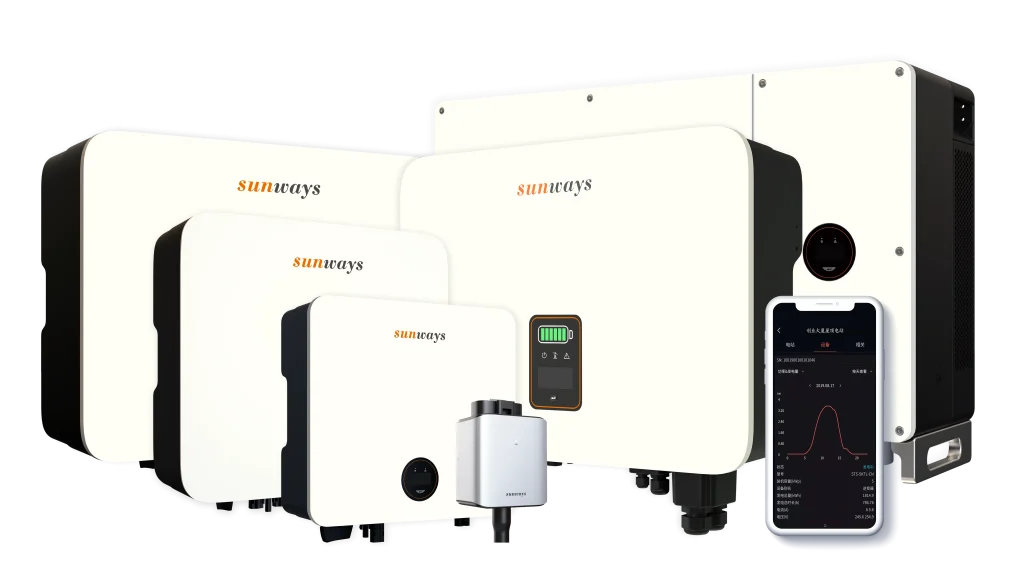
If you are planning a solar project for a factory, warehouse, hotel, office building, or other commercial and industrial (C&I) facility, please provide Sunways with the PV capacity, module specifications, grid type, and target market. We can use this information to verify the inverter power rating, MPPT configuration, PV input conditions, and key grid-connection requirements.
Start Your Project