On-Grid vs Off-Grid Inverter: Will Your Solar Keep Working in a Power Cut?
Table of Contents
During a power outage, standard grid-tied inverters cannot independently supply power to homes or businesses, even if there is sunlight during the day. Off-grid systems can provide power without a utility grid, but they require sufficient available energy and must be sized to match the actual load. When comparing on-grid inverters vs. off-grid inverters, the first consideration should be grid conditions and power supply objectives. Standard on-grid systems primarily use solar energy to meet daytime electricity needs and reduce the amount of electricity purchased from the grid. Off-grid systems, on the other hand, must independently handle the entire power supply.
If you are already connected to the grid but want lighting, refrigerators, or network equipment to continue operating during a power outage, you should evaluate hybrid inverters with backup capabilities and the corresponding systems. When selecting a system, first list the critical equipment and the required backup duration, then verify the battery capacity, backup output, and installation configuration. The following sections will compare these systems in terms of performance during power outages, battery requirements, and system costs to help you choose the right solution for your home, small business, or remote project.
On-Grid or Off-Grid? Here’s the Short Answer
When comparing on-grid inverters vs. off-grid inverters, you can start by choosing an approach based on the following three scenarios:
①. Grid access is available, and the primary goal is to reduce daytime electricity purchases; no backup power is needed during outages: Prioritize evaluating a standard on-grid inverter. For example, for retail stores open during the day, first verify whether electricity consumption during business hours matches solar power generation, then confirm local grid connection and surplus power handling requirements.
②. No grid access is available, and the building or site requires an independent power supply: Plan a complete off-grid system. Solar panels, batteries, and other backup power sources must be considered together. Selecting only an off-grid inverter will not solve energy supply issues during nighttime or prolonged periods of overcast or rainy weather.
③. Grid access is available, but critical equipment must remain operational during power outages: Prioritize evaluating hybrid inverters or energy storage solutions with backup capabilities. Have the installer specify which devices will be connected to the backup circuit and what switching or isolation configurations are required. Do not assume that simply because a model name includes “hybrid,” it can provide backup power for the entire home.
On-Grid vs Off-Grid Inverter: The Differences That Matter
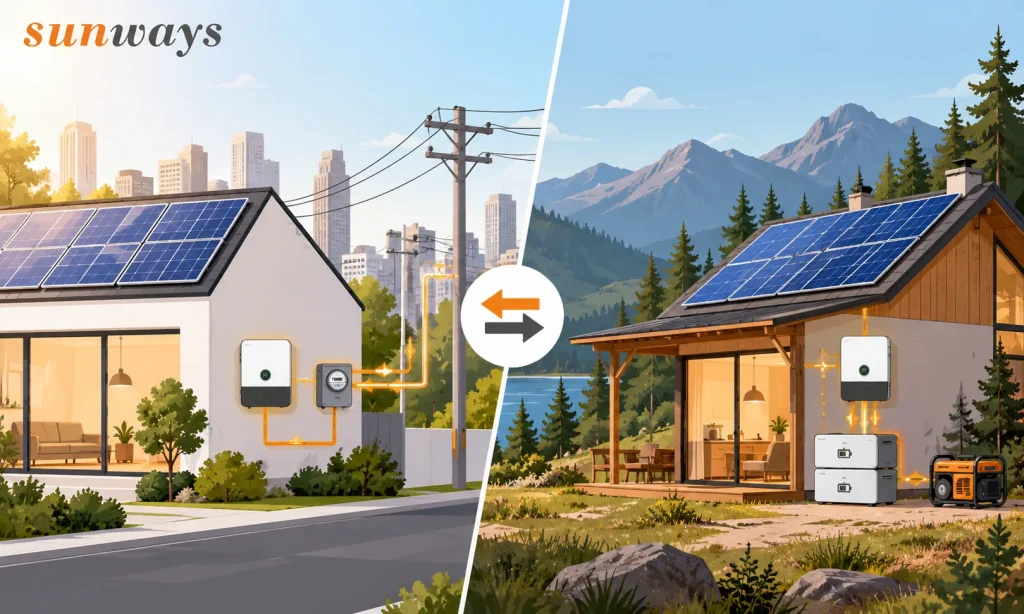
Grid-tied inverters (also commonly referred to as “on-grid” or “grid-tied”) operate in sync with the public grid, allowing solar power to be used locally and managing excess electricity according to connection requirements. Off-grid inverters are used for standalone power supply, and their supporting systems must independently meet the load’s power and energy demands.
| Comparison Criteria | Standard Grid-Tied System | Typical Off-Grid System | What You Need to Verify |
|---|---|---|---|
| Grid Connection | Relies on the grid to provide the voltage and frequency references required for operation. | Supplies power to independent loads. Some configurations can connect to the utility grid or a generator as an energy source. | Is a usable grid available at the project site? What connection methods does the equipment support? |
| Outage Behavior | Standard configurations do not provide independent backup power during grid outages. | Can provide independent power when properly configured, with sufficient energy storage and without exceeding system limits. | Which devices can the backup circuit support? How does the system switch between operating modes? |
| Battery Requirements | Pure grid-tied generation typically does not require a battery. | Nighttime or continuous off-grid operation typically requires energy storage or other power sources. | Do you only need daytime solar power, or do you also need energy supply at night and during low-generation periods? |
| Excess Power Handling | Can be used for self-consumption, exported to the grid, or limited according to system design. | Primarily supplies local loads and manages stored energy. Grid export capability depends on system configuration and regulations. | Confirm whether export is permitted and whether compensation mechanisms are available for excess electricity. |
| System Composition and Cost | Typically includes PV panels, inverters, protection devices and grid-connection equipment. Fewer components are required when no energy storage is included. | Requires additional energy storage, power control equipment or backup power sources depending on the application. | Does the quotation include batteries, auxiliary equipment, installation and commissioning costs? |
| Load Constraints | The grid can supplement PV shortages, but the system remains subject to grid connection and distribution conditions. | Must satisfy continuous power demand, equipment startup requirements and available energy capacity. | For loads such as air conditioners, pumps or motors, verify startup current and peak demand instead of relying only on rated power. |
| Future Expansion | Adding batteries later requires checking system compatibility and may require additional equipment or inverter replacement. | Adding PV, batteries or new loads requires re-evaluation of charging, output and control capabilities. | Ask suppliers to clearly define expansion conditions. Avoid assumptions such as "everything can be added later". |
This table compares standard grid-tied configurations with typical off-grid architectures; specific functionality depends on the equipment and system design.
When comparing quotes, request that both proposals clearly specify the same power supply objectives, load range, and backup duration, then determine which one meets your needs at a reasonable total cost.
Will Your Solar Work During a Power Cut—and Do You Need a Battery?
A standard grid-tied system cannot power your devices on its own during a power outage. Some off-grid or hybrid inverters can operate without a battery, but you must verify the specific model, power supply mode, and installation configuration. Just because you can use solar power during the day doesn’t mean you’ll have backup power at night.
1. Does an On-Grid Inverter Work During a Power Cut?
A standard grid-tied inverter typically stops outputting power after losing grid connection, even if sunlight is still hitting the roof.
It relies on the utility grid to provide voltage and frequency references. After losing grid connection, anti-islanding protection prevents the system from continuing to feed power into the downed utility lines. A standard grid-tied system is also not designed to establish an independent backup power grid on its own.
To continue using electricity during a power outage, you need a system capable of independent power supply, configured with safe grid isolation and backup circuits. Simply adding a battery does not automatically give a standard grid-tied system backup power capability.
2. Can an Off-Grid Inverter Work Without a Battery?
Some models can, but the term “off-grid” does not guarantee that it supports battery-free operation. You must also verify whether it can start up and power loads using only solar energy when neither the grid nor a battery is available.
Battery-free daytime backup does exist. For example, Fronius officially states that the GEN24 PV Point can provide up to 3 kW of basic backup power during sunny conditions by supplying power to selected single-phase loads through designated circuits. This feature has clearly defined output and wiring limitations. fronius.com
Battery-free daytime operation and reliable overnight backup power are two distinct requirements.
3. What Changes During Sunshine, Cloudy Conditions, and at Night?
The table below applies to systems that have been confirmed to support “battery-free, off-grid operation powered solely by solar.”
| Conditions During a Power Outage | Limits of Battery-Free Operation | What You Need to Confirm |
|---|---|---|
| Daytime, ample sunlight | Power supply may be available, but is limited by real-time PV generation and the backup output capacity of the inverter. | Which devices can be powered, and what are their minimum startup requirements? |
| Cloud cover, sudden drop in PV output | Power supply may be interrupted when PV output becomes insufficient. Recovery behavior depends on the specific inverter model and configuration. | Does the system restart automatically, and can connected devices tolerate a temporary interruption? |
| Nighttime | PV generation is unavailable. A battery or another available energy source is required to maintain power supply. | Available battery capacity or generator connection capability. |
| Motor startup (e.g., water pumps, refrigerators) | Instantaneous startup demand may exceed the available output power at that moment. | Startup current, peak output capability and allowable operating duration. |
Even with a battery, verify the power rating. Battery capacity determines how long it will last; the battery’s discharge capacity and the inverter’s backup output determine how many devices can be powered.
4. How Does Backup Power Reach Your Loads?
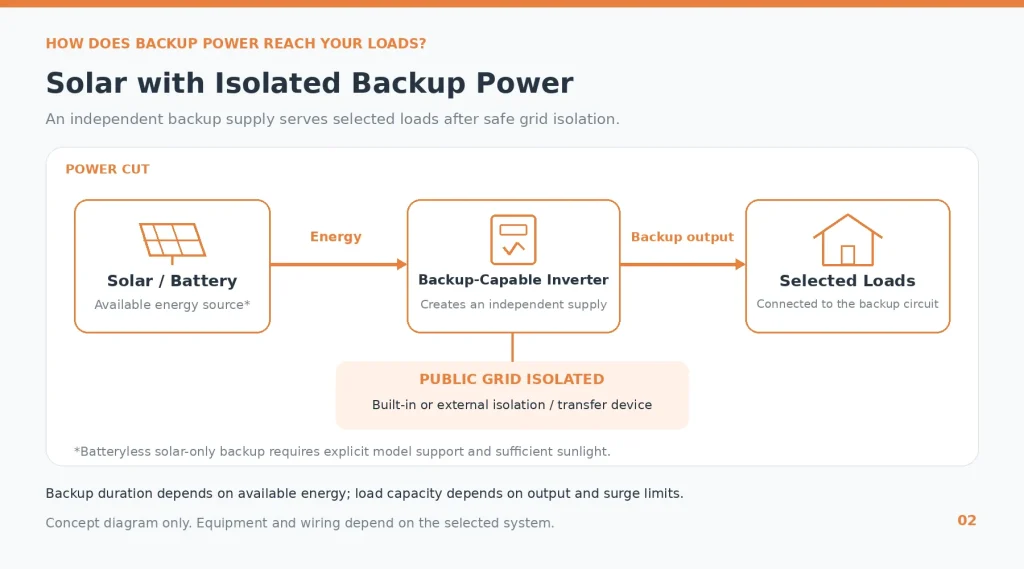
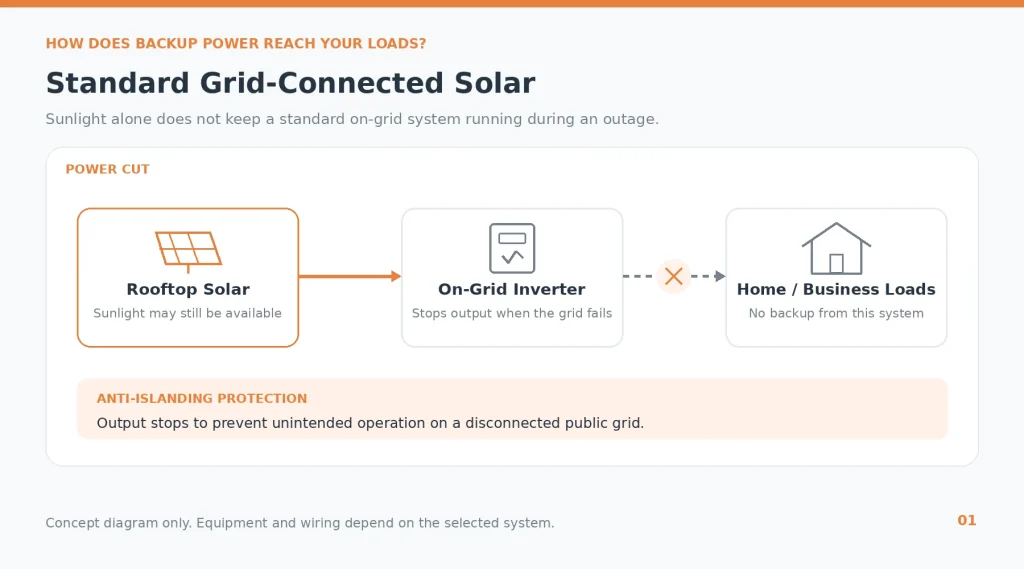
This is a functional diagram, not an actual wiring diagram. Isolation devices may be built-in or external, depending on the product configuration. Battery-less operation is only available on explicitly supported models.
5. Ask What Must Stay On—and for How Long
When selecting an inverter for power outages, I recommend first listing your critical equipment before discussing kW ratings. When requesting a quote, be sure to ask:
- Which devices need to be powered? List lighting, routers, refrigerators, and water pumps separately.
- For how long? For example, if the average critical load is 0.5 kW, running it for 4 hours requires supplying approximately 2 kWh to the load. When selecting a battery, also factor in energy loss and a reserve margin.
- Can the equipment be started? Verify motor starting requirements; do not simply add up the rated power listed on the nameplates.
- How is the switchover handled? Confirm the backup ports, single-phase or three-phase output, switchover time, and whether the quote includes isolation devices and circuit modifications.
The power figures above are for illustrative purposes only and do not represent product test data. If you require continuous backup power at night or on cloudy days, you should prioritize evaluating a comprehensive battery backup solution.
Compare System Costs—and the Power You Get for Your Budget
If you have a stable grid and only want to reduce daytime electricity costs, prioritize comparing grid-tied solutions without batteries; if you need to keep critical equipment running during power outages, compare complete backup solutions that include batteries, transfer switches, and installation; if there is no grid, evaluate off-grid solutions based on your 24-hour electricity needs and power requirements during periods of low generation. To determine which quote offers better value, first confirm that they can power the same equipment, provide the same runtime, and include the same scope of installation.
What Should the System Quote Include?
You are comparing the cost of a fully installed system that meets your electricity needs. Ask suppliers to itemize equipment, installation, and commissioning costs, and specify which items require additional payment. Subsequent maintenance and energy costs should also be factored into the total cost.
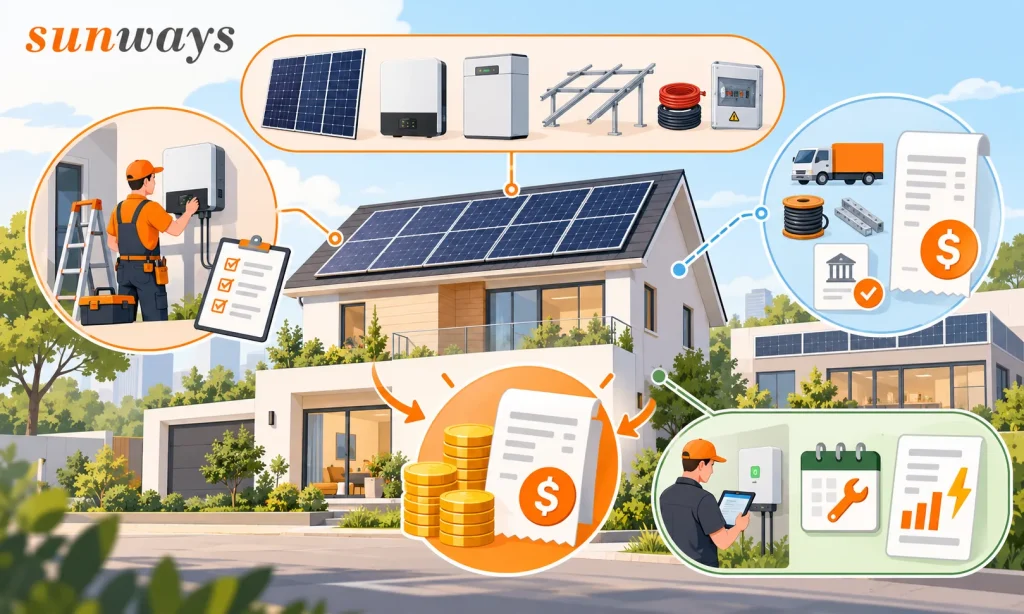
1. Solar Panels and Inverter
If you only want to reduce daytime electricity purchases, the solar panels and inverter should be configured based on daytime power needs and grid-connected conditions. If you also need backup power during outages, confirm which devices the inverter can power and whether it can connect to your chosen battery. For off-grid projects, you must also evaluate power supply capacity during low-generation seasons; do not base your selection solely on performance on sunny days.
2. Battery Storage
If the goal is solely to reduce daytime electricity purchases, a battery is typically not required; however, if nighttime power or backup during outages is needed, the system should be configured based on the power consumption of your devices and the desired runtime. When comparing batteries, in addition to the rated capacity, consider the actual usable energy and output power: the former affects how long the battery will last, while the latter affects how many devices it can power simultaneously.
3. Protection and Switching Equipment
Quotes should include necessary electrical protection devices. If you require backup power during outages, you must also confirm how the system will safely disconnect from the public grid and which circuits will be connected to the backup power source. Related devices may be built-in or require separate purchase; ask the supplier to clarify this. When planning to connect a generator, also verify the costs of connection and control equipment.
4. Installation and Commissioning
Installation costs go beyond simply mounting the equipment; they may also include cable laying, battery connections, and modifications to the power distribution circuits. Commissioning involves verifying that the equipment operates properly and testing the emergency power transfer function as agreed. A quote that simply lists “inverter + battery” may not necessarily include these tasks. When requesting a quote, be sure to confirm the final scope of delivery.
5. Maintenance and Replacement
In addition to the purchase price, you must also consider the costs of inspections, repairs, and equipment replacement during the system’s service life. Batteries gradually lose capacity over time, so you cannot assume they will always provide the same backup duration as new batteries. When comparing proposals, verify the warranty coverage, repair responsibilities, and who will bear the costs of future equipment replacement.
6. Backup Power
If the system requires a generator to supplement power, the costs of fuel, maintenance, and repairs must be factored in. For 24/7 off-grid projects, it is especially important to clarify how power will be supplied during prolonged periods of rain or overcast weather. Considering only the purchase costs of the solar panels and batteries may underestimate the long-term expenses required to maintain a reliable power supply.
7. Electricity Tariffs and Export Payments
When calculating electricity cost savings, distinguish between the price you pay to purchase electricity from the grid and the compensation you receive for feeding excess electricity back into the grid—the two are not necessarily the same. The PV electricity you consume yourself reduces your electricity purchases, while excess electricity fed into the grid is settled according to local regulations. Please verify rates and conditions with your local utility company or based on a valid contract.
How Much Energy Do Your Essential Loads Need?
Energy required = Average power consumption × Backup duration. First, list the devices that must remain operational during a power outage, then perform the calculation. The following is a hypothetical example:
| Average Power Consumption | Backup Duration | Energy Required for Load |
|---|---|---|
| 0.5 kW | 4 hours | 2 kWh |
| 2 kW | 4 hours | 8 kWh |
kW represents power consumption, while kWh represents the amount of electricity used. For the same 4-hour backup period, if the power consumption increases fourfold, the energy requirement also increases fourfold. Powering only essential equipment can reduce the required battery capacity.
The required energy does not equal the battery’s rated capacity. When selecting a battery, you must also account for energy loss and reserve capacity, and verify the output power and motor startup requirements. Having sufficient energy does not guarantee that all devices can be powered.
How Do You Calculate the Required Battery Capacity?
So how do you determine the rated battery capacity you need? First, calculate how much energy your devices require, then consider how much the battery can discharge and how much energy is lost during the power supply process. A preliminary estimate can be used:
Nominal Battery Capacity (kWh) = Power Required by the Load ÷ Utilization Rate ÷ Discharge Efficiency
For example, if you need to run a 0.5 kW average load for 4 hours, the load requires 2 kWh. Assuming the battery is fully charged at the start of the power outage, only 80% of its capacity is used, and the efficiency of power delivery from the battery to the equipment is 90%:
2 ÷ 80% ÷ 90% ≈ 2.8 kWh
This means that, under these assumptions, a preliminary calculation indicates a required nominal capacity of approximately 2.8 kWh. The values of 80% and 90% are used for illustrative purposes only; actual figures should be verified based on the selected equipment and operating conditions. Manufacturer’s selection guides also take into account the allowable discharge range and system losses.
It is especially important to confirm how much charge remains in the battery during a power outage. If the battery is down to 60% and stops discharging at 20%, only 40% of the capacity is available for this backup period—you cannot continue to calculate based on 80%. The usable range is subject to charge level settings and device protection limits.
Which Inverter Fits Your Home, Small Business or Remote Property?
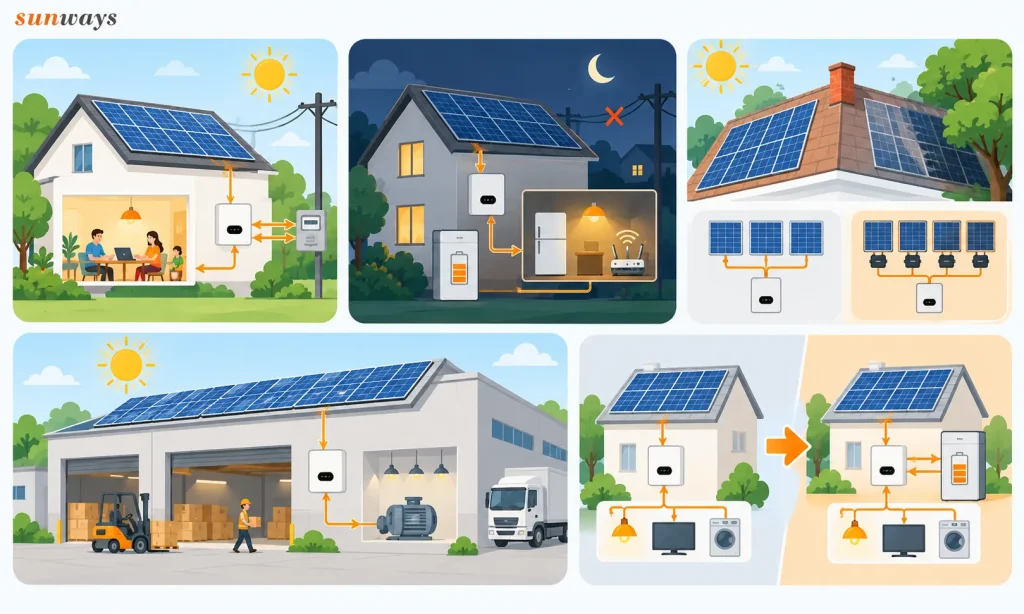
a. Your home is connected to the utility grid, and your main goal is to reduce daytime electricity purchases
If you have access to the utility grid and don’t need a backup power supply in case of outages, prioritize evaluating grid-tied inverters. Grid-tied means integrating your solar system with the public grid to provide power. When selecting a system, first determine your actual daytime electricity consumption, then verify local grid-tied requirements and how excess electricity is handled. If your household primarily uses electricity at night, don’t assume that a standard grid-tied system is the best option just because your monthly electricity bill is high. You need to reassess your options by considering daytime self-consumption, surplus electricity settlement, and nighttime electricity purchases. A standard grid-tied configuration also cannot directly meet backup power needs during a power outage.
b. Residential property connected to the grid, but critical equipment must be protected during power outages
In this scenario, it’s worth prioritizing the evaluation of hybrid inverters with backup functionality and energy storage systems. Hybrid inverters typically coordinate solar power, batteries, and the utility grid; energy storage involves saving electricity for use when needed. Critical loads are devices that must continue operating during a power outage, such as lighting, refrigerators, and routers. Have the installer clarify which devices will be connected to the backup circuit, how long they can be sustained, and how the switchover and grid isolation will be implemented. If air conditioners or water pumps must also run, include them in your calculations. The term “hybrid” does not guarantee that any configuration can provide whole-house backup power, nor does it mean the system can operate completely off-grid for extended periods.
c. Small Businesses with High Daytime Electricity Consumption
If your business operates primarily during the day and you can tolerate a temporary interruption in power during outages, start by evaluating a standard grid-tied system. Matching actual electricity consumption during business hours with the periods when solar power is generated is more useful than simply looking at the total monthly electricity bill. If a power outage would affect the cash register, internet connection, or equipment requiring continuous cooling, evaluate a suitable energy storage backup solution and separate your daily total electricity consumption from the consumption that must be maintained during an outage.
For equipment that must run continuously, also confirm the acceptable downtime; having a backup function does not mean there will be absolutely no interruptions. For equipment such as air conditioners and water pumps, verify the startup power—that is, the power demand at the moment of startup—rather than selecting models based solely on normal operating power.
d. Remote Residences Without Access to the Public Grid
In this scenario, plan for a complete off-grid system; simply purchasing a single off-grid inverter is insufficient. Off-grid means the system must provide power independently without support from the public grid. You need to provide information on daily electricity consumption, nighttime electricity consumption, devices that operate simultaneously, and whether the home is used occasionally or as a permanent residence. Then, have the installer design the system based on local year-round power generation conditions, periods of continuous rain or cloud cover, available battery energy, and necessary backup power.
Configuring the system based solely on power generation on sunny days will overlook power supply needs during nighttime and adverse weather conditions. If a grid is available but power outages occur only occasionally, you should generally first evaluate a grid-tied system with a backup configuration.
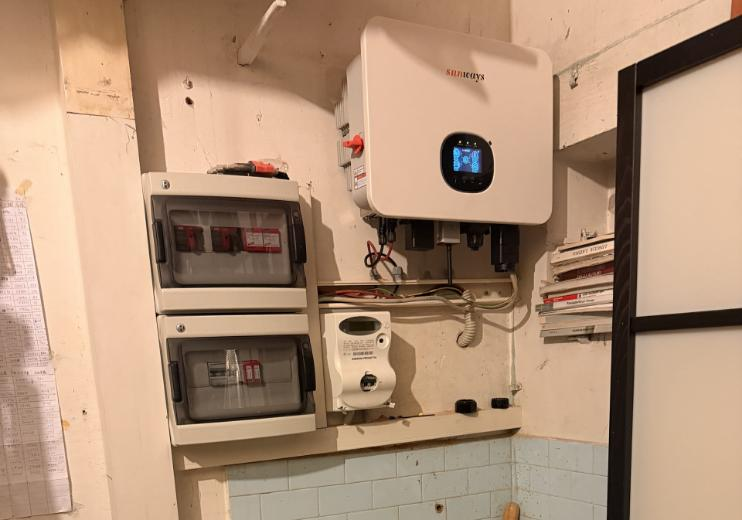
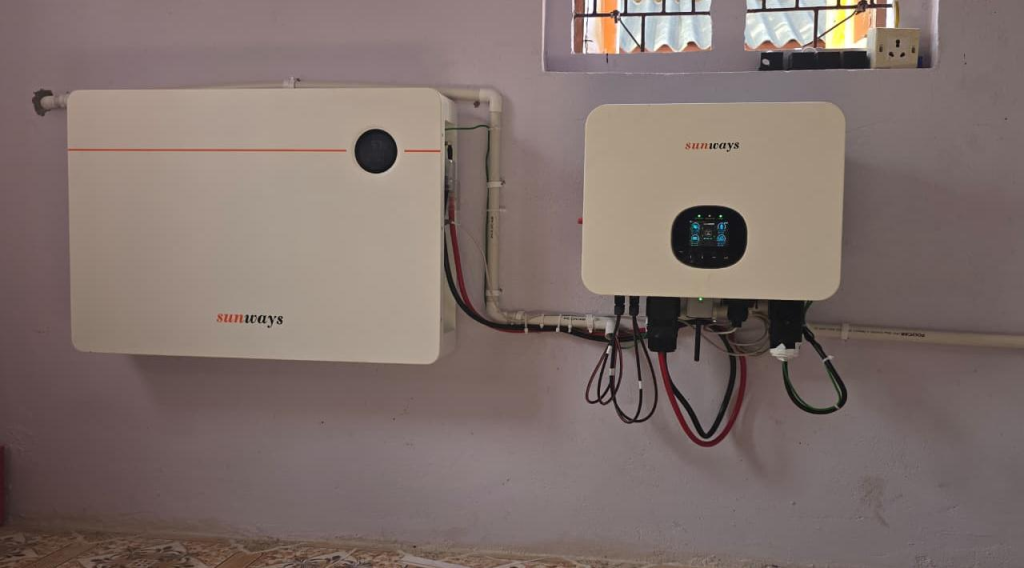
Real Sunways Installations: What to Check for Your Own Project
Confirm Three Things for Your Project
① First, clarify grid connection and surplus power objectives. Tell the installer whether your site has access to the utility grid, whether you plan to retain grid power, and whether you intend to feed excess solar power into the grid or limit exports. This is necessary to verify the corresponding connection requirements. Note in particular that not feeding power into the grid does not mean the system can operate off-grid independently.
② Next, provide a list of time-of-day electricity usage and critical equipment. Loads refer to devices that require power; critical loads are those that must continue operating during a power outage. Separate daytime, nighttime, and outage-period demands, specifying which devices will operate simultaneously and for how long. For example, keeping lighting and routers on standby, versus requiring air conditioners and water pumps to run simultaneously, are two distinct design requirements.
③ Finally, verify the power and available energy separately. Power is expressed in kW and determines which devices the system can support simultaneously; energy is expressed in kWh and determines how long the system can sustain power supply under given electricity demands. Require the installer to verify the operating power, startup requirements, and backup time based on your equipment list before finalizing the configuration. Do not assume that a solution from an existing project is suitable for you simply because it meets a certain capacity figure.
Can You Add Batteries Later? Questions Before You Upgrade
1. Can I Add Batteries to an Existing Grid-Tied Solar System?
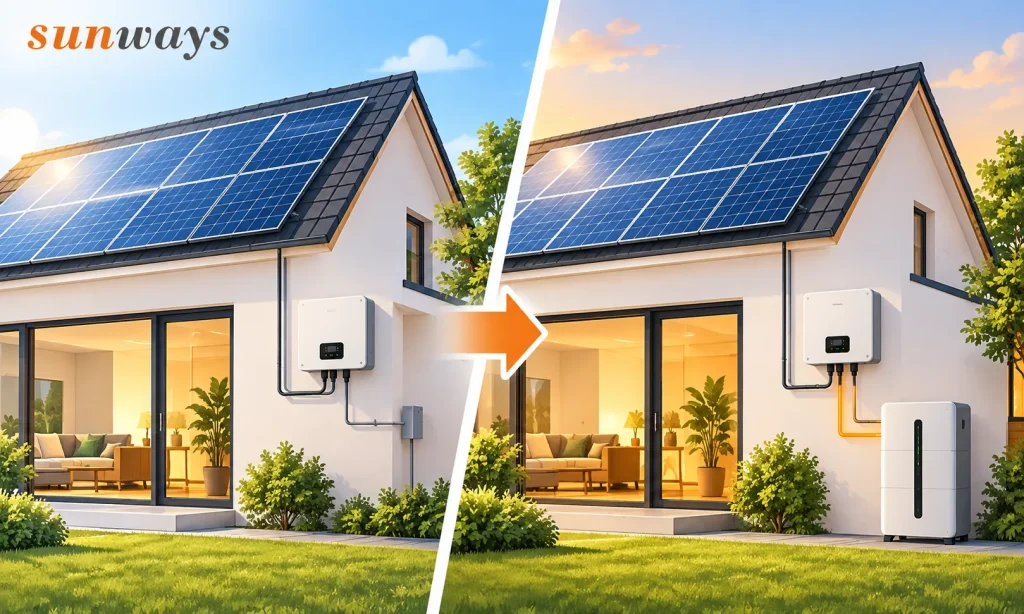
Energy storage can be added through an appropriate solution, but the original grid-tied inverter may not directly support batteries. You can consider keeping the original PV inverter and adding a battery inverter and compatible batteries, connecting the storage system on the AC side—a configuration known as AC-coupled. Before making a decision, provide the existing model, wiring diagrams, and electricity consumption data so the installer can verify compatibility, control methods, and backup configurations. While the system can be retrofitted, this does not mean the batteries can be directly connected to the original inverter.
2. Do I Need to Replace My Existing Inverter?
Not necessarily; it depends on whether retaining the original unit can meet your goals. Have the installer evaluate both options—“retaining the original inverter and adding energy storage” and “replacing it with a suitable hybrid inverter”—and clearly outline the new equipment, installation modifications, total costs, and functionality for each. Just because the original inverter still works doesn’t automatically mean retaining it is the best choice; if you replace the inverter, you must also verify that the existing PV and battery configurations are compatible.
3. Does Zero Export Mean My System Is Off-Grid?
No. Zero export is an export control feature designed to prevent the feeding of electricity back into the public grid. The system may still be connected to the grid and draw power from it when PV or energy storage is insufficient. Off-grid operation focuses on the ability to provide independent power. Therefore, “support for zero export” does not guarantee power supply during a power outage; backup output, switchover, and grid isolation must be verified separately.
4. Can I Use Any Battery with My Inverter?
Not all batteries are compatible by default, and voltage matching alone is not a sufficient criterion. You must also verify the manufacturer-approved battery models, communication protocols, and software and hardware versions. The BMS (Battery Management System) monitors the battery’s status and provides protection; it must work with the inverter in the supported manner. Sunways lists BMS data, software, and incompatibility with certain battery brands as factors to check for communication failures. Therefore, you should ask the supplier to confirm the specific equipment combination before purchasing.
5. Will My Existing PV Inverter Keep Working During an Outage After a Battery Retrofit?
Not necessarily; installing a battery storage system does not automatically enable the original PV inverter to participate in backup operation. If you want to continue using PV power or charge the battery during a power outage, you need to confirm whether the original inverter is part of the designed backup circuit, whether it can operate within that backup system, and whether its output power can be properly controlled.
6. Can I Add More Batteries Later?
Some modular battery systems support capacity expansion, but there is no guarantee that any system will allow batteries to be added at any time. Before purchasing, ask the supplier to specify the number of modules that can be added, the inverter’s support range, compatibility requirements between new and existing batteries, and whether additional equipment or software adjustments are needed. Increasing the number of batteries does not automatically mean you can run more high-power devices simultaneously; you must also verify the system’s output capacity.
Can You Add Batteries Later? Questions Before You Upgrade
When comparing on-grid inverters vs. off-grid inverters, first consider your power supply needs. If a grid is available and your primary goal is to reduce daytime electricity purchases without requiring backup power during outages, prioritize a standard grid-tied solution. If no grid is available, plan for a complete off-grid system. If a grid is available but critical equipment must remain operational during power outages, evaluate a hybrid energy storage solution with sufficient backup capacity.
When preparing for a consultation, you don’t need to have a specific model in mind. Just tell us the project location, grid conditions, and your day-and-night electricity needs, as well as which devices must remain operational during a power outage and for how long. Also, provide details on existing equipment, your budget, and the project stage; we can finalize the complete equipment list during our follow-up discussions.
Ready to plan a solar system for your home? Learn about Sunways’ residential solutions and share your project requirements via the inquiry form on this page to start discussing the right configuration for you.
Start Your Project