Types of Solar Inverters: Which One Do You Really Need?
Table of Contents
When choosing a solar inverter, first consider whether you require a battery and backup power supply in the event of a power cut. If you have access to the grid and primarily rely on photovoltaic power generation, with no immediate need for energy storage or backup power, you may wish to consider a grid-tied inverter; if you wish to use a battery to store electricity generated during the day for use at night, you should give priority to a hybrid inverter; if there is no accessible grid, the system must be designed as an off-grid power supply system. If you require backup power during power cuts, you must also verify the inverter’s backup capabilities, battery configuration and load capacity; do not rely solely on the term ‘hybrid’.
Next, consider your roof and project conditions to select a string inverter, microinverter or central inverter architecture. These fall under different classification categories from grid-connected, off-grid and hybrid systems, and may overlap. For example, an inverter can be both ‘hybrid’ and ‘string-type’ at the same time; you do not need to choose between the two.
Your decision-making process can be summarised as follows: first, determine your grid, energy storage and backup power requirements; next, compare roof suitability with the inverter architecture; and finally, verify the specific model. It is particularly important to distinguish between the following: support for battery connection does not equate to support for off-grid power supply; nor does support for off-grid power supply guarantee the ability to power all appliances in the home.
On-Grid vs Off-Grid vs Hybrid: Start with Your Power Needs
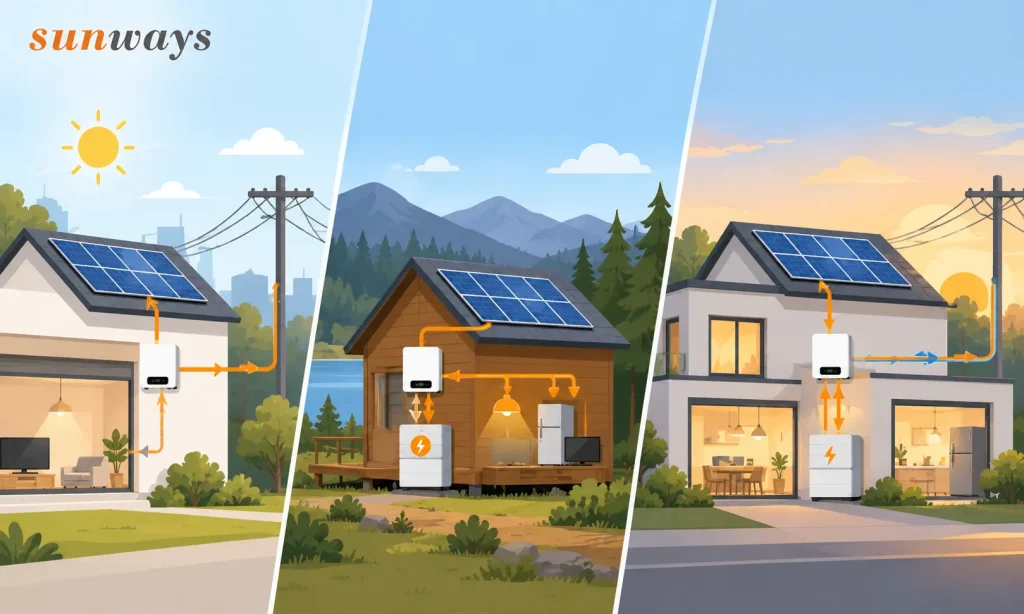
Whether it is worth investing in additional energy storage depends on whether you need to save electricity for later use or to maintain a power supply during power cuts. When comparing these three options, first clarify your power supply objectives, then review the full system quotation. Comparing only the price of the inverter can easily lead to overlooking the costs of batteries, switching equipment and electrical distribution modifications.
| Comparison Criteria | Standard Grid-Connected System On-grid | Off-grid System | Hybrid System |
|---|---|---|---|
| Grid Connection | Operates on the grid; the grid supplements power when generation is insufficient | Stand-alone power supply; some systems can be connected to a backup AC power source | Coordinates solar, batteries and the grid according to supported modes |
| Battery Management | Standard pure PV grid-connected inverters do not typically manage batteries directly | Energy storage and charging control configured according to load and supply periods | Verify compatible batteries and charge/discharge modes |
| Power Supply During Outages | A standard grid-connected solution alone cannot provide backup power | Depends on the system’s energy reserves and output capacity | Requires appropriate backup power functionality, supporting equipment and circuits |
| Key Quotation Considerations | Inverters, protection equipment, installation and grid connection | Energy storage, charging control, necessary backup power and O&M | Batteries, metering control, transfer switches and power distribution works |
Swipe horizontally to compare all system types.
When Grid-Tied Is Sufficient
Where a grid is available, electricity consumption is primarily during the day, and there is no need for battery storage or backup power during power cuts, a standard grid-tied solution should be prioritised. For example, shops open during the day and factories operating during daylight hours can initially utilise solar power to meet their immediate electricity needs, without needing to install energy storage simply for the sake of ‘additional functionality’.
Before selecting a system, confirm two points: how much solar power the daytime load can absorb, and whether surplus electricity can be fed into the grid and how this will be settled. If you also require a continuous power supply during power cuts, a standard grid-tied solution alone will not suffice, and a separate assessment of backup power provision will be necessary.
When to Consider a Hybrid System
If you wish to store surplus electricity generated during the day, or require backup power in the event of a power cut, you should prioritise evaluating hybrid solutions capable of meeting these requirements. For self-consumption of stored energy, consider the amount of surplus electricity and evening electricity consumption; for power cut backup, consider critical loads and the target power supply duration. These two requirements cannot be addressed using a single inverter power rating.
When requesting a quotation, ask the supplier to clearly specify compatible batteries, the backup power range, and whether switching equipment and installation are included in the quote.
When the Site Needs Stand-Alone Power
Where there is no accessible grid, prioritise confirming whether the system can provide long-term independent power supply. The design must take into account night-time, periods of low sunlight and equipment start-up requirements; it must not be based solely on power generation on sunny days.
Ask the designer to answer the following three questions:
- What will maintain power supply when generation is insufficient?
- Which loads must be shut down once the battery reaches its minimum discharge level?
- Is a backup power source required, and how will it be connected?
To determine whether a hybrid inverter is suitable for this scenario, its standalone operation capability must be verified. Support for short-term backup power does not, in itself, constitute sufficient grounds for deeming the system suitable for long-term off-grid operation.
Same Power Rating, Different Functions
String, Microinverter or Central: What Changes in the Design?
The main difference between string, micro and central inverters lies in where the conversion from direct current to alternating current takes place. ‘Hybrid’ refers to energy storage functionality, which can co-exist with a string architecture. Therefore, ‘string or hybrid’ is not a case of choosing one or the other.
String Inverters vs Microinverters
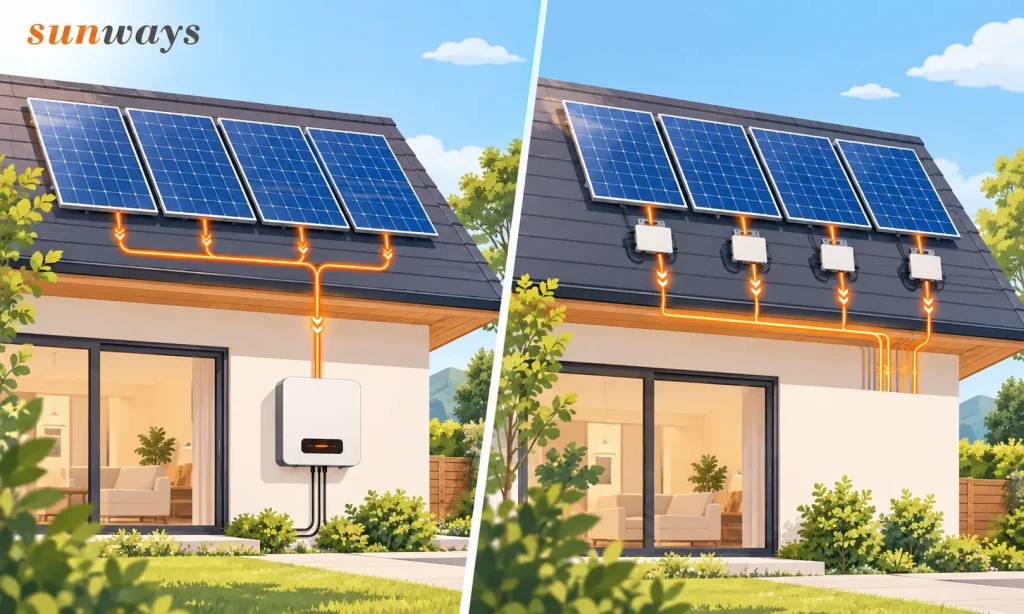
If your roof layout is regular, it is advisable to assess string inverter solutions first; if the roof is fragmented, has complex orientations, or if you need to monitor the performance of individual modules, you should then focus on comparing microinverter and optimiser solutions. Multi-orientation roofs can also utilise string inverters with multiple MPPT channels; the key lies in how the modules are grouped and whether the inputs for each channel are matched.
The table below can help you with an initial screening:
| Architecture | Project Conditions | Design Considerations: Conversion and Control/Monitoring | Maintenance Trade-offs and Impact of Faults |
|---|---|---|---|
| String inverter | Residential and commercial/industrial roofs; modules can be grouped appropriately | After modules are connected in series, the inverter performs the DC–AC conversion. MPPT is controlled per input channel; monitoring typically occurs at the unit, MPPT or string level, depending on the model. | The main unit can be positioned in a location convenient for maintenance. A single unit shutdown will affect the modules connected to that unit; in multi-unit systems, not all units will necessarily cease generation. |
| Microinverter | Projects with scattered rooftop installations, multiple orientations, or a focus on module-level monitoring | DC–AC conversion takes place near the modules. Verify the number of connected modules per unit, the number of independent MPPT channels, and the level of monitoring detail. | Equipment is distributed across the roof; replacement usually requires access to the roof. A single unit failure typically affects the modules connected to it; however, a fault in the shared AC circuit may still affect a wider area. |
| String + optimisers | Projects seeking to retain a string architecture whilst adding module-level optimisation capabilities | Optimisers handle DC–DC regulation, whilst the inverter handles DC–AC conversion. Verify compatibility, string length and monitoring configuration. | Both rooftop optimisers and the inverter require maintenance. The main inverter remains the common conversion point; the impact of an optimiser failure depends on the system design. |
| Central inverter | Suitable for projects such as large-scale ground-mounted power stations that require centralised power collection and unified operation and maintenance | DC–AC conversion is carried out centrally after power from multiple strings is consolidated. Control is primarily managed by the central unit; string monitoring can be achieved using equipment such as combiner boxes. | Equipment is centralised, but maintenance relies on specialist O&M personnel and spare parts. The shutdown of a single conversion unit may affect a large section of the array. |
Do not treat a power optimiser as a fourth type of standalone inverter. It handles DC optimisation, and its output remains DC; the system still requires an inverter to perform the AC conversion. Nor should you assume that ‘one optimiser connects to only one module’: for example, the SolarEdge S1000/S1200 is designed to connect to two modules, so you must check the specific wiring rules when selecting a model.
For a more detailed comparison, please read String Inverter vs Microinverter.
Where Central Inverters Fit
Central inverters are primarily used in large-scale projects, but ‘commercial and industrial rooftops’ do not necessarily equate to ‘centralised’ systems. SMA’s product specifications cover both string inverters for commercial projects and central inverters for large-scale power stations. One cannot simply draw a line based on a single capacity figure.
For your project, a more useful assessment would be: whether the array is centralised, whether the DC consolidation is appropriate, and how much generation capacity would be affected by a single outage. If the rooftops are spread across multiple buildings, you should include multiple string inverter solutions in your comparison.
Is a Hybrid Inverter Also a String Inverter?
Yes. The PV side of a hybrid inverter can certainly utilise a string design. ‘String’ refers to how the modules are connected to the conversion system; ‘hybrid’ indicates that the equipment integrates both PV and battery conversion functions. SMA’s hybrid inverter products, for example, feature both PV input and battery connections.
When requesting a quotation, it is advisable to record your requirements under two separate headings:
- PV architecture: How are the modules grouped? How many independent MPPT channels are required? How detailed should the monitoring be?
- Energy storage functionality: Will a battery be connected? Which batteries are compatible? Which loads need to be powered during a power cut?
For example, you might opt for a “string-based PV design + hybrid inverter + battery compatibility”. Confirm the roof installation first, then determine how the battery will be utilised; this will prevent confusion when comparing different quotations.
Need Power During an Outage? Check More Than “Hybrid”
Do Grid-Tied Solar Inverters Work During a Power Cut?
Standard grid-tied solar systems usually stop supplying power after a power cut, even if there is still sunlight on the roof. This is due to anti-islanding protection, which prevents the system from continuing to feed electricity into the public grid that has lost power.
To continue supplying power during a power cut, the system must be able to safely isolate itself from the public grid and establish an independent voltage and frequency. Simply adding an off-grid switch does not automatically give a standard grid-tied inverter backup power capability.
Below is a diagram illustrating the backup power functionality for critical loads:
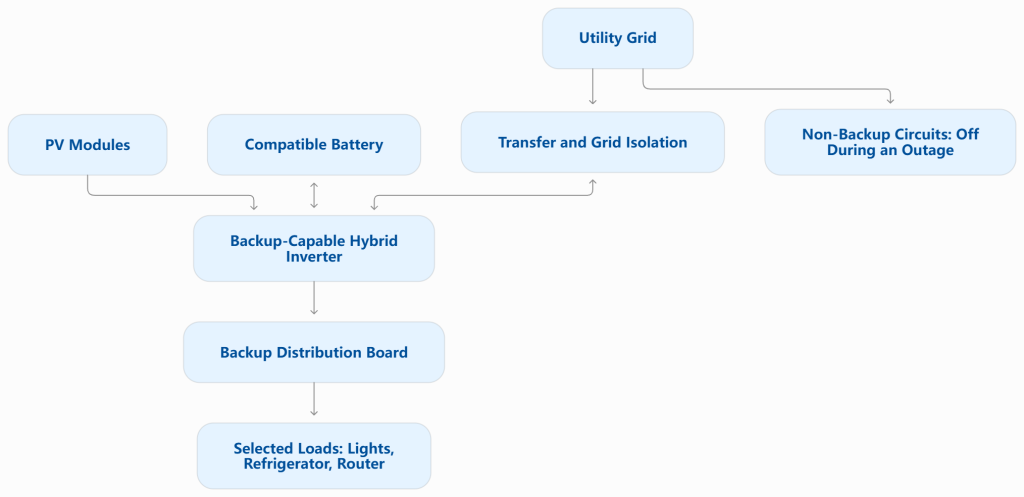
The transfer and isolation devices may be built-in or may need to be supplied separately. This diagram illustrates the functional relationships only; actual wiring should be designed in accordance with the installation manual for the specific model.
Can a Hybrid Inverter Operate Without a Battery?
Some models can operate on the grid without a battery, but this does not mean they can provide emergency power during a power cut without a battery. You need to consider two separate issues:
- When the grid is operational: Without a battery, can the system utilise PV power and operate normally on the grid?
- During a power cut: Without a battery, is there still an available emergency power output? What are the power, sunlight and start-up conditions?
Specialised PV emergency power supply functions do indeed exist. For example, Fronius distinguishes between the ‘PV Point’ basic backup and ‘Full Backup’ in its specifications, and explicitly states that its ‘Full Backup’ requires a battery and a safety grid disconnection switch. This illustrates that backup capability should be assessed based on specific modes and configurations, and cannot be inferred from the product name alone.
Does a Hybrid Inverter Provide Whole-House Backup?
Not necessarily. Only appliances connected to the backup power circuit will be able to continue operating after a power cut; whole-house backup must also meet requirements for total load, inrush current and battery capacity.
If your aim is to maintain lighting, the fridge and internet connectivity, prioritising critical load circuits makes it easier to manage capacity and costs. If you wish to continue using air conditioning, water pumps and kitchen appliances as well, you will need to verify their requirements when operating simultaneously and during start-up. Connecting the entire house to the backup power supply does not mean that all appliances can operate at full load simultaneously.
Taking the Sunways STH-6KTL-LS as an example, the two fields in the data sheet should be interpreted as follows:
| Official Field | Value | What this means for your selection |
|---|---|---|
| Output (Back-up) → Rated Output Power | 6,000 W | Used to verify continuous load. Actual available power is also subject to battery discharge capacity, PV input and operating conditions. |
| UPS Switching Time | <10 ms | Used to assess the switching process; it cannot be used to determine battery runtime, nor does it guarantee absolutely uninterrupted power for all equipment. |
In addition to these two figures, you should also ask the installer to confirm:
- Start-up capacity: How much power is required when motors and compressors start up? What is the short-term peak power during backup, and for how many seconds can it be sustained? Do not mistake the peak value for continuous output.
- Available power: How much battery charge remains when a power cut occurs? After deducting the minimum reserve charge and conversion losses, how much power can be delivered to the load?
- Circuits and switching: Which circuits are connected to the backup power supply? Are the isolation devices complete? Has practical verification been carried out for equipment sensitive to switching?
6,000 W answers the question ‘how much load can it support’, whilst <10 ms answers ‘how fast is the switchover’; neither can directly answer ‘how many hours of runtime can be expected’.
When requesting a quotation, please provide a list of equipment specifying operating power, start-up requirements, whether they will be used simultaneously, and the target backup runtime.
Shaded or Split Roof? Check the Layout Before the Label
The fact that a roof has multiple orientations does not necessarily mean that micro-inverters must be used; nor does partial shading mean that a string-based solution is unsuitable. First, consider whether the modules can be reasonably zoned, then compare independent MPPT, module-level control and maintenance costs.
Multiple Roof Orientations Are Not the Same as Module-Level Shading
Different orientations primarily affect the periods of sunlight received by each group of modules; localised shading, on the other hand, may cause variations in operating conditions among modules within the same string. These two situations require separate assessment.
| Roof Conditions | Priority Checks | Selection Approach |
|---|---|---|
| East and west roofs, each with relatively uniform sunlight | Can the number of modules on each roof form suitable strings? | First assess a string-based solution with separate MPPT connections |
| Partial shading of modules by chimneys, trees or parapets | Which modules are shaded, for how long, and how this varies by season | First adjust module positioning and grouping, then compare string-level shading management with micro-inverters or optimisers |
| Multiple small, scattered roof areas with significant variations in the number of modules | Can each section meet the start-up voltage and MPPT operating range requirements? | If it is difficult to form reasonable strings, include module-level solutions in the comparison |
For example, the east and west roofs can first be assessed as follows. When there is shadow from the chimney on the west side, the affected modules must also be analysed separately:
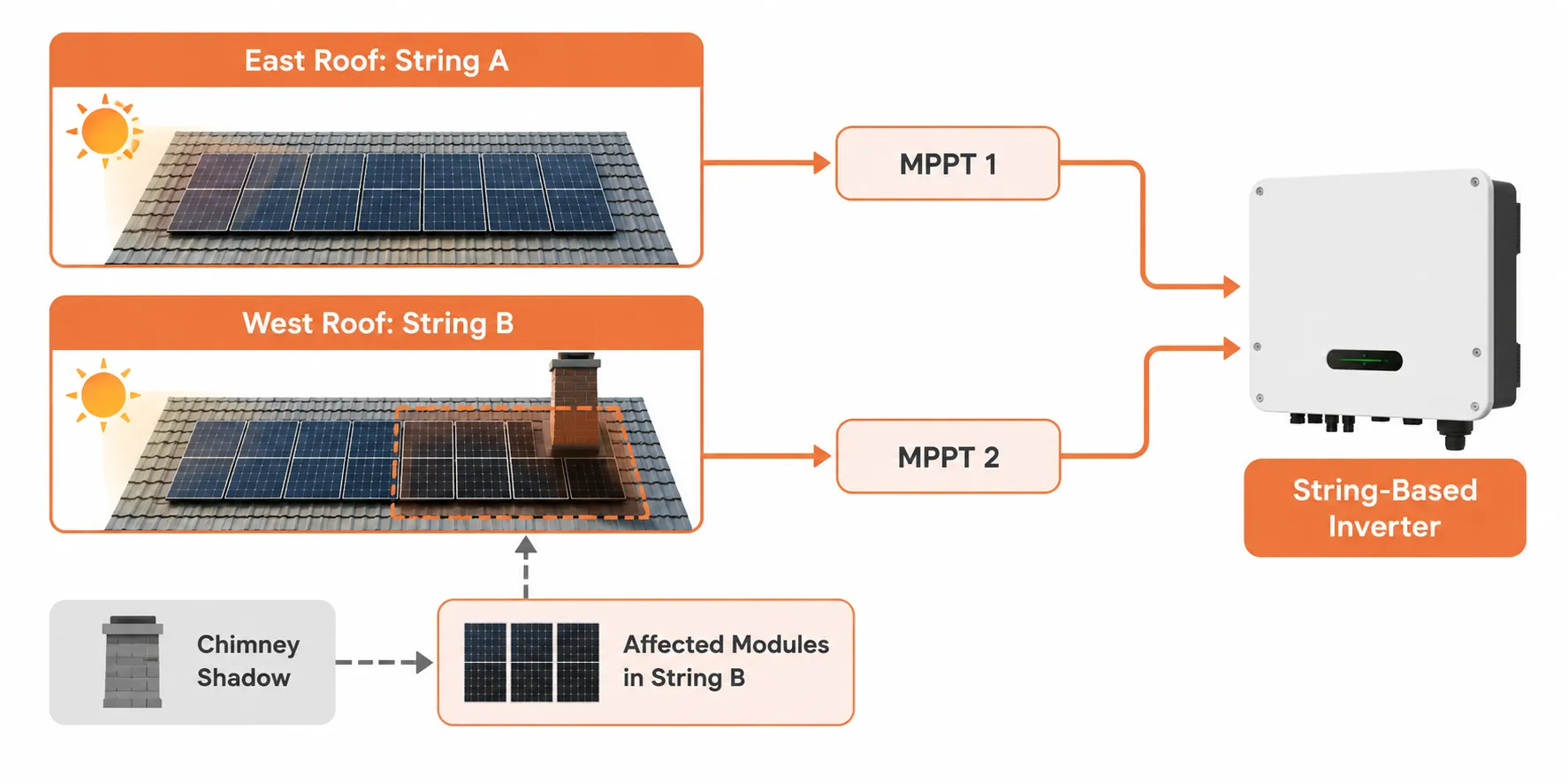
This is a schematic representation of the zones and is not a standard wiring diagram. Independent MPPT units can track different zones separately, but each module within the same string must not operate independently. Specific grouping still requires verification of voltage, current and module configuration.
MPPT Count Is Not String Input Count
The MPPT count refers to the number of independent tracking channels, whilst the string input count refers to the number of strings that can be connected. The two should not be confused.
An inverter may allow multiple strings to share a single MPPT. These strings share the tracking operating point, which does not mean that each string can be adjusted independently. Therefore, when reviewing the specifications, you should check the following simultaneously:
- No. of MPP Trackers: How many independent tracking channels are there?
- Strings per MPPT: How many strings can be connected to each channel?
- Electrical Limits: Is the string voltage suitable? Does the current exceed the limit when connected in parallel?
Taking two Sunways models as examples:
| Model | Product Category | No. of MPP Trackers |
|---|---|---|
| STS-6KTL-SE | Grid-connected inverter | 2 |
| STH-6KTL-LS | Low-voltage hybrid inverter | 2 |
Both list 2 MPPT channels, indicating that ‘whether energy storage is supported’ and ‘how roof sections are managed’ are separate issues. This does not imply that their power generation performance is identical, nor does it mean that any two sets of modules can be connected or that all shading issues can be resolved.
For a deeper understanding of these parameters, please refer to MPPT Solar Inverter.
Compare Shading Benefits with Maintenance Costs
When there are significant differences in sunlight exposure between modules, it is worth comparing micro-inverters or optimisers, but do not treat them as devices designed to eliminate shading. Module-level control can reduce some mismatch losses, but it cannot compensate for sunlight that is blocked.
Ask your installer to compare the estimated annual energy yield and total costs based on the same roof layout. In addition to equipment and installation costs, ask: Is the equipment on the roof easily accessible in the event of a fault? Does replacement require removing modules, erecting scaffolding or using lifting equipment?
Before requesting a quote, prepare the following three items of information:
- Roof layout: The orientation, pitch and usable area of each roof section.
- Shading records: The location of obstacles, along with photographs of shadows taken in the morning, midday and evening; seasonal variations should be supplemented by on-site surveys or simulations.
- Module configuration: Module models, the number of modules in each zone, and the proposed string configuration.
For roofs that can be reasonably zoned, first assess a suitable MPPT design; only when module operating conditions vary significantly should you compare module-level solutions. Let the layout, shading and maintenance conditions determine the equipment, rather than relying solely on labels such as ‘string’ or ‘microinverter’.
Adding Batteries Later? Compare Your Upgrade Options Now
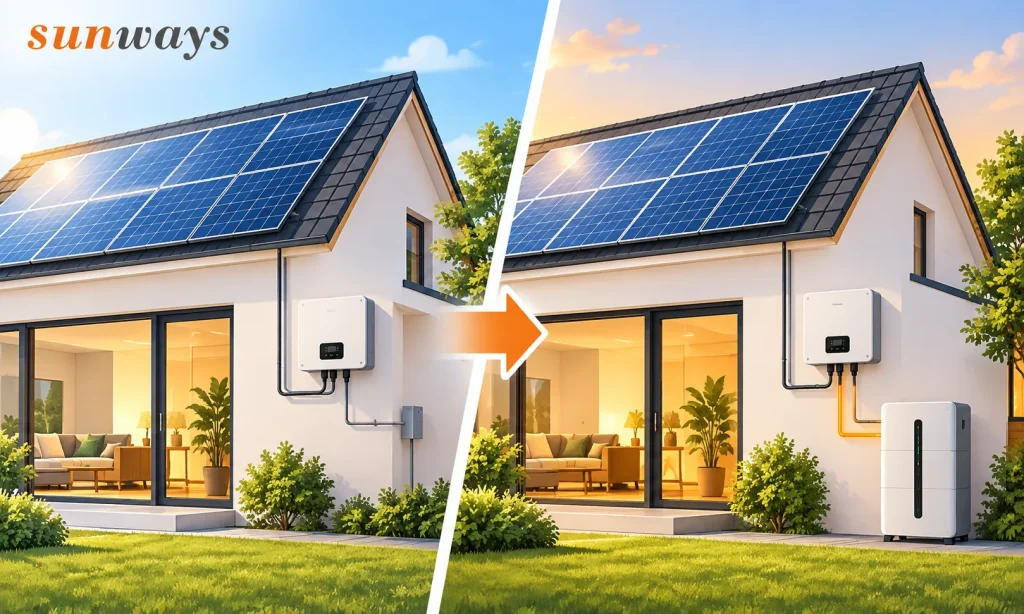
Can I Add Batteries to an Existing Solar System?
Yes, but ‘adding energy storage to the system’ does not mean ‘connecting the batteries directly to the existing inverter’. For grid-connected systems without a battery interface, the common approach is to add a battery inverter and compatible batteries on the AC side, or to use energy storage equipment with an integrated battery inverter. This is known as an AC-coupled retrofit.
SMA’s official guidance clearly states that AC-coupled energy storage can be integrated into existing PV systems without the need to modify the original PV side to accommodate the batteries. This demonstrates that ‘adding batteries requires replacing the inverter’ is not a universal rule.
You can select the appropriate approach based on the site-specific conditions:
| Site Conditions | Preferred Approach | Must Verify Before Concluding |
|---|---|---|
| Brand-new PV project with battery plans already finalised | Incorporate a compatible hybrid solution into the overall design | Supported batteries, operating modes, backup power configuration and local grid connection requirements |
| Existing PV inverter operating normally | Retain existing equipment and evaluate AC-coupled energy storage | Battery inverter, metering and control coordination, restrictions on feeding power into the grid and power-outage modes |
| Original inverters require replacement, whilst preparations are being made to add batteries | Compare options for replacing with compatible hybrid inverters | Input matching of original modules and strings, cabling adjustments, ancillary equipment and warranties |
| Batteries may be added at a later date | Include upgrade conditions in the current request for quotation | Whether paid authorisation or additional hardware is required, compatible batteries and restrictions on future expansion |
The remaining warranty period, operational status and residual value of the existing inverter should be factored into the comparison. Do not assume that replacement is more cost-effective simply because new equipment is labelled ‘hybrid’. Conversely, if the existing equipment already needs replacing, the costs of maintenance and ancillary investments required to retain it should also be taken into account.
Furthermore, the fact that surplus electricity can be stored during grid connection does not mean that the original PV system will still be able to charge the battery during a power cut. If you require this capability, you should ask the installer to confirm equipment compatibility, power control and wiring arrangements for off-grid operation. Manufacturers provide specific configuration instructions for AC-coupled backup power systems; commitments should not be based solely on the statement that the system ‘supports AC coupling’.
What to Compare in an Upgrade Quote
First, standardise the battery’s usable capacity, charge and discharge power, and backup power range, then compare the total price. A quote that only covers energy storage for personal use differs in scope from one that includes modifications for power outage backup.
Ask the installer to list the following six items separately:
| Quote Item | Details to Be Specified |
|---|---|
| Inverter and Battery | Which equipment will be retained, replaced or added; battery model, usable capacity, charge/discharge capacity, and basis for Battery Management System (BMS) compatibility |
| Metering and Control | Whether electricity meters, current transformers (CTs), controllers or gateways are included; how the existing PV system will be coordinated with the new energy storage system |
| Isolation and Switching | Whether equipment required for backup power is included; which circuits will remain available during a power cut |
| Power Distribution and Installation | Cables, protective devices, modifications to distribution boards and necessary circuit splitting |
| Installation and Commissioning | Parameter configuration, firmware upgrades, monitoring integration, and acceptance testing of the agreed operating mode |
| Service and Warranty | Who is responsible for the equipment and the installation respectively; fault diagnosis, on-site service and conditions for subsequent capacity expansion |
Regarding the statement ‘batteries can be added later’, it is essential to ask: What exactly does the term ‘upgradable’ refer to in this context, and what specific additions will be permitted in the future? Please include the supported battery models, capacity ranges, and any firmware or authorisation requirements in the proposal. A mere description of ‘battery-ready’ is insufficient to clarify subsequent costs and configuration restrictions.
Which Type Fits Your Home or Business? Five Practical Scenarios
The most suitable inverter for you depends on your electricity consumption goals, roof conditions and existing equipment. The options to compare will differ depending on whether you intend to use the electricity yourself during the day, provide backup power for critical loads, or add a battery to an existing system. Start by identifying the scenario that most closely matches your situation, then narrow down your selection.
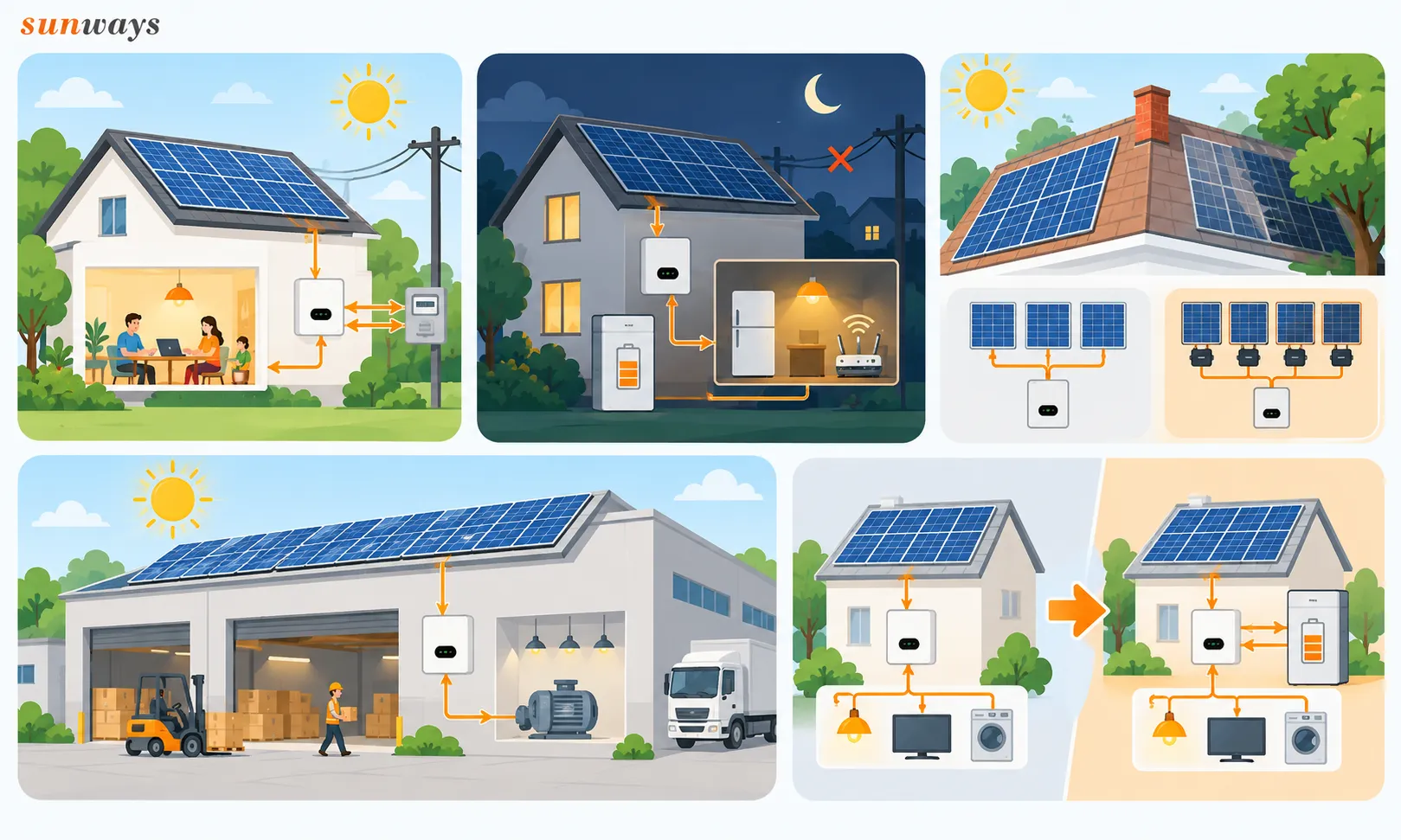
Choose by Project Conditions
The following are examples to help you choose; they do not represent the actual outcomes of specific projects.
| Your Project Conditions | Priority Considerations | Reasons for Selection | Next Steps and Further Checks |
|---|---|---|---|
| Residential or small retail premises: Connected to the grid, with high daytime electricity consumption; no current need for batteries or backup power | Standard grid-connected solution; compare string-level and module-level architectures based on roof conditions | Prioritise meeting daytime self-consumption targets; avoid additional investment for functions not yet defined | Provide electricity bills and roof layout; verify grid connection and surplus power feed-in conditions; specify whether there are future plans to add batteries |
| Residential or commercial premises: Critical loads such as fridges, lighting and internet must be maintained during power cuts | A hybrid system capable of meeting the required backup power functions | The key consideration is whether specific equipment can operate, and for how long | List operating power, start-up requirements and target duration; verify battery capacity, backup power output and transfer switch configuration. Long-term off-grid projects require separate design as standalone systems |
| Roof with multiple orientations and partial shading | String solution with appropriate MPPT zoning, compared with micro-inverter/optimiser solutions | Differences in orientation and module shading must be addressed separately; the architecture cannot be determined solely on the basis of a ‘complex roof’ | Provide photographs of roof zoning and shading; request a comparison of power generation estimates, total costs and roof maintenance conditions based on the same layout |
| Factories or warehouses: Primarily daytime loads; no current energy storage or backup power objectives | Grid-connected string solution matched to the power distribution system and roof zoning | First assess the alignment between PV generation and loads during business hours, then determine whether additional energy storage is necessary | Provide load profiles for weekdays and weekends; verify connection capacity, surplus power feed-in limits and multi-roof wiring configurations |
| Existing PV: Seeking to increase self-consumption in the evenings or provide backup power during power cuts | AC-coupled energy storage retaining the original inverter, compared with hybrid retrofit solutions | Where the original equipment still has practical value, compare the total costs of retaining versus replacing it | Provide the original equipment model, warranty details and wiring diagrams; request that quotations specify retained equipment, the scope of the retrofit and the operating mode during power cuts |
Do not select equipment based solely on ‘residential’ or ‘commercial and industrial’ labels. Even within the residential sector, the need for backup power will alter the system configuration; similarly, within the industrial sector, continuous daytime production versus night-time production requires different assessments. Whether single-phase or three-phase should be determined based on on-site power supply and load conditions.
Two Documented Sunways Installations
Gujarat, India — 6 kW
- Project Capacity: 6 kW.
- Date of Commissioning: May 2026.
- Inverter Model: Sunways STH-6KTL-LS.
Riccione, Italy — 6 kW
- Project Capacity: 6 kW.
- Inverter Model: Sunways STH-6KTL-LS.
These two records confirm actual installations, but no conclusions can be drawn from them regarding the customer’s reasons for selecting a particular model, the percentage of savings achieved, or the duration of backup power.
A more useful comparison for you would be to assess whether your own load, roof and backup power requirements match the proposed equipment. When requesting a quotation, please submit the relevant details from the table above for your specific scenario; this will enable the process to progress from a ‘recommended model’ to a ‘confirmed, viable configuration’.
Your Next Step: Shortlist the Type, Then Check the System
If your primary aim is to use solar power to meet daytime electricity consumption and you do not currently require a battery or backup power in the event of a power cut, you should first assess a grid-connected solution; if you have already finalised your energy storage plans, you should include compatible hybrid inverters in your selection process. If you require backup power, you will also need to verify the battery, load and transfer switch configurations. If there is shading on the roof, assess the module layout first; if you already have a solar system, compare the options of retaining the existing equipment with a retrofit solution involving the replacement of the inverter.
During your initial enquiry, you need only provide your country/region, user role (installer, EPC, distributor or homeowner), whether it is a new installation or a retrofit, whether you require a battery or backup power, and your contact details. This information will help our team determine a preliminary direction; there is no need to prepare comprehensive technical documentation from the outset.
Once you proceed to the specific selection process, please provide additional details such as the number of phases at the site and connection data, module configuration or roof plans, models of existing equipment, battery plans, as well as installation and maintenance conditions. If backup power is required, please list the equipment that must be maintained and the target runtime, so that the solution can be tailored to the actual load.
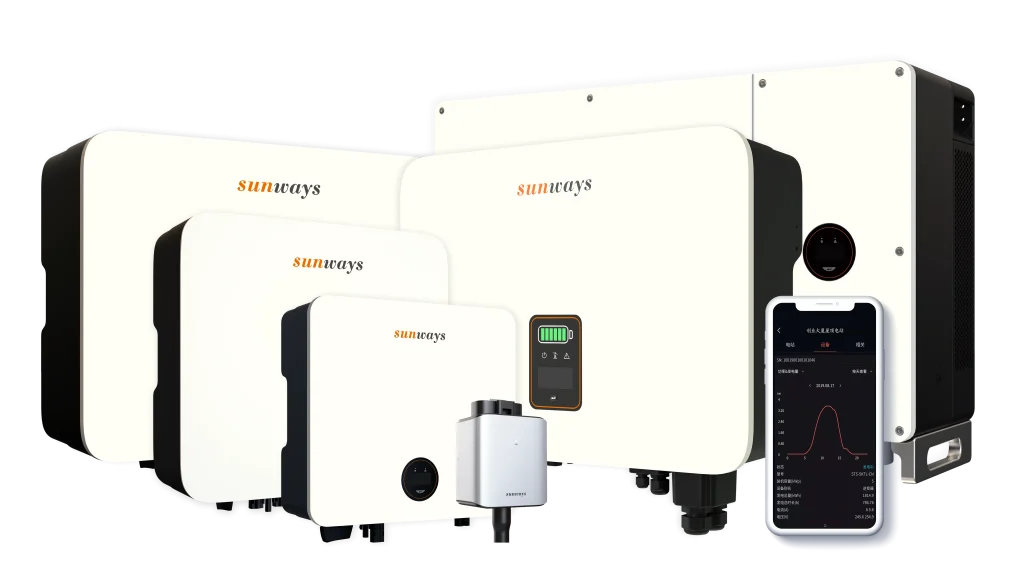
Visit the Sunways product overview to view grid-tied or hybrid inverter categories according to your project requirements, and submit the above information to our team to further confirm suitable models and system configurations.
Start Your Project