How to Choose a Solar Inverter Manufacturer?
Table of Contents
When selecting a solar inverter manufacturer for a long-term partnership, one must never base the decision solely on low price. Purchasers should focus on assessing whether the products are suitable for the project, whether production and quality control are traceable, whether certifications cover the target market, and whether R&D, delivery, monitoring platforms and after-sales support are effectively in place. This article is aimed at PV distributors, EPC contractors, installers, project developers and OEM/ODM clients, and is designed to help you screen for reliable inverter partners using a clear set of criteria.
Solar Inverter Manufacturer Evaluation Checklist
A solar inverter manufacturer worthy of a long-term partnership must be able to provide verifiable product documentation, certification documents, production processes, test records, project case studies and after-sales support mechanisms.
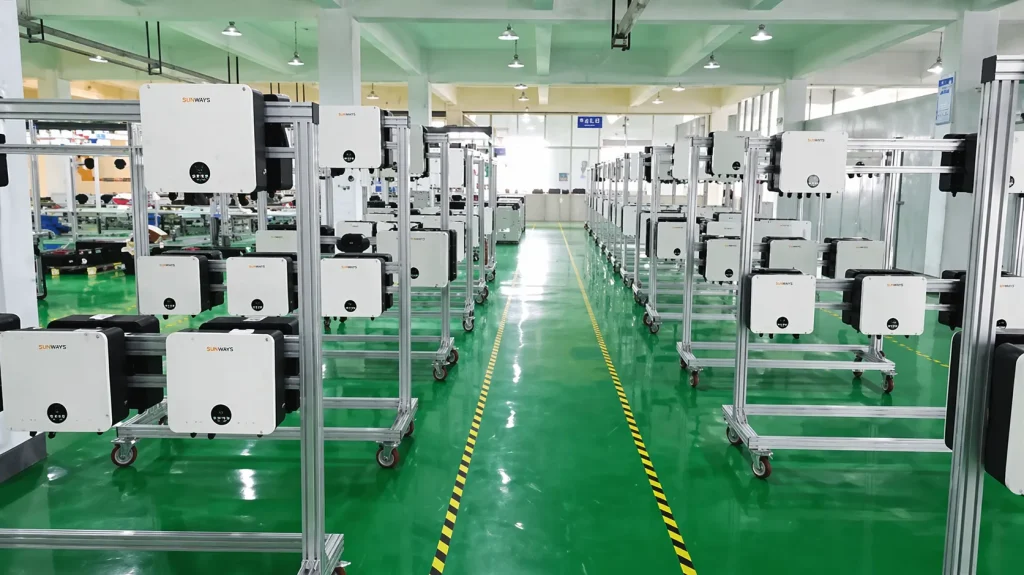
In the manufacturing phase, a comprehensive inverter quality process should typically cover incoming material control, PCBA testing, circuit board coating, complete unit assembly, functional testing, ageing testing, finished product inspection and dispatch control, forming a full-process quality management system through IQC, IPQC, FQC and OQC. The quality process at Sunways’ smart factory is also structured in accordance with this logic.
| Assessment Criteria | Key Areas for the Purchaser to Check | Recommended Supporting Documentation |
|---|---|---|
| Product Compatibility | Application scenarios, single-phase or three-phase, power range, number of MPPT channels, module input current, battery and standby load requirements | Product data sheets, system wiring diagrams, model recommendation schemes |
| Certification and Compliance | Whether the product complies with the target country’s safety standards, grid connection regulations and market access requirements | Valid certificates, test reports and official equipment lists for the relevant models |
| Manufacturing Capability | Whether the production process is complete, whether production capacity is accurate, and whether the BOM, hardware and firmware versions are under control | Factory documentation, production flowcharts, version control specifications |
| Quality Control | Are incoming, in-process, finished product and outgoing inspections carried out, and do these include functional and ageing tests? | IQC/IPQC/FQC/OQC processes, test specifications, quality records |
| R&D and Validation | Are there capabilities for hardware, software, control algorithms, laboratory testing and product validation? | R&D team profiles, laboratory equipment, product validation processes |
| Project Experience | Whether there are case studies similar to the target country, application scenarios and project capacity | Project locations, capacity, models used, on-site photographs and operational records |
| Delivery Capability | Whether standard lead times, peak-season production capacity, supply of critical components and spare parts inventory are stable | Production plans, delivery cycles, inventory and spare parts solutions |
| After-sales support | Scope of warranty, RMA process, technical response times, and whether local service and monitoring platforms are comprehensive | Warranty terms, RMA process, service network and platform demonstration |
| Collaboration capabilities | Whether distribution, OEM, ODM and long-term product maintenance are supported | Minimum order quantities (MOQ), scope of customisation, certification responsibilities and partnership policies |
Solar Inverter Manufacturer vs. Supplier vs. Brand: What Is the Difference?
What is a Solar Inverter Manufacturer?
A solar inverter manufacturer is a company that develops, produces, tests and supports inverters used to convert photovoltaic DC electricity into usable AC electricity.
Put simply, a genuine solar inverter manufacturer does more than simply sell inverters; it possesses the full range of capabilities, from product research and development and manufacturing to long-term technical support.
Many buyers fall into a common misconception when selecting partners: if a company has a factory, products and a brand, it must be a manufacturer.
In reality, the key to determining whether a company is a genuine solar PV inverter manufacturer lies not in whether it owns a factory building, but in whether it possesses the core product capabilities:
- Does it participate in product definition and planning?
- Does it possess hardware R&D capabilities?
- Does it master control algorithms and software development?
- Does it manage core components and BOM versions?
- Is it responsible for product testing and certification?
- Does it assume responsibility for quality?
- Does it continuously maintain firmware and smart management platforms?
A genuine manufacturer must take responsibility for the entire product lifecycle, rather than simply sourcing products from other manufacturers and affixing its own logo.
What Does a Real Solar Inverter Manufacturer Do?
- Hardware Design
Responsible for power topology, PCB, components, electrical protection, EMC and thermal management design. - Software & Control Algorithms
Develops MPPT, battery charging and discharging, grid-connected/off-grid switching, energy management and communication control functions, whilst continuously maintaining the app and cloud platform. - Manufacturing & Testing
Establish a comprehensive process covering incoming quality control (IQC), PCBA testing, process control, unit assembly, functional testing, ageing testing and final inspection prior to dispatch. Sunways’ manufacturing process encompasses IQC, IPQC, PCBA testing, unit ageing, FQC and OQC. - Certification & Compliance
Complete safety, grid connection, EMC and local market access certifications in accordance with the requirements of different countries and regions. A mature solar power inverter manufacturer should provide valid certificates corresponding to specific models and target markets, rather than shifting the responsibility for certification onto the customer. - Firmware Updates & Product Lifecycle Management
Provide ongoing support after product sale, including firmware updates, adaptation to grid standards, remote diagnostics, security patches and maintenance of monitoring platforms. Inverters often need to operate for over ten years; suppliers without ongoing R&D and technical support will find it difficult to fulfil their long-term project responsibilities.
Manufacturer vs Supplier vs Brand: Key Differences
| Company Type | Main Responsibility |
|---|---|
| Manufacturer | Develops, manufactures and supports products |
| Supplier | Sources or supplies products |
| Brand | Sells products under its own name |
| Distributor | Handles local sales, inventory and service |
| OEM Manufacturer | Produces products under buyer’s brand |
| ODM Manufacturer | Provides product platforms with deeper customization |
What Products Should Solar Power Inverter Manufacturers Offer?
PV Application Scenarios and Common Inverter Products:
| Application Scenario | Typical Products | Key Considerations for Buyers |
|---|---|---|
| Residential PV | Single-phase grid-connected inverters or hybrid inverters | Operating noise, ease of installation, remote monitoring and backup power supply |
| Small-scale commercial projects | Three-phase string grid-connected inverters | MPPT configuration, module input current, anti-backfeed protection and grid connection certification |
| Commercial and industrial rooftops | Medium- to high-power string inverters | Adaptability to complex roof structures, multi-channel MPPT, string monitoring and remote O&M |
| Commercial and Industrial Energy Storage | Three-phase hybrid inverters or integrated energy storage systems | Battery compatibility, EMS, parallel operation capability and peak-off-peak tariff management |
| Large-scale PV projects | High-power string inverters | Grid support, power regulation, multi-unit management and centralised O&M |
| Off-grid or weak grid projects | Hybrid inverters or off-grid inverters | Generator integration, peak load handling, black start capability and off-grid operational stability |
A reliable on-grid inverter manufacturer should offer both single-phase and three-phase products, covering residential, small commercial and large-scale commercial and industrial projects. In addition to rated power, attention should be paid to the number of MPPT channels, input current, DC voltage range, grid-connection protection, anti-backfeed protection and remote operation and maintenance capabilities.
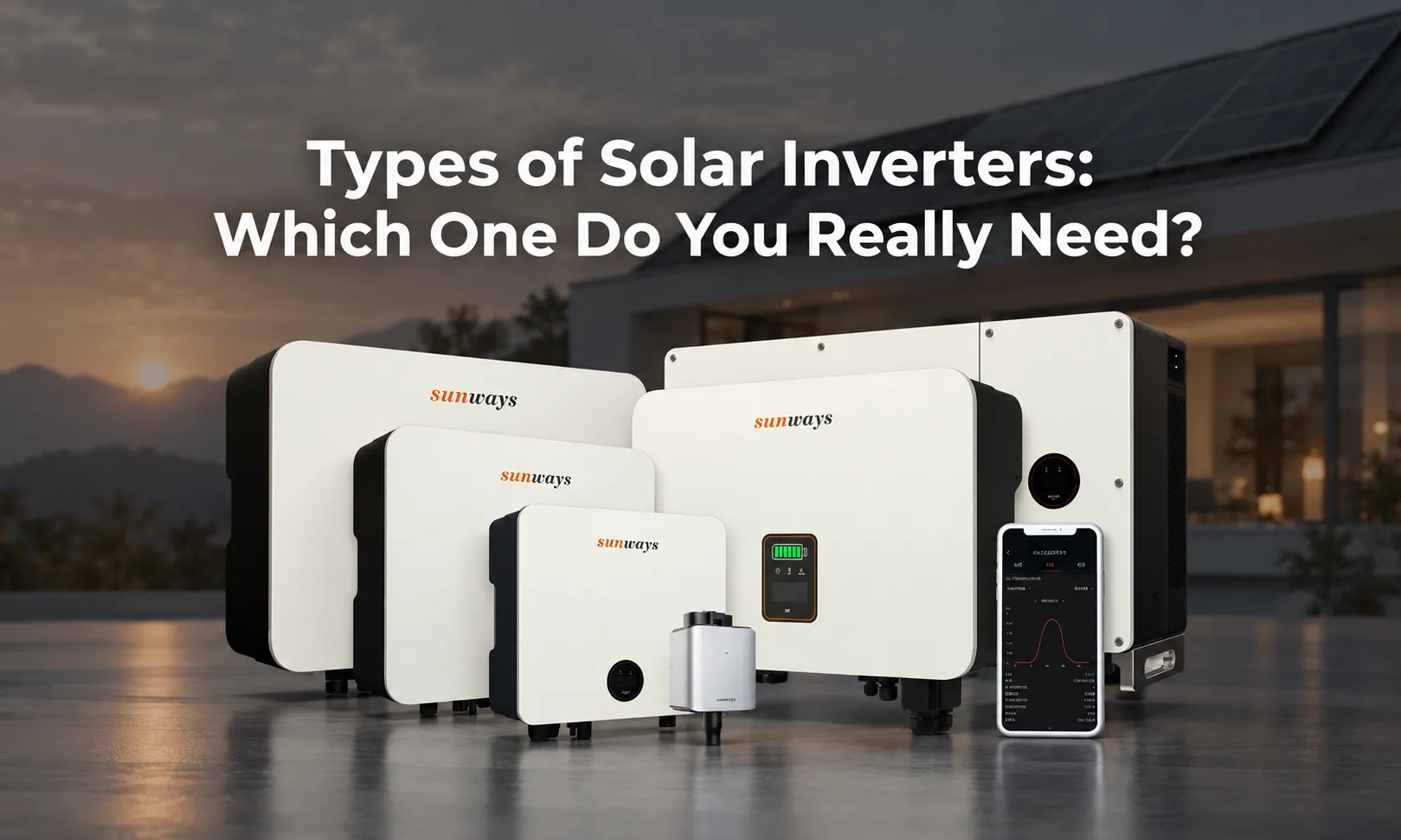
Sunways’ current on-grid product range includes the STS single-phase series and the STT three-phase series, with a power range covering residential to large-scale commercial and industrial applications; certain models offer multiple MPPT channels, IP66 protection, remote firmware updates and a variety of communication methods.
An established hybrid inverter manufacturer should offer single-phase, three-phase, low-voltage and high-voltage products to cover both residential and commercial and industrial energy storage scenarios. Products should also feature grid-connected and standby outputs, rapid grid-on/off switching, generator connection and multi-unit parallel operation capabilities.
The Sunways STH series covers both low-voltage and high-voltage hybrid inverters, and provides standby power supply, remote commissioning and a variety of energy storage control functions.
Batteries and Energy Storage Systems
Low-voltage and high-voltage batteries are suitable for different power ratings and application scenarios, whilst wall-mounted and stackable configurations cater to varying installation and expansion requirements. The Battery Management System (BMS) is responsible for battery safety and status management, whilst the Energy Management System (EMS) coordinates the photovoltaic system, batteries, the grid and the load.
The Sunways product range includes the STE series of batteries and the STA series of commercial and industrial energy storage systems, meeting the needs of both residential and commercial and industrial projects.
Monitoring and System Accessories
A comprehensive inverter product range should also include communication, metering, control and remote operation and maintenance equipment. Wi-Fi, LAN, GPRS and 4G modules are used for device networking, data loggers for multi-unit management, and smart meters for power measurement and anti-backflow control. Web platforms and apps display power generation, battery status, energy flow and alarm information, whilst supporting remote diagnostics and firmware upgrades.
Sunways provides communication modules, data loggers, smart meters and monitoring platforms, covering device connectivity, operational monitoring and remote maintenance.
Sunways Product Portfolio
Sunways has now established a systematic product portfolio covering the following products:
- Grid-connected inverters
- Low-voltage hybrid inverters
- High-voltage hybrid inverters
- Low-voltage and high-voltage batteries
- C&I energy storage systems
- Monitoring devices and system accessories
This combination is suitable for a range of projects, including residential grid-connected systems, home energy storage, commercial and industrial rooftop installations, and commercial and industrial energy storage. Sunways has a track record of residential, commercial and industrial, and energy storage projects across Europe, Asia and other markets.
PV Application Scenarios and Common Inverter Products:
| Application Scenario | Typical Products | Key Considerations for Buyers |
|---|---|---|
| Residential PV | Single-phase grid-connected inverters or hybrid inverters | Operating noise, ease of installation, remote monitoring and backup power supply |
| Small-scale commercial projects | Three-phase string grid-connected inverters | MPPT configuration, module input current, anti-backfeed protection and grid connection certification |
| Commercial and industrial rooftops | Medium- to high-power string inverters | Adaptability to complex roof structures, multi-channel MPPT, string monitoring and remote O&M |
| Commercial and industrial energy storage | Three-phase hybrid inverters or integrated energy storage systems | Battery compatibility, EMS, parallel operation capability and peak-off-peak tariff management |
| Large-scale PV projects | High-power string inverters | Grid support, power regulation, multi-unit management and centralised O&M |
| Off-grid or weak grid projects | Hybrid inverters or off-grid inverters | Generator integration, peak load handling, black start capability and off-grid operational stability |
How to Choose a Solar Inverter Manufacturer for Your Project?
a. PV Input Compatibility
Firstly, verify the maximum DC input voltage, start-up voltage and MPPT voltage range. The open-circuit voltage of the strings at low temperatures must not exceed the inverter’s upper limit, and the normal operating voltage should also fall within the MPPT range.
The number of MPPT channels should be selected based on the roof orientation, pitch and shading conditions. Complex roof layouts typically require more independent MPPT channels to minimise mismatch losses between different strings.
At the same time, check the maximum input current and short-circuit current for each MPPT channel to confirm compatibility with high-power, high-current modules. The PV over-design ratio advertised by manufacturers should not be applied directly; the design must still take into account local irradiance, module orientation and potential peak-shaving losses.
b. AC and Grid Compatibility
The inverter must be compatible with the project’s single-phase or three-phase configuration, as well as the rated grid voltage and frequency. Different countries, and even different grid operators, may have varying grid connection requirements.
The purchaser should also verify functions such as power factor correction, THDi, reactive power control and output power limitation. These parameters directly affect whether the equipment can pass grid connection acceptance testing and whether it is suitable for the power control requirements of commercial and industrial projects.
A reliable commercial solar inverter manufacturer should clearly specify the countries, grid connection standards and firmware versions applicable to a particular model, rather than making a general claim of ‘global compatibility’.
c. Battery and Backup Compatibility
For energy storage projects, it is essential first to distinguish between low-voltage and high-voltage batteries, and to verify the battery voltage range permitted by the inverter. The fact that voltages match does not necessarily mean the batteries are compatible; it is also essential to confirm whether CAN or RS485 communication protocols have been tested.
Charge and discharge currents determine the battery power the system can draw, whilst the UPS switchover time affects whether sensitive loads can continue to operate during a power cut. For backup output, the rated power, short-term peak capacity and motor starting capability should also be checked.
For weak grid or off-grid projects, it is also necessary to confirm generator connection, black start and off-grid parallel operation capabilities. Grid-connected multi-unit operation and off-grid multi-unit parallel operation are not the same function; these must be verified separately during procurement.
d. Environmental Compatibility
The installation environment directly affects the inverter’s output capacity and service life. The operating temperature range should be verified, along with the point at which derating begins under high-temperature conditions.
For high-altitude projects, the altitude at which derating begins must be confirmed. The IP rating indicates dust and water resistance, but cannot replace salt spray, corrosion resistance and high-humidity environment testing.
The cooling method must also be assessed in the context of the specific application. Natural cooling produces lower noise levels and requires minimal maintenance; intelligent forced-air cooling is more suitable for high-power equipment, but attention must be paid to fan protection, noise levels and long-term maintenance.
Sunways’ product documentation indicates that different series vary significantly in terms of the number of MPPT trackers, input current, battery voltage, operating temperature, altitude and protection rating. Therefore, selection must be based on specific models rather than simply on brand or power range.
Solar Inverter Manufacturing Process and Quality Control
-1024x768.webp)
Reliable solar inverter manufacturing does not depend on the size of production facilities or claims of automation, but rather on controlled R&D processes, a stable supply chain, comprehensive testing coverage and traceable quality management. Any shortfall in these key areas could amplify an issue with a single unit into a batch-wide quality risk.
A typical solar inverter manufacturing process is as follows:
Product Definition
→ Hardware and Software Development
→ Prototype Validation
→ Component Procurement
→ Incoming Inspection
→ PCBA Testing
→ Circuit Board Coating
→ Mechanical Assembly
→ Whole-Unit Assembly
→ Functional Testing
→ Ageing Test
→ Final Inspection
→ Packaging and OQC
→ Shipment
Sunways’ existing manufacturing process covers product design, incoming materials control, circuit board assembly, PCBA testing, circuit board coating, mechanical and complete unit assembly, functional testing, complete unit ageing, final inspection, packaging and dispatch control.
Product Development and Validation
PV inverter manufacturing should begin with product definition, rather than with the production line. Manufacturers must determine power, voltage, MPPT, battery and communication configurations based on the target market, before finalising the hardware, firmware, thermal management and structural designs.
Prior to mass production, prototype testing, engineering validation, certification testing and small-batch trial production should be carried out to identify design, material and assembly issues at an early stage.
Component and Supplier Management
Consistent quality depends on a controlled supply chain. Manufacturers should establish a list of approved suppliers and carry out incoming inspections on electronic components, circuit boards, structural parts and cables.
When replacing critical components, performance, reliability and the impact on certification must be reassessed, whilst strictly managing the BOM, ECOs and hardware and software versions to ensure product traceability.
Assembly and Testing
A professional solar inverter factory does not merely carry out final assembly; it should also cover PCBA testing, PCB coating, mechanical assembly, functional testing, safety testing, communication testing and ageing testing.
These stages serve to verify the inverter’s assembly consistency, protective functions and operational stability, whilst identifying potential defects at an early stage.
IQC, IPQC, FQC and OQC
Comprehensive solar inverter quality control should span the entire process from incoming materials, through production, to finished products and dispatch.
- IQC: Checks whether raw materials and components meet specifications.
- IPQC: Monitors the production process and adherence to procedures.
- FQC: Checks the functionality, appearance and communication status of the complete unit.
- OQC: Verifies model numbers, accessories, packaging and dispatch quality.
Sunways’ quality management system also incorporates quality tools such as SPC, CPK, FMEA, MSA, GR&R and PDCA, which are used to measure, analyse, improve and continuously control the production process.
Solar Inverter Manufacturer R&D, Testing and Certifications
Hardware and Software Development
Hardware development determines the fundamental performance of an inverter. Manufacturers should have a thorough understanding of power topologies, component selection, thermal management, EMC, electrical protection and mechanical design, and should validate efficiency, temperature rise, safety and environmental adaptability through testing.
Software development, meanwhile, determines whether the equipment can operate stably within complex systems. Core capabilities should cover MPPT algorithms, grid adaptation, battery management, off-grid control, energy management and firmware updates
Testing Equipment
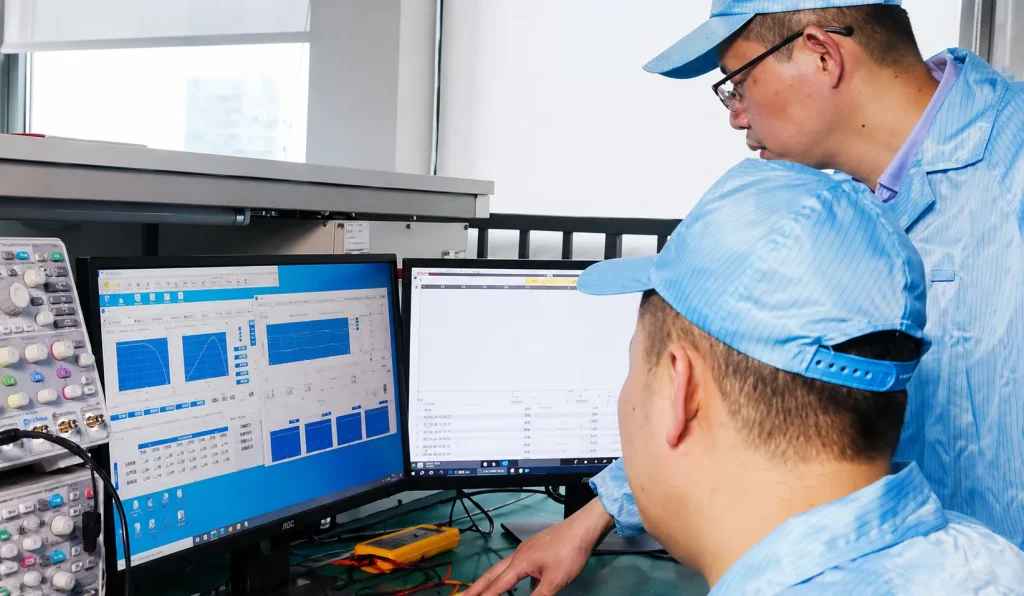
A professional inverter testing laboratory should be capable of simulating the actual operating conditions of photovoltaic modules, the grid, batteries and loads, rather than merely conducting power-on checks.
Common testing equipment includes:
- Solar simulator: simulates different irradiance levels and photovoltaic array output
- Grid simulator: simulates voltage, frequency and abnormal grid conditions
- Battery simulator: verifies battery charging, discharging and communication control
- Bidirectional DC power supply: simulates bidirectional DC energy flow
- AC/DC electronic load: tests different load and power conditions
- Power analyser: measures efficiency, power factor and harmonics
- Oscilloscope: analyses voltage, current and control waveforms
- Withstand-voltage tester: checks insulation and withstand voltage safety
- Anti-islanding test load: Verifies anti-islanding protection functionality
- Automatic Test Equipment: Enhances test coverage and consistency
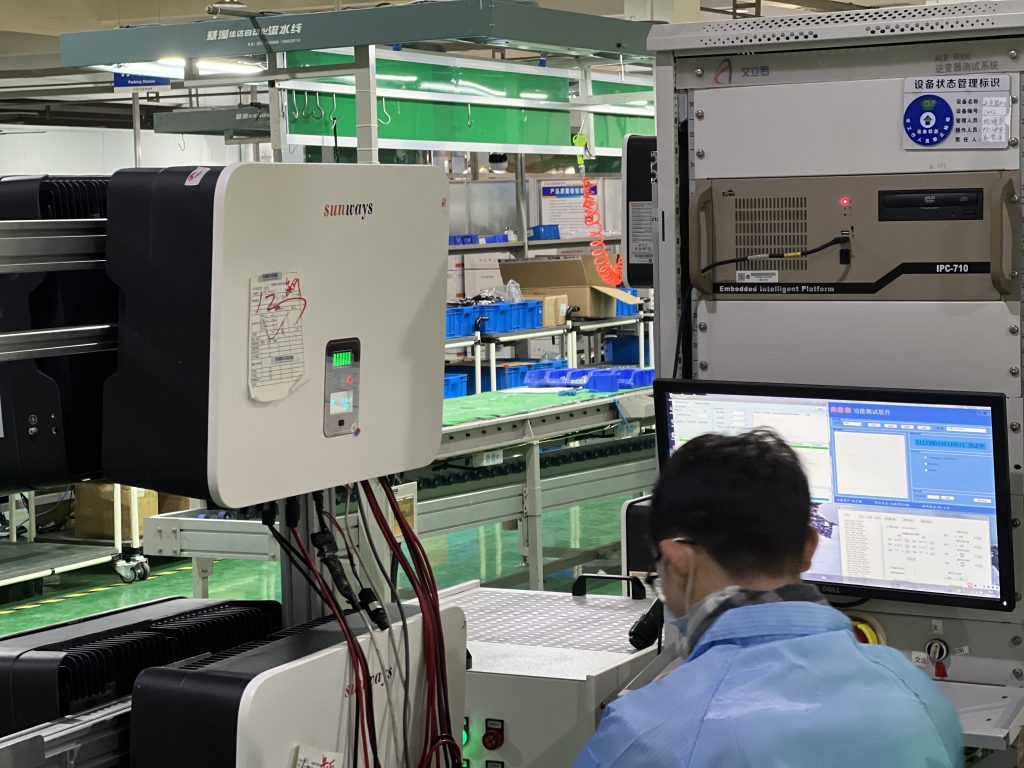
Sunways’ R&D testing system is equipped with solar simulators, grid simulators, battery simulators, electronic loads, power analysers, oscilloscopes, withstand-voltage testers, anti-islanding test loads and automatic test equipment, all of which are used for inverter R&D and product validation.
The sheer number of devices is not the key consideration. Purchasers should instead verify whether testing adheres to clear standards, whether test records are traceable, and whether anomalous results are incorporated into the design improvement process.
Certifications and Grid Compliance
There is no such thing as a ‘global certification’ that automatically makes an inverter suitable for all countries. Requirements regarding safety standards, EMC, grid protection and power control may vary across different countries, grid operators and project types.
Furthermore, a single certificate does not necessarily cover an entire product range. Changes to rated power, hardware platforms, communication modules or firmware versions may all affect the scope of the certification. Manufacturers should be able to provide documentation specific to the target country, model and version.
How to Compare Solar Inverter Manufacturing Capacity and After-Sales Support?
Manufacturing Capacity and Delivery
A high stated production capacity does not automatically guarantee short lead times. The annual or monthly production capacity published by manufacturers represents only theoretical production capacity and does not guarantee that orders will be delivered on time.
When assessing solar inverter manufacturing capacity, you should confirm both standard and peak-season lead times, and understand the supply of key components, production scheduling and the track record for delivering large orders.
For bulk solar inverter supply, it is also essential to check whether the BOM, hardware and firmware versions are consistent. Unconfirmed component substitutions or mixed versions may affect certification, commissioning and subsequent maintenance.
Overseas warehouses, local spare parts stock and transport plans are equally important. Local warehouses without spare parts support can only shorten the delivery time for new units; they cannot truly improve after-sales efficiency.
Sunways’ manufacturing process encompasses BOM/ECO version changes, spare parts management, dispatch notifications, OQC and dispatch control, demonstrating that bulk deliveries involve not only production volumes but also coordination across versions, quality and logistics.
Monitoring Platform
A comprehensive solar inverter monitoring platform should support both web and mobile interfaces, providing real-time operational data, fault alerts, remote diagnostics and firmware updates.
For installers and distributors, the platform should also support the management of multiple power stations, tiered accounts and the allocation of device permissions, to facilitate the centralised management of different customers and projects.
Purchasers must not merely assess the platform’s interface; they should also verify data ownership, account permissions, network security, server stability and long-term maintenance policies. Inverters can operate for over ten years; if the platform ceases service prematurely, remote operation and maintenance capabilities will consequently become ineffective.
Sunways supports the Sunways Portal App, remote monitoring and remote upgrades, which can be used for equipment commissioning and operational maintenance.
Warranty and RMA
Warranty terms do not guarantee that faults will be resolved quickly; what matters is whether responsibilities are clearly defined and whether the processes are workable.
Sunways Warranty and RMA
| Item | Current Sunways Terms |
|---|---|
| Standard Inverter Warranty | Specified grid-connected and energy storage inverter series: 60 months (5 years) |
| Standard Warranty for Components | Wi-Fi, GPRS, LAN modules, data loggers, CTs and electricity meters, etc.: 24 months (2 years) |
| Warranty Start Date | Calculated as the earlier of the ‘date of first installation’ and ‘6 months after dispatch from the factory’ |
| Extended Warranty | May be purchased by contacting the sales or service team within 24 months of the warranty coming into effect |
| Applicable Channels | In principle, applies to products purchased through Sunways authorised channels |
| Cross-Regional Installation | Where the country of sale differs from the country of installation, written approval from Sunways must be obtained prior to installation |
| Proof of Warranty | The original purchase invoice or receipt must be retained |
Why Choose Sunways as Your Solar Inverter Manufacturer?
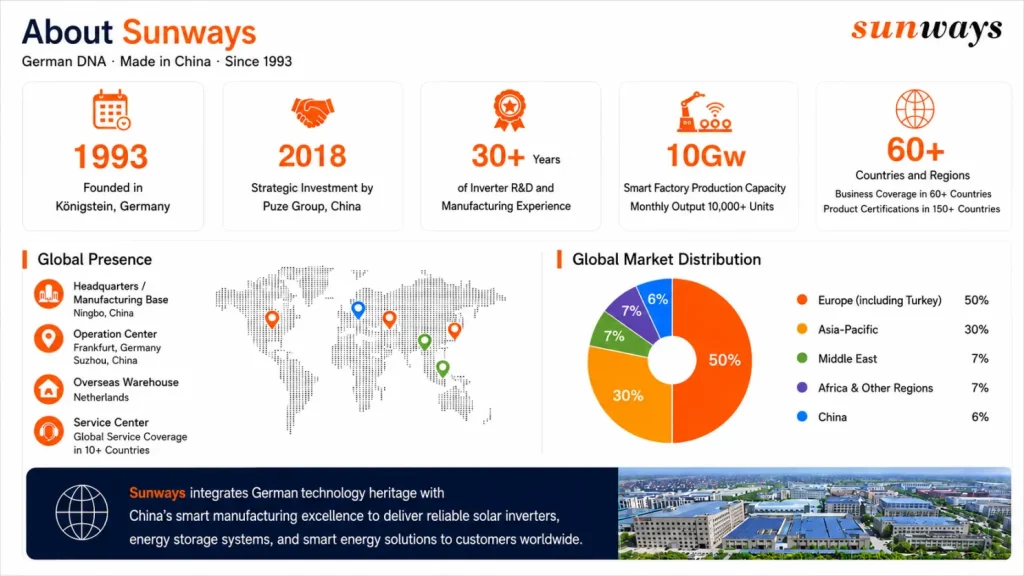
Choose Sunways as your long-term solar inverter manufacturing partner: we combine industry experience, R&D and testing capabilities, controlled manufacturing processes, a comprehensive product portfolio and the ability to deliver projects across multiple regions.
Industry Experience Since 1993
Founded in Konstanz, Germany, in 1993, Sunways has long specialised in photovoltaic inverters and energy conversion technology, whilst continuously expanding its range of grid-connected, energy storage and smart energy products. Having progressed through inverter R&D, the establishment of manufacturing facilities, product line expansion and global market expansion, the company’s products are now deployed across numerous countries and regions.
Extensive industry experience enables manufacturers to understand different grid standards, application scenarios and product lifecycle requirements. For distributors and EPC clients, this is more important than short-term price advantages.
International R&D and Testing
Sunways’ R&D scope covers grid-connected inverters, hybrid inverters and energy storage systems, including hardware design, control algorithms, firmware, battery management and energy management functions. R&D testing equipment includes solar simulators, grid simulators, battery simulators, electronic loads, power analysers, oscilloscopes, withstand voltage testers, anti-islanding test loads and automated test equipment.
Comprehensive R&D and laboratory capabilities enhance the compatibility of products with components, batteries, the grid and project environments, whilst also facilitating the resolution of technical issues and the continuous upgrading of firmware.
Controlled Solar Inverter Manufacturing
Sunways’ solar inverter manufacturing process covers incoming material inspection, printed circuit board assembly, PCBA testing, PCB coating, mechanical assembly, final assembly, functional testing, ageing testing, final product inspection and dispatch control.
The quality system comprises IQC, IPQC, FQC and OQC, and utilises quality tools such as SPC, CPK, FMEA, MSA, GR&R and PDCA for process analysis and continuous improvement.
Controlled processes help to improve the consistency of mass-produced products and enable the traceability of materials, production batches and inspection stages in the event of quality issues. Truly reliable manufacturing capabilities must be underpinned by testing and documentation.
Complete Product Portfolio
Sunways’ product portfolio covers grid-connected inverters, low-voltage and high-voltage hybrid inverters, batteries, commercial and industrial energy storage systems, monitoring equipment and communication accessories. Products include residential single-phase inverters, three-phase string inverters, residential and commercial hybrid inverters, low-voltage and high-voltage batteries, all-in-one energy storage units, data loggers, smart meters and communication modules.
Distributors can expand their residential, commercial and industrial, and energy storage businesses within a single product portfolio; EPCs and system integrators can also minimise the coordination required for communication, compatibility and after-sales support across different brands.
Global Projects and Support
Sunways’ projects span residential, commercial and industrial, and energy storage applications across Europe, Asia and other markets. Read more case studies to discover how Sunways products are being deployed in various markets, covering applications such as residential grid-connected systems, commercial and industrial power generation, and hybrid energy storage.
FAQs:Solar Inverter Manufacturer
Q1. What does a solar inverter manufacturer do?
Solar inverter manufacturers are responsible for product definition, hardware and software R&D, component management, production testing, certification and long-term technical support. A true manufacturer does not merely assemble equipment; it must also control the bill of materials (BOM), firmware versions and quality processes, whilst continuously maintaining monitoring platforms and managing the product lifecycle.
Q2. What is the difference between a manufacturer and a supplier?
Manufacturers are responsible for research and development, production, testing and product liability, whilst suppliers are primarily responsible for the procurement, sale or delivery of products. Some solar inverter suppliers do not have control over core design and production; therefore, purchasers should verify who controls the bill of materials (BOM), certification, firmware and after-sales processes, rather than relying solely on the brand name.
Q3. How do I verify a solar PV inverter manufacturer?
When verifying a manufacturer, one should examine the R&D team, laboratory equipment, production processes, quality records, model certificates and genuine project case studies. It is advisable to further confirm the factory address, BOM version management, testing standards, serial number traceability and RMA procedures. Manufacturers capable of providing verifiable documentation are more likely to be reliable partners.
Q4. What should I check during solar inverter manufacturing?
Key areas for inspection include incoming material inspection, PCBA testing, circuit board coating, assembly control, functional testing, safety testing, ageing testing and final inspection. It is also essential to verify that records are maintained for IQC, IPQC, FQC and OQC, and that these can be traced back to material batches, hardware versions and product serial numbers.
Q5. Are the largest solar inverter manufacturers always the best choice?
Not necessarily. Large manufacturers typically possess advantages in terms of scale, procurement and service networks, but they may not be the most suitable for every market or project. Purchasers should instead compare product suitability, certification coverage, lead times, technical responsiveness and flexibility in collaboration. A manufacturer suited to the project is of greater value than one that is simply the largest.
Q6. Can solar inverter manufacturers provide OEM and ODM services?
Yes, but the extent of OEM and ODM support depends on the manufacturer’s R&D and certification capabilities. Purchasers should confirm the scope of brand customisation, appearance, firmware, communication protocols, feature development, minimum order quantities (MOQs) and certification responsibilities. The specific scope of collaboration that Sunways can support should be assessed on a project-by-project basis, taking into account the target market, order size and customisation requirements.
Work with Sunways
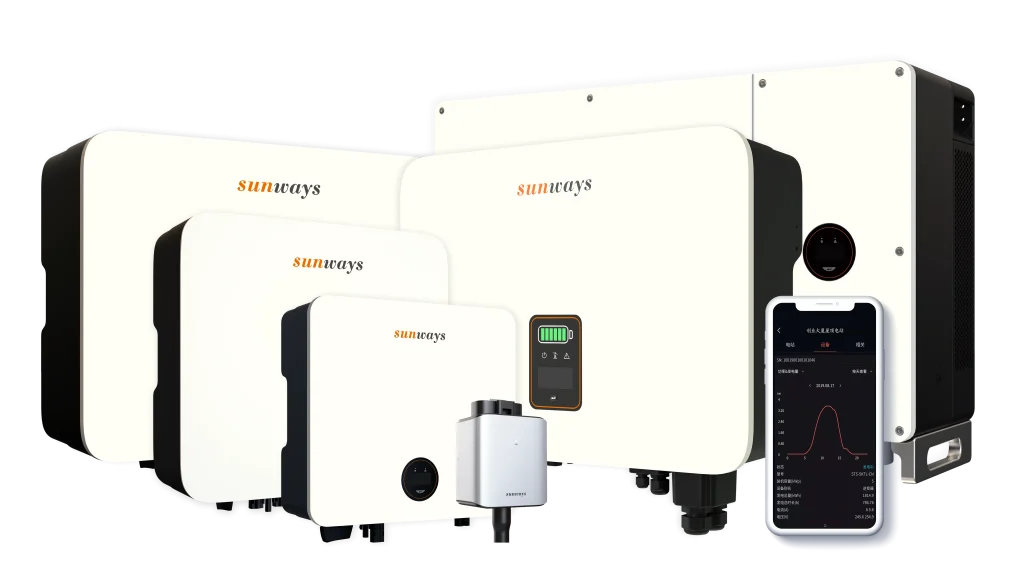
Choosing Sunways, a solar inverter manufacturer, means that customers can access product selection, grid-connection and energy storage solutions, manufacturing quality control, monitoring systems and project support, all within a single partnership framework.
Provide details of your target market, project type, system capacity, modules, batteries and grid-connection requirements, and Sunways will offer product recommendations tailored to your specific circumstances, rather than simply suggesting models with similar rated power.
Start Your Project