Energy Storage System: More Than a Battery—How It Works and Why It Matters
Table of Contents
Energy storage is becoming a critical component of solar power, power grids, and energy management, but energy storage systems are more than just batteries. Different energy storage technologies vary significantly in terms of response speed, storage duration, efficiency, cost, and application scenarios.
This article will cover how energy storage systems work, their main types, application value, advantages and disadvantages, and selection criteria to help you quickly understand the differences between various energy storage technologies and determine which solution is best suited for your project.
What Is an Energy Storage System—and Why Is It More Than a Battery?
An energy storage system (ESS) stores energy when it is available and releases it when it is needed. The stored energy does not necessarily come from batteries; it can also be converted into chemical, thermal, or mechanical energy. The U.S. Department of Energy (DOE) defines energy storage as: capturing electricity, converting it into other forms for storage, and releasing it again when needed.
The time when energy is generated often differs from the time when it is needed. For example, solar power generates electricity during the day, but electricity demand may be higher in the evening or at night. Energy storage allows some energy to be transferred from “now” to “later,” increasing the flexibility of energy use.
Energy Storage System ≠ Battery
A battery is one type of energy storage technology, but an energy storage system does not always use batteries.
Common energy storage technologies include:
- Battery Storage — Storing energy in electrochemical form;
- Pumped Hydro Storage — Storing potential energy using differences in water levels;
- Compressed Air Energy Storage (CAES) — stores energy by compressing air;
- Flywheel Storage — stores kinetic energy using a high-speed rotating flywheel;
- Thermal Energy Storage — stores energy in the form of heat or cold.
The EIA classifies batteries, pumped hydro storage, compressed air, and flywheels as electricity storage technologies. The reason you often see batteries mentioned is that they are rapidly becoming a key electrical energy storage technology. According to IEA data, global new battery storage capacity reached 108 GW in 2025, representing a year-over-year increase of approximately 40%. However, battery storage remains just one branch of the ESS technology family.
How Does an Energy Storage System Actually Work?
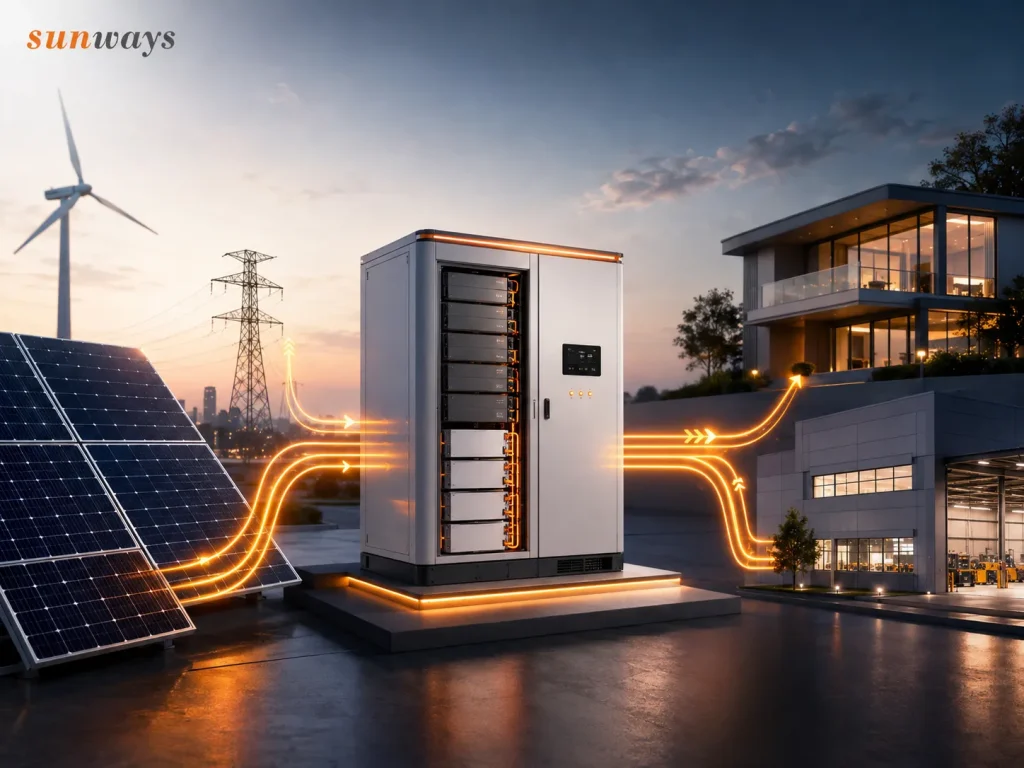
An energy storage system works by charging when energy is available, storing that energy, and releasing it when electricity is needed. Different energy storage technologies use different methods of energy storage, but the basic process can be summarized as Charge → Store → Discharge → Control. The U.S. Energy Information Administration (EIA) also describes ESS as follows: first, the energy storage device is charged using electricity or other energy sources, and then the electricity is released when needed.
1. Charge — Energy Enters the Storage System
When energy supply is abundant, the ESS begins storing energy. It can receive energy from solar PV, wind power, the grid, or other power sources. During the day, when solar power generation exceeds current electricity demand, the excess electricity can be stored in the ESS; if charging from the grid, one can also choose to charge during periods of low load or when electricity rates are lower.
2. Store — Energy Is Converted and Held
Once it enters the system, the energy is converted into different forms for storage, depending on the energy storage technology. Many ESS systems first convert electrical energy into another form of energy, then store it until it is needed, at which point it is converted back.
| Energy Storage Technology | Stored Energy Form |
|---|---|
| Battery Storage | Chemical Energy |
| Pumped Hydro | Gravitational Potential Energy |
| Flywheel | Kinetic Energy |
| Compressed Air | Mechanical / Pressure Energy |
| Thermal Storage | Thermal Energy |
3. Discharge — Stored Energy Is Released When Needed
When the load increases or the power supply is insufficient, the ESS releases the previously stored energy to supply power to the load.
For example, after solar power generation decreases, energy storage can continue to power equipment; during peak electricity demand, the ESS can also supplement part of the power supply, reducing the instantaneous demand on the grid. If the system supports backup functionality, it can also provide backup power to critical loads during a power outage.
4. Control — Decide When to Charge and Discharge
The ESS must control charging and discharging based on actual electricity consumption. The system determines when to charge, when to discharge, and how much energy to retain.
What Is Storage Duration?
Combining Power and Energy yields another important parameter:
Duration ≈ Energy Capacity ÷ Power Capacity
For example: 200 kWh ÷ 100 kW ≈ 2 hours
In other words, a 100 kW / 200 kWh system, under ideal conditions and when continuously outputting 100 kW, corresponds to an energy storage duration of approximately 2 hours.
What Are the Main Types of Energy Storage Systems?
Energy storage technologies are commonly classified based on how energy is stored. Depending on the form of energy storage, they can be broadly categorized into Electrochemical, Mechanical, Thermal, Chemical, and Electrical/Electromagnetic Energy Storage.
①. Electrochemical Energy Storage
Electrochemical Energy Storage stores and releases energy through electrochemical reactions, with battery storage being the most common form. Common technologies include lithium-ion batteries, lead-acid batteries, flow batteries, and sodium-ion batteries.
These energy storage systems respond quickly and allow for easy capacity expansion by adding battery modules. Since they do not rely on specific terrain, they can be applied in residential, commercial, and industrial projects, as well as in large-scale grid energy storage.
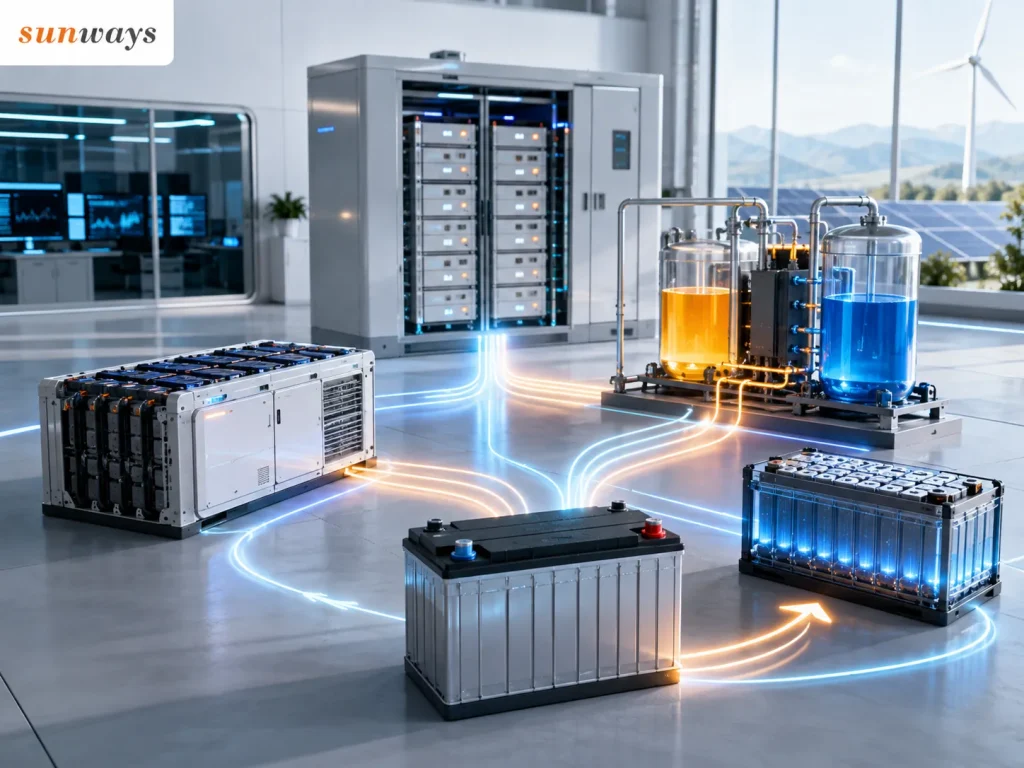
Lithium-ion batteries are particularly widespread in solar power projects. When there is excess solar power generated during the day, the system can first store the surplus electricity in the batteries; then, at night, during peak load periods, or during power outages, the stored energy is released. Therefore, electrochemical energy storage is well-suited for applications such as renewable energy integration, backup power, peak shaving, load shifting, and distributed energy storage.
It is important to note that battery storage is only one form of electrochemical energy storage and represents just one branch of the broader energy storage system technology ecosystem.
For more information on batteries, BMS, PCS, EMS, and battery safety, please refer to the Battery Energy Storage System (BESS) section.
②. Mechanical Energy Storage
Mechanical Energy Storage converts electrical energy into potential, pressure, or kinetic energy for storage. Common technologies primarily include:
- Pumped Hydro Storage —
Stores potential energy by utilizing differences in water levels. When electricity is abundant, water is pumped to a higher elevation; when power is needed, the water flows down to drive a turbine and generate electricity. It is suitable for large-scale, long-duration energy storage but has high requirements for topography, water resources, and infrastructure. - Compressed Air Energy Storage (CAES) —
Uses electricity to compress air and store it at high pressure. When electricity is needed, the compressed air is released to expand and drive power generation equipment. It is suitable for large-scale, long-term energy storage but typically has certain requirements regarding underground space, geological conditions, and infrastructure. - Flywheel Energy Storage —
Stores kinetic energy using a high-speed rotating flywheel. During charging, the flywheel accelerates; during discharge, it decelerates and releases electricity. Its advantage is extremely fast response time, making it suitable for frequency regulation, power quality, and short-term grid support, but it is not suitable for providing large-capacity power for several hours.
③. Thermal Energy Storage
Thermal Energy Storage primarily stores heat or cold, rather than storing electricity directly. Common methods include molten salt, hot water, chilled water, and ice storage.
For example, commercial buildings can produce ice or store chilled water during off-peak hours and use it for air conditioning during daytime peak electricity demand periods, thereby reducing electricity demand during peak hours. For Concentrated Solar Power (CSP) projects, molten salt can also be used to store heat generated by solar energy and used to generate electricity when needed. Thermal Energy Storage is particularly well-suited for applications such as building heating and cooling, industrial heat, and Concentrated Solar Power.
④. Chemical Energy Storage
Chemical Energy Storage involves storing energy in chemical substances and releasing it for use when needed. Common forms include hydrogen, ammonia, and synthetic fuels.
For example, excess wind or solar power can be used to produce hydrogen through water electrolysis, which is then stored. Later, this hydrogen can be used for power generation, industrial production, or transportation.
The advantage of this type of energy storage is that it is suitable for longer-term energy storage, making it particularly well-suited for energy balancing across days, weeks, or even longer periods.
However, the system is also more complex. Energy losses occur during the conversion process (“electricity → chemical fuel → electricity or other energy forms”), and additional storage and transportation facilities are required. Chemical Energy Storage is better suited for long-duration energy storage and large-scale energy balancing, unlike the Battery Storage applications commonly found in everyday solar projects.
⑤. Electrical / Electromagnetic Energy Storage
Electrical / Electromagnetic Energy Storage directly utilizes electric or magnetic fields to store energy. Common technologies include capacitors, supercapacitors, and Superconducting Magnetic Energy Storage (SMES).
This type of energy storage is characterized by extremely fast charging and discharging speeds and high power output, but typically has a short energy storage duration. For example, supercapacitors can charge and discharge in a very short time, making them more suitable for scenarios requiring rapid response.
They are typically used for power quality, voltage support, short-term power support, and applications requiring frequent charging and discharging. These technologies are better suited for providing rapid energy over short periods rather than handling large-capacity energy transfers lasting several hours, as is the case with battery storage or pumped hydro.
How Do the Main Energy Storage Technologies Compare?
| Main Type | Typical Technologies | Energy Stored As | Main Strength | Main Limitation |
|---|---|---|---|---|
| Electrochemical | Batteries, Flow Batteries | Chemical Energy | Fast response, modular, flexible | Degradation |
| Mechanical | Pumped Hydro, CAES, Flywheel | Potential / Pressure / Kinetic Energy | Large-scale or fast-response applications | Site or duration limitations |
| Thermal | Molten Salt, Hot Water, Ice | Heat / Cold | Effective for thermal loads | Application-specific |
| Chemical | Hydrogen, Ammonia | Chemical Bonds | Long-duration storage potential | Conversion losses and infrastructure |
| Electrical / Electromagnetic | Supercapacitors, SMES | Electric / Magnetic Field | Extremely fast response | Short storage duration |
Which Type of Energy Storage Is Best?
- Requires rapid response: Prioritize supercapacitors or flywheels, which are suitable for short-duration, high-power output.
- Requires flexible installation and continuous power supply for several hours: Battery storage is more suitable, especially for solar PV, commercial and industrial, and distributed energy storage projects.
- For large-scale, long-duration energy storage: Consider pumped hydro, CAES, or chemical storage.
- For solar PV projects: Battery storage is more common because it offers flexible deployment and integrates more easily with solar systems.
Main Benefits of an Energy Storage System
Energy storage systems can store energy when supply is high and release it when demand increases or power supply becomes insufficient.
1. Renewable Energy Integration
Solar and wind power generation fluctuates with weather and time, but your electricity demand may not always align with it. Energy storage systems for renewable energy can store excess electricity temporarily and release it when generation decreases or demand increases. Simply put, this means saving excess solar power generated during the day for use at night. This reduces waste of renewable energy and improves the actual utilization rate of solar and wind power.
2. Peak Shaving
Peak shaving involves discharging the energy storage system during periods of highest electricity demand to help reduce the peak load drawn from the grid.
For example, a factory typically consumes about 400 kW of electricity, but this rises to 500 kW during production peaks. In such cases, the energy storage system can supply a portion of this additional power, preventing the entire peak load from being borne by the grid. For scenarios with significant load fluctuations—such as factories, commercial buildings, and EV charging stations—this can reduce peak electricity demand and help optimize electricity costs.
3. Load Shifting
Energy storage systems can charge when electricity demand is low or electricity rates are low, and discharge during peak hours or when rates are higher.
- Peak Shaving: Focuses on reducing the maximum power consumption.
- Load Shifting: Focuses on shifting a portion of electricity consumption from peak hours to other times.
If your project has significant peak-to-off-peak load variations or time-of-use rates, Load Shifting can help you manage your electricity usage more flexibly and may also reduce your overall electricity costs.
4. Backup Power
Backup Power refers to the energy storage system continuing to supply power to critical equipment during a grid outage.
For example, after a power outage, critical loads such as production equipment, refrigeration, lighting, communication equipment, and IT systems can be prioritized to minimize the impact of the outage on normal operations.
However, not all ESS systems can directly provide backup power. The system must also be equipped with appropriate inverters/PCS, switching mechanisms, and backup circuit designs. If backup power during outages is a core requirement for your project, it is best to clarify during the design phase: which equipment must remain operational and for how long.
The next consideration is how long the available battery capacity can actually support those loads, which depends on factors such as battery capacity and power consumption. Understanding how long a battery backup can last when the power goes out can help homeowners and system designers estimate the expected backup duration more accurately.
5. Grid Stability
Grid stability refers to helping the power grid maintain stable operation.
When solar or wind power generation fluctuates suddenly, or when electricity demand increases rapidly, the power grid needs to adjust supply and demand in a timely manner. Energy storage systems can charge or discharge quickly to help offset these fluctuations.
Common functions include frequency regulation, voltage support, supply-demand balance, and short-term grid support.
For utilities and large-scale renewable energy projects, the value of energy storage lies not only in “storing electricity,” but also in responding quickly when needed to help maintain grid stability.
6. Reduce Renewable Curtailment
When solar or wind power generation is high but cannot be fully consumed at that moment, or when the grid is temporarily unable to accept such a large amount of electricity, a portion of the power may have to be curtailed—this is known as renewable curtailment.
ESS can store this excess energy temporarily. This reduces waste of renewable energy and allows for more full utilization of solar and wind power generation.
Which Energy Storage Application Fits Your Project?
Different projects use ESS for different purposes. You can start by identifying the most pressing issue you need to address:
| Your Project Need | Main Energy Storage Application |
|---|---|
| Mismatch between solar/wind generation times and electricity consumption times | Renewable Energy Integration |
| Significant peak loads in factories or commercial facilities | Peak Shaving |
| Desire to adjust energy usage timing | Load Shifting |
| Power outages affect the operation of critical equipment | Backup Power |
| Utility projects require rapid adjustment of supply and demand | Grid Stability |
| Solar/wind generation is subject to curtailment or cannot be consumed in a timely manner | Reduce Renewable Curtailment |
What Are the Limitations of Energy Storage Systems?
Energy storage systems can improve energy efficiency, but they also have some practical limitations you need to consider before choosing a solution.
Energy Losses
Losses occur during energy storage, conversion, and discharge, so not all of the stored energy can be recovered.
Initial Investment
ESS typically require additional energy storage equipment, inverters or PCS, control systems, and installation work, resulting in a relatively high upfront investment.
Limited Storage Duration
Each energy storage system has a limited capacity. Once the stored energy is depleted, the system must be recharged; therefore, it cannot provide power indefinitely.
Technology Degradation
Some energy storage technologies experience a decline in performance over time and with repeated use. For example, the capacity and performance of battery storage are affected by the number of charge-discharge cycles, temperature, and operating conditions.
Space and Site Requirements
Different energy storage technologies have varying installation requirements. Battery storage requires adequate installation space, while pumped hydro and CAES are more dependent on topography and infrastructure.
Safety and Maintenance
ESS requires comprehensive protection, temperature management, and regular maintenance. Generally, the larger the project scale, the higher the requirements for system design, monitoring, and operations and maintenance.
ESS vs BESS vs Battery: What Is the Difference?
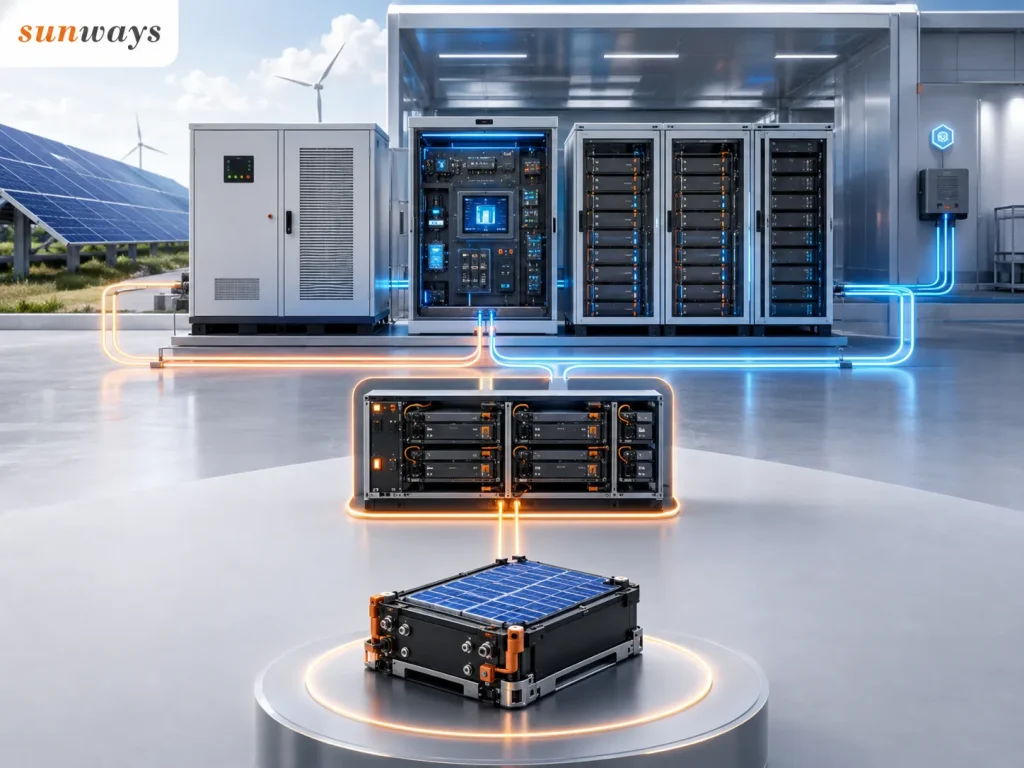
ESS, BESS, and “Battery” are often used interchangeably, but they are not the same concept. ESS has the broadest scope; BESS is a type of ESS, while “Battery” refers only to one of the energy storage devices within it.
| Term | Meaning |
|---|---|
| ESS | General term for Energy Storage System. It can include various energy storage technologies such as battery storage, pumped hydro, thermal storage, and compressed air. |
| BESS | Battery Energy Storage System. Specifically refers to an ESS that uses a battery as the energy storage medium. |
| Battery | The device or medium itself that stores energy. A battery can be part of a BESS, but it is not equivalent to a complete Energy Storage System. |
| Solar Battery Storage | An application that combines solar PV with battery storage. It is typically used to increase the self-consumption rate of solar power, for energy shifting, or as backup power. |
How Do You Choose the Right Energy Storage System?
First, identify the problem you need to solve, then determine the Power, Energy Capacity, Storage Duration, and Response Time, and finally compare suitable energy storage technologies.
①. Start With the Problem You Need to Solve
- Backup Power — Focus on the size of the critical load and how long it needs to be supported; therefore, pay closer attention to Power, Energy Capacity, and Backup Duration.
- Peak Shaving — Focus on how much the peak load exceeds the target value and how long the peak lasts; therefore, prioritize Discharge Power and Peak Duration.
- Renewable Energy Integration — Focus on how much solar or wind energy cannot be used immediately each day and to which time periods it needs to be shifted; therefore, prioritize Energy Capacity and Charging Strategy.
- Energy Shifting — Focuses on how much energy needs to be shifted between periods of high and low load or high and low electricity prices; greater emphasis is placed on Storage Duration, Efficiency, and Control Strategy.
- Grid Support — Focuses on whether the system can respond quickly to changes in the power grid; greater emphasis is placed on Response Time and Power Capability.
②. Determine How Much Power You Need
The EIA defines Power Capacity as the maximum power that an energy storage system can continuously deliver. Power is typically expressed in kW or MW and determines how much power the system can deliver at any given time.
For example, if 200 kW of critical equipment needs to continue operating during a backup, the energy storage system must have sufficient power output capacity.
③. Determine How Much Energy You Need
Energy Capacity refers to the total amount of energy that can be stored or released. It is typically expressed in kWh or MWh and determines how much energy the system can store.
- Power → How much load it can support
- Energy → How long it can last
For example, 100 kW / 200 kWh can theoretically sustain 100 kW of power for approximately 2 hours.
④. Decide How Long the Storage Must Last
Storage Duration refers to how long the energy storage system needs to sustain power supply.
If the system only needs to support a few seconds to a few minutes, the focus is usually on whether the system can respond quickly; if it needs to last for several hours, more attention should be paid to energy storage capacity and sustained discharge capability—commonly seen in Energy Shifting, Peak Shaving, and Backup applications. If the duration exceeds 10 hours, it generally falls within the scope of Long-Duration Energy Storage (LDES).
Even if the project power is 100 MW, the required energy storage capacity, equipment scale, and technology approach will be completely different for a system that needs to provide support for 30 minutes versus one that needs to provide support for 10 hours.
⑤. Check How Fast the System Must Respond
Different applications have different requirements for the response speed of energy storage systems. Applications such as Frequency Regulation and Power Quality often require the system to charge or discharge rapidly within a very short time frame, so Fast Response is a key consideration. In contrast, applications such as Energy Shifting or Long Backup focus more on how long the system can sustain power supply, and typically do not place as high a priority on response speed.
⑥. Compare the Factors That Affect Long-Term Operation
Once the technology meets basic requirements, compare its long-term operational performance.
- Efficiency — How much of the stored energy can be reused
- Service Life — How long the system can operate reliably
- Scalability — Whether it is easy to expand capacity in the future
- Safety — Whether it meets the project’s safety requirements
- Space Requirement — How much installation space is required
- Maintenance — Whether future maintenance is complex
For example, battery storage offers flexible deployment but requires consideration of degradation and safety; pumped hydro is suitable for large-scale, long-duration energy storage but has significant terrain requirements.
⑦. Check the Actual Project Conditions
If your project faces a high risk of power outages, backup capability and storage duration should be prioritized; if solar PV accounts for a high proportion of the energy mix, focus on whether the energy storage system can effectively utilize excess solar power.
For projects in South Asia—such as India, Pakistan, Sri Lanka, and Bangladesh—if the project itself involves grid stability or backup requirements, System Resilience, Backup Duration, and Renewable Integration should be prioritized in the selection process.
For European projects in countries like Italy, Poland, and Spain, if the focus is on PV utilization and energy management, greater emphasis can be placed on Renewable Integration, Energy Shifting, and Smart Energy Management.
A Simple Rule for Choosing Energy Storage
First define the application, then determine the power and energy requirements, and finally select the technology.
Sunways can assist in evaluating suitable inverters, energy storage capacity, and system architecture based on the actual requirements of Solar + Storage projects, helping to avoid under- or over-provisioning.
Energy Storage System FAQs
Q1. What Is the Most Efficient Energy Storage System?
When considering only round-trip efficiency, supercapacitors and lithium-ion batteries generally rank among the highest. According to the DOE’s technology comparison, ultracapacitor systems achieve approximately 92%, flywheels approximately 86%, and pumped hydro approximately 80%; while the efficiency of lithium-ion systems varies depending on battery type, PCS, and operating conditions.
Q2. How Does an Energy Storage System Work?
ESS typically undergoes three processes: Charge → Store → Discharge. Energy is stored when it is abundant and released when electricity is needed; the control system determines when to charge and discharge. The DOE notes that energy storage can preserve energy when supply is abundant and release it when demand increases or supply is insufficient.
Q3. What Are the Main Types of Energy Storage Systems?
Energy storage technologies can be classified by storage method into Electrochemical, Mechanical, Thermal, Chemical, and Electrical/Electromagnetic Storage.
Common technologies include Battery Storage, Pumped Hydro, CAES, Flywheel, Thermal Storage, and Hydrogen Storage. Different technologies vary significantly in terms of Response Time, Storage Duration, Scale, and Site Requirements; therefore, there is no single technology suitable for all projects. The EIA’s list of electric power storage technologies also includes Battery, Pumped Hydro, Compressed Air, and Flywheel, among others.
Q4. What Is the Difference Between ESS and BESS?
ESS is the general term for Energy Storage Systems, while BESS specifically refers to Battery Energy Storage Systems.
In other words, BESS uses batteries to store energy, but ESS can also employ other technologies such as Pumped Hydro, Thermal Storage, and Compressed Air. The DOE also uses BESS to specifically describe systems that store energy using rechargeable batteries.
Q5. Is an Energy Storage System the Same as a Battery?
No. A battery is one type of energy storage technology, not the entire energy storage system category.
Battery storage stores energy through chemical reactions, while other ESS technologies can utilize water level differences, compressed air, heat, or other methods to store energy. The EIA similarly lists batteries alongside pumped hydro, flywheels, and compressed air as distinct energy storage technologies.
Q6. What is the cheapest form of energy storage?
For energy storage projects lasting a few hours, lithium-ion batteries typically offer a good balance of cost, performance, and maturity; for large-scale, long-duration energy storage, technologies such as pumped hydro may offer a greater cost advantage if the project site has suitable geographical conditions.
Need Help Choosing an Energy Storage Solution?
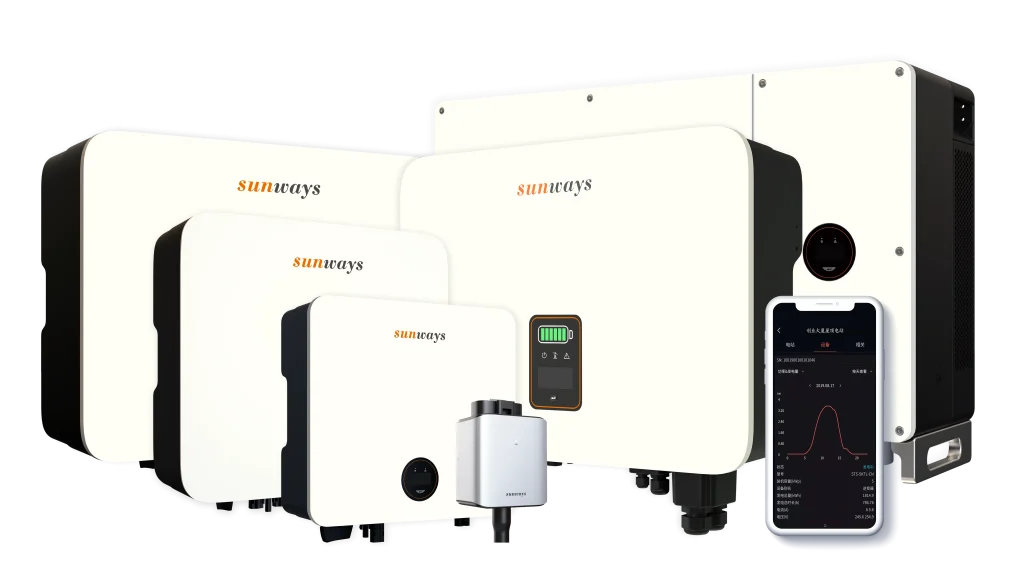
If you are planning a Solar PV, Battery Storage, or Backup Power project, please provide Sunways with your PV capacity, load profile, grid conditions, and backup requirements.
Based on your specific project needs, we can help you select the appropriate inverter, energy storage capacity, and system architecture.
Reference
U.S. Department of Energy (DOE), Solar Integration: Solar Energy and Storage Basics
U.S. Energy Information Administration (EIA), Energy Storage for Electricity Generation
Start Your Project