Solar Battery Cost: How Much Should You Really Spend?
Table of Contents
How much should you actually spend on solar panels? A reasonable budget should be based on a comprehensive installation quote that meets your actual electricity needs. When assessing the cost of solar panels, first identify which appliances need to be powered and for how long, then compare the total cost of the panels, ancillary equipment and installation.
If you wish to use solar energy stored during the day at night, the key considerations are your night-time electricity consumption and the amount of surplus energy that can be stored. If the primary aim is to cope with power cuts, you should first identify the essential appliances and the required backup duration, and confirm that the system can provide power during an outage. These requirements will influence the system configuration and budget.
To determine whether an expenditure is worthwhile, you must also take into account local electricity prices, projected savings on electricity bills and warranty terms. This article will break down the key factors affecting costs, helping you to understand quotations, assess which configurations are worth investing in, and identify which expenses can be avoided.
How Much Does a Solar Battery Cost to Buy and Install?
The budget you set aside should cover a system that meets your electricity consumption targets and is ready for use. When comparing solar battery costs, first clarify which category the quote falls into: a standalone battery, an add-on to an existing solar installation, or a new installation comprising both solar panels and a battery.
Battery Price vs Installed Cost: Real Price Examples
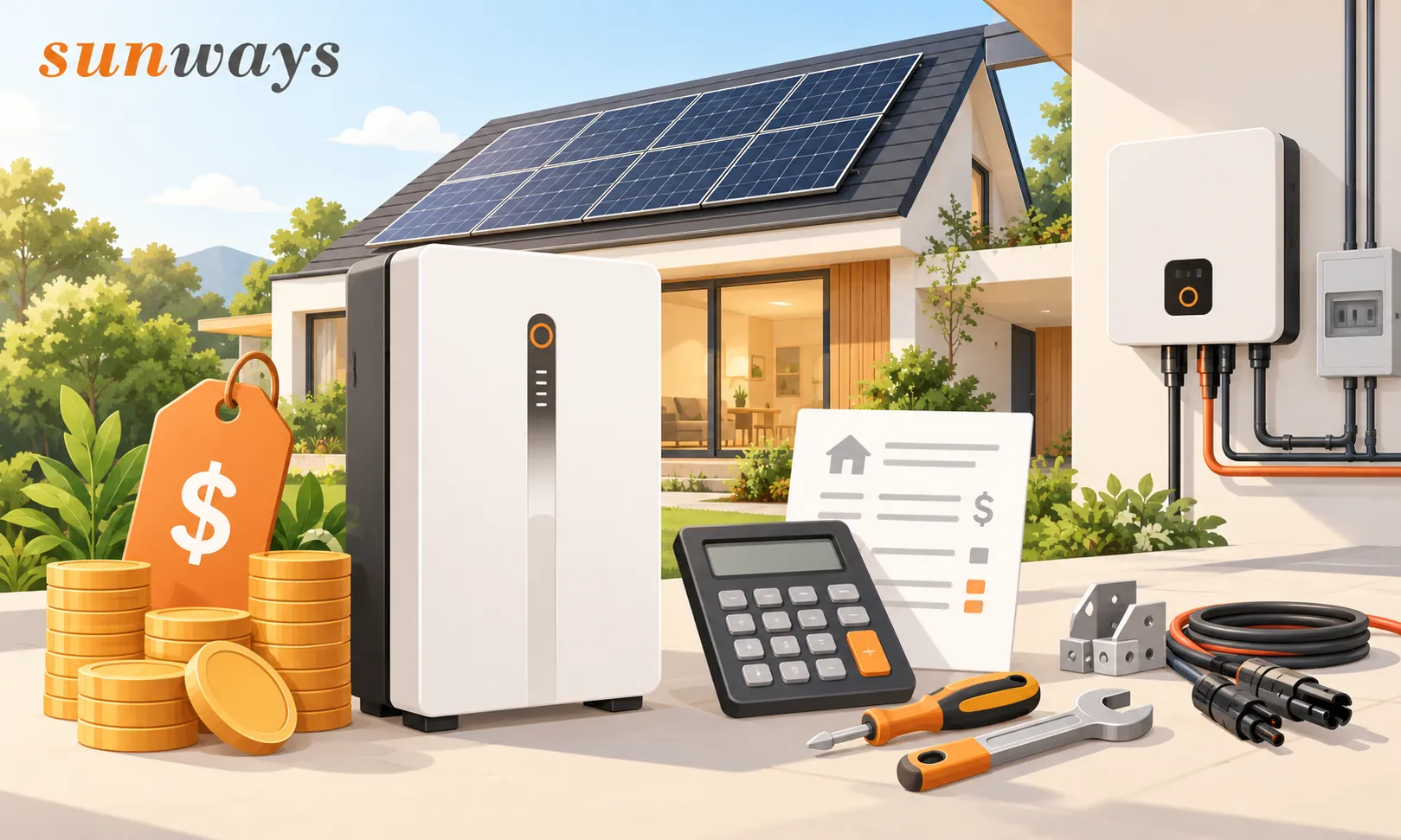
The following are publicly listed prices from suppliers, verified on 19 October 2026. Configurations are quoted as stated on the suppliers’ websites. These are examples of specific quotations and do not represent national average prices.
| Purchase Scenario | Market and Configuration | Listed Price | What You Need to Be Aware Of |
|---|---|---|---|
| Battery only | India · Loom Solar Nominal 5 kWh rack-mounted battery | ₹99,000 Indian rupees | This is the listed price for the battery unit; full installation costs, taxes and delivery terms must be confirmed. |
| Retrofitting to an existing PV system | Veneto, Italy · Voltio 5 kWh rated energy storage solution | From €4,500 Excluding VAT | The page lists the battery, compatibility check, installation, cabling and protection; the scope of any additional modifications and backup power during power cuts must be confirmed. |
| New installation of PV and battery together | Triveneto, Italy · Atelio Rated 3.29 kW PV + 5 kWh battery | €6,863 Including VAT and installation | This is a price for the complete system; the final price is subject to on-site assessment, and the scope of backup power supply must be verified separately. |
As the table above covers different countries, equipment and tax regimes, installation costs cannot be calculated by simply subtracting one figure from another.
What Makes One Quote More Expensive?
Check these three points first, then decide whether the more expensive option is worth it:
- Energy and output: The amount of available electricity determines how long the system can supply power; output power limits which appliances can be powered simultaneously. Comparing capacity alone can easily overlook actual load requirements.
- Inverter Modifications: Ask the installer to confirm whether your existing inverter is compatible with the selected battery system. If additional equipment is required or the inverter needs replacing, request a separate quotation.
- Installation and emergency power coverage: Check the wiring, protective equipment, labour costs and taxes. If you require power supply during a power cut, also confirm the switching equipment and connection circuits. Separate quotations should be obtained for powering only a fridge and lighting versus full-house emergency power.
Battery capacity, output power and emergency power capability during a power cut are distinct selection criteria. Even after installing a battery, appropriate configuration is required to ensure power supply during a power cut.
5 kWh vs 10 kWh: Is the Bigger Battery Worth the Extra Cost?
The additional cost is only justified if the extra capacity meets electricity demands that cannot be covered by a smaller configuration. To determine whether 5 kWh or 10 kWh is right for you, check your electricity requirements, the actual available power supply, the output capacity and the charging conditions in turn, then compare the price difference.
① Calculate Your Energy Needs First
List only the appliances you intend to power from the battery. Calculate the power consumption for each using the formula “average power (W) ÷ 1,000 × hours of use”, then add the results together. This will give you your electricity requirement, measured in kWh (kilowatt-hours, commonly known as ‘electricity units’). As the power consumption of refrigerators and air conditioners can vary, prioritise using actual electricity usage records for your estimate; do not simply treat the maximum power rating as the average for the entire period.
For example, suppose the average total power consumption of these appliances is 1.5 kW and they need to be powered for 4 hours; the electricity required would be 1.5 × 4 = 6 kWh. If the system relies entirely on the battery during this period, with no other power source to supplement it, a configuration with a rated storage capacity of 5 kWh would be insufficient.
② Compare Usable Energy, Not Just the Capacity on the Label
A 10 kWh system could be a candidate for the next tier, but you cannot assume it will be sufficient based solely on the label. Usable capacity refers to the range of electricity that the manufacturer permits for actual charging and discharging, which is not necessarily equal to the rated capacity. You must also verify how much energy is stored at the start of power supply, as well as account for conversion losses and the reserve energy that needs to be retained.
Referring to the previous example, ask the installer to clarify: Given the estimated initial charge, and taking into account losses and the agreed reserve, can the system supply at least 6 kWh to your appliances? Also, confirm whether the capacity figures have already factored in relevant limitations to avoid double-counting the same losses or reserves.
③ Check Power and Recharging Before You Upgrade
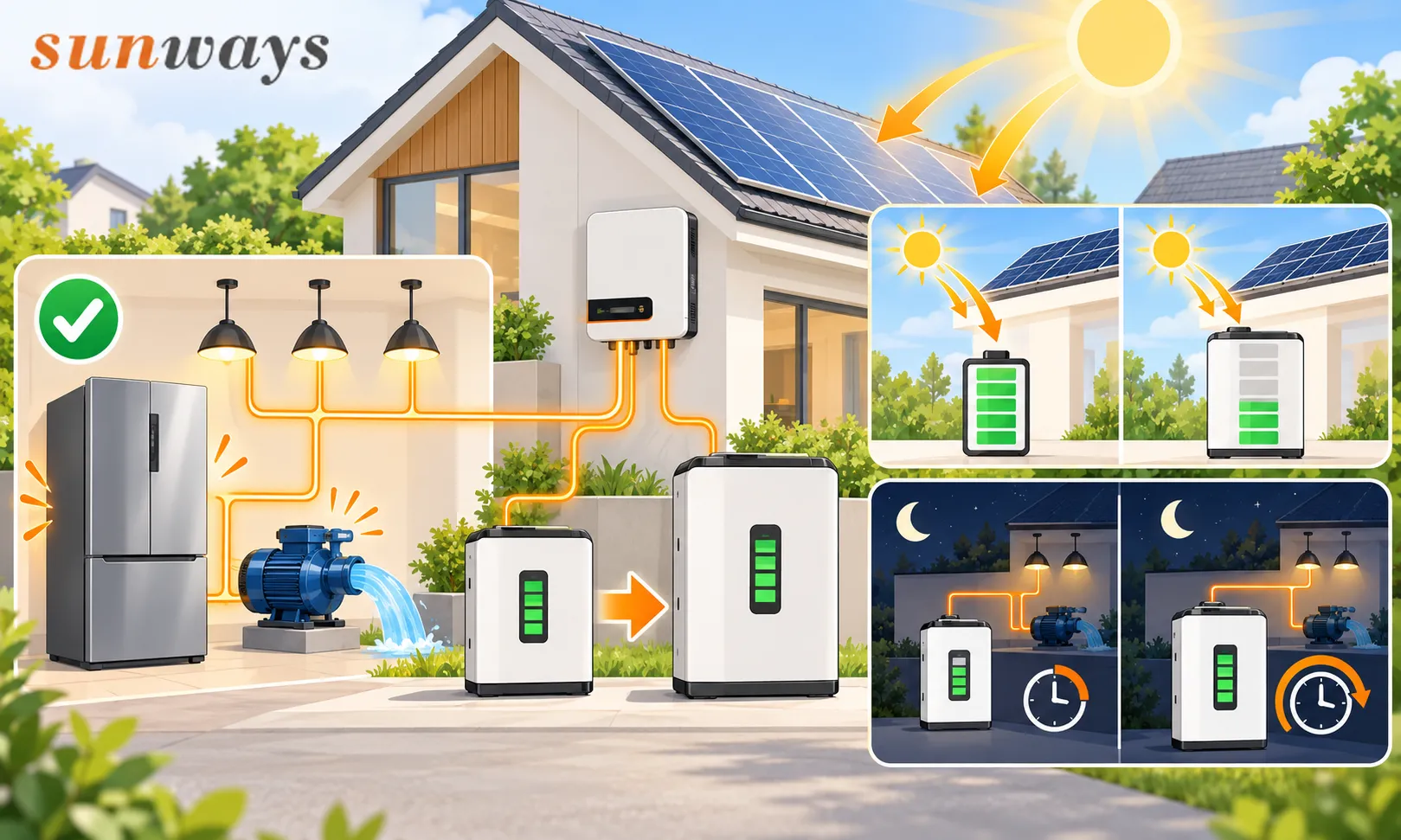
First, check whether the system can power the appliances you intend to use simultaneously. For example, if you run the fridge, water pump and lighting at the same time, ask the installer to confirm that this battery and inverter combination can handle the load, particularly during the initial start-up of the fridge and water pump. Upgrading to a 10 kWh system may simply allow for longer usage times, but it does not necessarily mean you can run more appliances simultaneously.
Next, check whether the additional capacity can actually be charged and utilised. If a 5 kWh system already accommodates surplus solar energy during the day and is sufficient for evening use, there is no need to upgrade simply for the sake of greater capacity. If you wish to extend your power supply by a few hours during a power cut, ask the installer to calculate, based on the same set of appliances, exactly how much longer the upgraded system will provide power before deciding whether it is worth the extra cost.
④ Compare the Extra Cost, Not Just Cost per kWh
Ask the installer to provide two configuration options based on the same market, the same quotation date, and the same scope of installation and backup power coverage. When comparing solar battery cost per kWh, you can use the formula: “total installation cost for the same scope ÷ verified usable capacity”. This represents the initial installation cost per unit of available capacity, not the cost per kilowatt-hour over the battery’s entire service life. Any additional modules or inverter modifications required to increase capacity must also be factored in; do not assume that the total price for 10 kWh is simply double that of 5 kWh.
It is advisable to ascertain how long each of the two configurations can supply power to the same set of electrical appliances under identical initial conditions. If the smaller configuration already meets the requirements for duration, simultaneous load and reserve capacity, stick to that budget; if it is insufficient, weigh up the options between increasing capacity, reducing the number of appliances powered, or shortening the power supply duration. A lower cost per unit of capacity can serve as a point of comparison, but should not be the sole factor in determining the size of your system.
Lithium vs Tubular Batteries: Which Costs Less for Your Use?
If the batteries are only required as a backup for occasional power cuts and your existing batteries still meet your needs, you should first assess whether to continue using them; there is no need to rush into replacing them with lithium-ion batteries. If you need to charge and discharge them daily, you should compare maintenance and charging costs alongside potential replacement costs; you should not simply choose the option with the lowest purchase price. Tubular batteries are a type of lead-acid battery; the comparison here is between lithium-ion batteries and tubular lead-acid batteries.
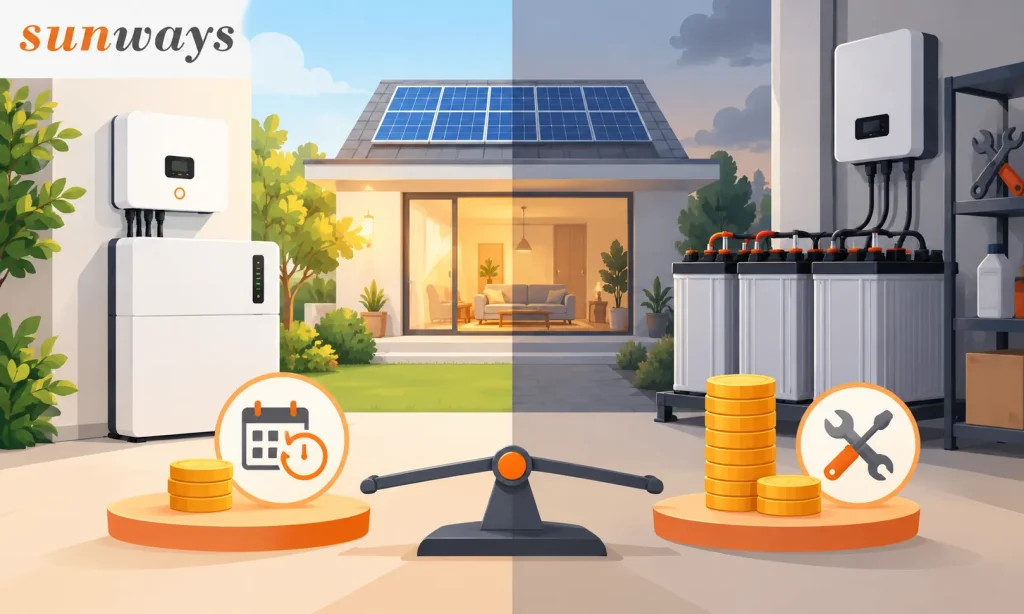
1. Compare the Same Backup Job
Ask the installer to provide a manufacturer-supported lithium-ion solution and a tubular lead-acid solution, ensuring that both can power the exact same set of appliances for the same duration. For example, if you need lighting, a fan and a router to run until bedtime, compare the entire battery system and associated costs based on this objective. Do not compare the price of a single tubular battery directly against an entire lithium-ion system.
Nor should you compare based solely on Ah. Ah (ampere-hours) is a unit of battery charge capacity; it does not directly tell you how many kilowatt-hours of electricity the appliances will consume or how many hours they will run. You must also take into account voltage, the permissible discharge range and the actual load. Before comparing prices, ask the installer to specify in writing: how many batteries each system requires, how much usable energy each system can provide, and whether your existing inverter can be retained.
2. Factor in Maintenance and Replacement Costs
When comparing lithium solar battery costs, include the battery pack, installation and modification costs, maintenance services, charging costs, and substantiated replacement costs on the same list. Common flooded lead-acid batteries require the liquid level to be checked and distilled water topped up according to the manual; lithium batteries do not require water topping up, but must still comply with installation, usage and inspection requirements. The fact that they do not require water topping up does not mean they are completely maintenance-free.
If a supplier claims that “lithium batteries are more economical in the long run”, ask them to specify: based on your usage frequency, how long do they expect the batteries to last? Under what temperature conditions and with what discharge rates were the lifespan figures obtained? Does the warranty cover a free replacement, or will you only be able to exchange them for a new unit at a discounted price later on? Who bears the costs of labour and transport? In the absence of relevant documentation, list the cost items first; do not assume that lead-acid batteries need replacing every few years, nor should you treat the warranty period as a guarantee of service life.
3. What Changes When You Replace an Existing Battery?
Before replacing a battery, first confirm whether the old equipment can still be used, then compare quotes. When switching from tubular lead-acid to lithium-ion batteries, do not simply assume that the plugs are compatible or that the nominal voltages are similar. Ask the installer to verify whether the inverter and charging equipment support the selected battery, whether charging settings need adjusting, and whether cables and protective devices need replacing.
For lithium-ion batteries, you must also verify how the BMS (Battery Management System, used to monitor and protect the battery) interfaces with the charging equipment, and whether communication between the devices is required. Different combinations have different requirements; refer to the documentation provided by both manufacturers. All these adjustments must be factored into the solar battery replacement cost.
For occasional backup power, prioritise retaining a system that is already functioning correctly or adopting a replacement solution supported by the manufacturer; for frequent charging and discharging, compare the costs and service levels of both combinations under identical usage conditions. The initial cost saving depends on the full quotation, whilst long-term savings must be assessed based on maintenance, lifespan and replacement requirements; conclusions should not be drawn solely on the basis of battery type.
Adding a Battery to Existing Solar: What Else Might Need to Change?
Adding a battery does not necessarily require replacing the inverter. First, check which connection methods your existing equipment supports, then assess what new equipment is required and which wiring modifications are needed. Do not buy a battery first and then try to sort out compatibility issues later.
Can You Add a Battery Without Replacing the Inverter?
If you are using a hybrid inverter—that is, a device capable of managing both the solar array and the battery simultaneously—first ask your installer to check whether it supports the battery you intend to purchase. Do not rely solely on the product name; you must also confirm the full model number, battery configuration, software version and local applicability requirements.
If your existing solar inverter cannot be connected directly to the battery, this does not necessarily mean it must be removed. An alternative approach is to retain it and install additional energy storage equipment to manage battery charging and discharging.
What Does Each Option Require?
You will come across the terms ‘AC’ and ‘DC’. AC stands for alternating current, which powers most household appliances; DC stands for direct current, which is used by solar panels and for charging and discharging batteries. AC coupling involves adding energy storage equipment to the household’s AC distribution side; common DC solar-storage solutions, on the other hand, connect the solar panels to the batteries via a compatible hybrid inverter.
| Retrofit Option | What Can Be Retained | What Needs to Be Added or Modified |
|---|---|---|
|
1
The existing hybrid inverter already supports the selected battery
|
The inverter (verified as compatible) and existing PV equipment | The battery, connection accessories, and any necessary wiring, protection and configuration |
|
2
Retain the PV inverter and install on the AC side
|
PV inverter and original PV components found suitable for continued use following inspection | Battery and energy storage inverter, or energy storage equipment with a built-in inverter; new AC wiring and protection |
|
3
Upgrade or replace, adopting a compatible DC photovoltaic-storage
solution
|
Modules, wiring and other components verified as suitable for continued use | Hybrid inverter, batteries, as well as removal of old equipment, rewiring and protection modifications |
All three approaches require verification of metering, communication and commissioning. Put simply, this refers to how the system knows how much electricity is being used in the home, how devices exchange information with one another, and how to confirm proper functionality after installation. Whether existing components can be reused and whether new equipment has the relevant functions built-in should all be specified in the proposal to avoid omissions or duplicate purchases.
Do You Need a Backup During a Power Cut?
‘Being able to store electricity for use at night’ does not equate to ‘being able to supply power during a power cut’. If you require a backup power supply during a power cut, you must ensure the installer clearly specifies: how the system will be isolated from the grid following a power cut, which electrical appliances will continue to operate, and what equipment will handle the switchover. The switchover function may already be built-in, or it may require additional equipment and adjustments to the electrical circuits.
If you are retaining your old solar inverter, you should also ask: After a power cut, will the existing solar system continue to generate electricity and charge the battery, or will you only be able to use the electricity stored in the battery? This depends on the specific equipment and wiring configuration; it cannot be determined simply by terms such as ‘AC-coupled’ or ‘hybrid inverter’.
Do You Need a Backup During a Power Cut?
When comparing solar battery installation costs, ensure the quote clearly distinguishes between items to be retained, added, removed and commissioned, and specifies what requirements each new piece of equipment addresses. For example, if you require the fridge and lighting to continue operating during a power cut, the quote should clearly outline the corresponding circuits and switching arrangements, rather than simply listing the battery. This is an example of a quote check and not a record of an actual project.
If a manufacturer supports a direct connection path, assess this option first; if the existing equipment is functioning well, obtain a quote for adding an AC unit whilst retaining the existing equipment; if replacement is already necessary, compare the price of a complete retrofit compatible with DC solar-storage systems. Retaining the old equipment may save on replacement costs, but there will still be expenditure on new energy storage equipment and installation. Only by comparing comprehensive quotes for equivalent functionality can you determine which approach is more suitable; you cannot assume that AC or DC is always cheaper.
Backup or Night-Time Use: What Are You Paying to Power?
If you’re on a tight budget, prioritise paying for appliances that cannot cope without power; don’t automatically opt for a whole-house backup system. If your main aim is to reduce your night-time electricity costs, configure your system to store enough energy during the day to use at night; if you want more appliances to continue functioning as normal during a power cut, set aside a budget for the necessary power supply capacity and electrical rewiring.
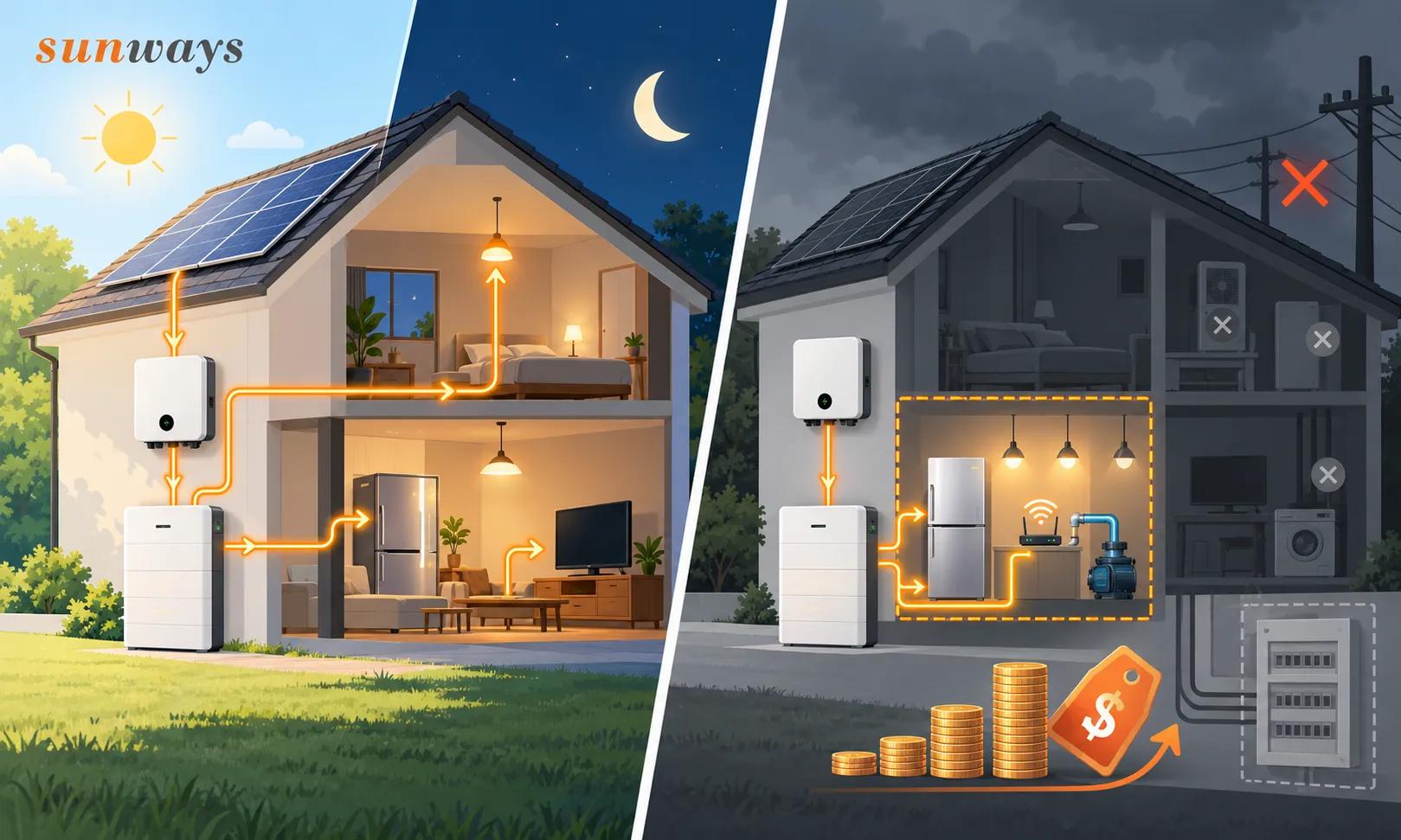
Choose Your Main Goal First
| Your Main Objective | What You Need to Provide Before a Quote | Where Your Budget Should Be Spent |
|---|---|---|
| Essential Backup Ensuring essential appliances work during a power cut | List of appliances, power consumption at idle and when switched on, duration of power required, desired amount of backup power | Required capacity, load-carrying capacity, protection and switching mechanisms, and related wiring work |
| Night-Time Use Storing electricity during the day for use at night | Actual surplus electricity during the day, night-time electricity consumption records, available charging periods, local electricity contract | The amount of electricity that can actually be stored and used, as well as charging and discharging capacity and metering controls |
| Extended Backup Wider-range or whole-house backup power | Appliances running simultaneously, start-up requirements, home wiring configuration, coverage area and duration | Corresponding output and capacity, wiring modifications and switching equipment; assess the load first, then provide a quote |
For example, if you only require the fridge, lighting and router to remain operational during a power cut, ask the installer to confirm the circuit—that is, the wiring in the fuse box that supplies power to these appliances. If tasks such as laundry, heating or charging can be postponed, there is no need to automatically include them in the backup power scope. These are examples of requirements, not a list of appliances from a specific household.
When comparing whole-home battery backup costs, be sure to clarify exactly which appliances are included under ‘whole home’, which can be operated simultaneously, and for how long. Connection to the whole-home circuit does not mean that all appliances can be operated at the same time. Your home’s single-phase or three-phase electrical distribution must also be compatible with the system; the issue cannot be resolved simply by increasing battery capacity.
If you are purchasing a battery solely for night-time use, you must also check the price of electricity at night, as well as how the settlement works for surplus electricity fed back onto the grid during the day. Storing surplus electricity will alter your electricity consumption and feed-in tariff revenue; actual savings should be calculated based on your contract.
Does a Solar Battery Automatically Provide Backup Power?
No. Even with a battery installed, you must ensure the entire system supports power supply during a power cut. You need to verify the inverter, battery connection interfaces, grid isolation and switching functions, connection circuits and control settings. No matter how large the battery capacity, it cannot replace missing backup power functions. Backup power configuration criteria
Quotations should at least specify: which appliances will continue to operate after a power cut, whether the switchover is automatic, and how long the system can supply power based on the agreed initial charge and load. Do not accept quotations that merely state ‘supports backup power’ without specifying the scope or conditions.
What If You Want Both Night-Time Use and Backup?
If you wish to use the battery at night whilst also ensuring power is available during a sudden power cut, you must set aside a portion of the battery’s capacity for backup. **With a single charge and no additional charging, the more you use for daily consumption, the less remains for emergencies. ** Systems that support backup capacity settings can allocate power according to your needs; specific functionality should be confirmed with the manufacturer.
We recommend categorising your appliances into three groups: ‘must be guaranteed’, ‘can be paused’ and ‘not connected to backup power’, then ask the installer to provide separate quotes for the essential circuit configuration and the additional costs for an expanded scope. First, check which of the appliances you genuinely need are covered by the additional cost before deciding whether to upgrade.
Is a Solar Battery Worth It—and What Determines Payback?
If the primary aim is to save on electricity bills, you need to assess whether the net annual savings from the battery can cover the additional investment; if the main purpose is to provide backup power during power cuts, you must consider separately whether this level of security is worth the cost. A reduction in electricity bills does not necessarily mean a return on investment, nor should all the savings from the existing solar panel system be attributed to the new battery.
Compare the Same Home With and Without a Battery
Ask the installer to calculate the annual costs for both a ‘no battery’ and a ‘battery included’ scenario, based on the same property, the same solar panel system and the same electricity consumption. The difference represents the impact of the battery. Both sets of projections should use the same weather and electricity consumption data; any changes to the electricity supply contract must also be clearly stated.
First, verify the returns using the following criteria:
Annual net monetary benefit from the battery = reduction in electricity purchase costs – reduction in surplus electricity revenue – additional operation and maintenance costs.
‘Surplus electricity revenue’ refers to the income that would originally have been earned by feeding surplus solar power into the grid. By storing this electricity in the battery instead, this revenue may decrease. If the battery is charged using low-cost grid electricity, this expenditure must also be included in the post-installation electricity purchase costs; one must not simply calculate the savings made during discharge.
Calculations must be based on the actual amount of electricity transferred via the battery and used to replace grid electricity, taking into account losses, reserve capacity and usage periods. If these factors are already reflected in the electricity consumption and billing forecasts, do not deduct a ‘loss charge’ a second time. Furthermore, do not multiply the battery’s nominal capacity by the number of days in a year and treat this as the annual saving in electricity costs.
Calculate Payback Only After Checking the Inputs
Simple payback period (years) = net incremental initial investment in the battery solution ÷ annual net monetary return.
The “net incremental initial investment” refers to the additional cost incurred compared to a system without a battery, including the battery itself, necessary modifications and installation, etc., minus any one-off grants that have been verified as eligible and have not yet been deducted from the quotation. Do not include photovoltaic costs that have already been paid, and do not deduct grants twice.
The payback period should only be calculated when the inputs have been verified and the annual net revenue is greater than zero. If the annual net revenue is zero or negative, a positive initial investment cannot be recouped through this revenue stream. Furthermore, this simple calculation does not fully account for battery degradation, replacement costs or the cost of capital. Degradation refers to the gradual reduction in the amount of electricity the battery can store and supply over time; consequently, the savings from the first year cannot be applied directly to subsequent years.
Test Whether the Estimate Still Holds True
Taking the scenario of storing surplus solar power for self-consumption as an example, and using the same quotation, examine the following variations. These illustrate the direction of impact, not the actual results for any specific household.
| Change in Conditions | Impact on Payback Period All other conditions being equal |
|---|---|
| Insufficient surplus electricity; the actual amount stored and used to replace purchased electricity is reduced. | Savings decrease; payback period lengthens. |
| Electricity consumption patterns align better; more stored electricity can replace what would otherwise need to be purchased. | Annual returns may increase; payback period shortens. |
| Electricity purchase price remains unchanged, but income from feeding surplus electricity into the grid increases. | Storing electricity means forgoing more income; the payback period may lengthen. |
First, examine the sources of the surplus electricity, electricity consumption and electricity price data for each scenario, then consider the payback results. Do not simply accept optimistic predictions that ‘the battery will be fully charged every day and all stored electricity will replace high-cost purchased electricity’. Official guidelines also caution that the savings generated by the battery may not necessarily be sufficient to recoup the investment within its service life.
My advice is: If your primary aim is to save on electricity bills, but the actual amount of electricity that can be transferred is small and the net profit is insufficient, you should scale back your setup or postpone your purchase; if your primary aim is to have a backup power supply, set your budget based on essential appliances and your target duration. Protection against power cuts can be a reason to buy, but you must not equate ‘greater peace of mind’ with a fixed annual saving.
Before You Accept a Quote, Check These Costs and Responsibilities
A truly comprehensive quotation must clearly state what you will receive, any additional costs you may incur, and who is responsible for installation and after-sales service. First, ensure that the key features, cost ranges and responsibilities are fully specified, then compare the total prices. A lower price is not in itself proof that a quote offers better value, nor is it sufficient grounds to judge a supplier as unreliable.
Mark Every Item Before Comparing Totals
Compare the two quotations based on the same market, similar dates, identical power supply requirements and site conditions. Mark each item as ‘Included’, ‘Not included’, ‘Charged separately’ or ‘Unconfirmed’. If a quotation does not specify an item, mark it as ‘Unconfirmed’ first; do not assume it is included by default. Items marked as ‘Charged separately’ should specify the amount or the basis for calculation.
The following is a checklist, not a comparison of actual quotations. You can use it to check the two quotations item by item:
| Checkpoint | What the Quotation Must Specify |
|---|---|
| Batteries and Accessories | Full model numbers, quantities, and whether brackets, bases and connection accessories are included |
| New or Replacement Inverters | Whether to retain or replace the existing unit; whether there are charges for new equipment, removal of old equipment and disposal of old equipment |
| Metering and Communication | Components and settings required for measuring household electricity consumption and device communication; whether there are ongoing charges for monitoring services |
| Protection, Switching and Wiring | Wiring and scope of protection; if backup power is required, which electrical circuits are connected and whether switching functions are included |
| Installation, Commissioning and Taxes | Transport, installation, configuration and functional testing, as well as taxes; what is included in 'standard installation' and how are charges calculated for anything beyond this |
| Handover and After-sales Service | Who carries out the installation, what documentation is provided, and how functionality is verified; who to contact for product and installation warranty claims respectively |
Check Who Handles Problems—and Who Pays
Even if the warranty periods are the same, this does not mean you will bear the same costs or receive the same level of service. Ask separately about equipment faults and installation issues: who to contact, who will carry out on-site inspections, under what circumstances repairs or replacements will be provided, and who bears the costs of labour, transport and dismantling/reassembly. Also confirm the service coverage area, response arrangements, and whether there are any additional charges for maintenance or monitoring services.
Ask the supplier to list the names and contact details of the seller, the installation contractor and the after-sales service provider. If these are not the same company, ensure the fault reporting and coordination procedures are clearly set out. Do not simply accept a verbal response such as ‘contact the manufacturer if there is a problem’. When comparing quotations, cost transparency and after-sales support should also be factored into your decision.
Ask for a Revised Quote When the Scope Changes
For example, you may require the fridge and lighting to continue operating during a power cut, but the quotation only states ‘battery + installation’, without specifying the backup power circuit or the scope of the switch-over. First, ask the supplier to confirm whether the existing quotation meets your requirements; if not, list the additional equipment, works and costs required, and request a revised quotation. Retain the original quotation and insist that the revised version clearly states what has been added or removed, the reasons for the adjustments, the difference in cost, and who is responsible. After verifying the quotation’s validity period, taxes, fees, payment and delivery terms, compare the total costs.
What Should You Buy Now—and What Can Wait?
What you should buy now is a setup that can meet your current power supply needs and has proven compatibility. When assessing the cost of a solar battery, prioritise your budget for the appliances that need power, the actual amount of electricity you will use, and the full installation. Whole-house backup power, higher capacity or additional equipment should only be added once there is a clear need for them.
Choose Your Next Step
| Your Current Situation | Action to Take Now |
|---|---|
| Only need to power a small number of essential appliances during a power cut | First obtain a comprehensive quote for the necessary circuits; do not extend to whole-house backup power without load data |
| You have records of night-time electricity consumption and surplus daytime electricity | Compare manufacturer-supported configurations and total installation costs that can actually replenish energy and cover your target consumption |
| Existing hybrid inverter has a manufacturer-approved battery connection solution | First assess this approach and the required accessories, then decide whether to add other energy storage equipment |
| Existing equipment is operating normally; no plans to replace it at present | First obtain a retrofit proposal for the existing equipment, then compare the scope and costs with a replacement solution |
| Compatibility, backup power capacity or quotation range are still unclear | First, obtain a complete written proposal and supporting documentation; do not finalise the procurement package at this stage |
| The primary aim is to save on electricity bills, but the amount of electricity that can be transferred is limited and the returns are insufficient | First, assess whether to scale down the configuration or postpone the purchase; recalculate after supplementing records of electricity consumption and surplus generation |
When making an enquiry, please first specify your country or region, whether you are a property owner or an installer, and whether you are planning a new installation or an upgrade to an existing PV system. Then provide the known inverter model, the electrical appliances requiring power and their operating times, your backup power or electricity cost-saving targets, and your budget range. If the model is unclear, you may attach a photograph of the equipment label; existing quotations may also be provided as supplementary information – there is no need to prepare a full set of project documents at this stage.
Review Sunways’ residential PV and energy storage solutions, then discuss suitable system configurations based on your existing equipment and electricity consumption targets.
Start Your Project