Commercial Energy Storage System: Where Do the Real Savings Come From
Table of Contents
By deploying a commercial energy storage system, businesses can reduce electricity costs through peak shaving and by taking advantage of peak-off-peak pricing. At the same time, energy storage can increase the self-consumption rate of solar power and provide backup power during outages to minimize the impact of power outages on business operations.
How can you determine whether energy storage is a worthwhile investment? This article will help you assess which commercial energy storage solution is best suited for your project by covering topics such as how it works, application scenarios, capacity selection, costs, and ROI.
What Is a Commercial Energy Storage System?
A commercial energy storage system is an electricity storage and dispatch system designed for commercial and industrial users. This system stores electrical energy from solar panels or the grid in batteries and charges or discharges them based on load, electricity rates, solar generation, and grid conditions. It helps you reduce electricity costs, improve energy efficiency, and enhance power supply reliability.
Within the industry, commercial ESS, C&I energy storage system, and commercial BESS are commonly used to describe these battery-based commercial and industrial energy storage systems.
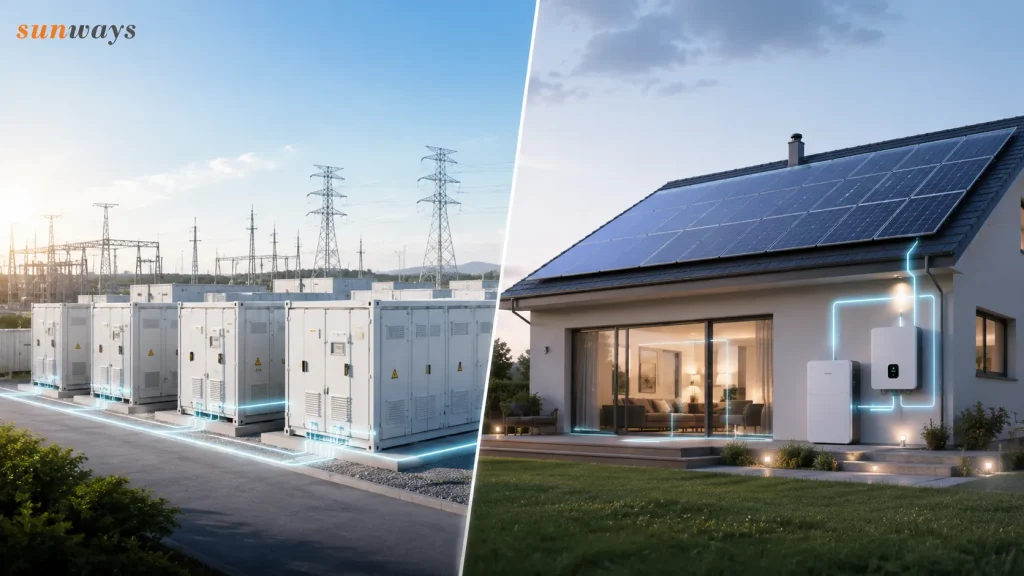
Commercial vs. Residential Energy Storage
| Residential | Commercial / C&I |
|---|---|
| Household load | Commercial and industrial load |
| Self-consumption + Backup | Peak shaving + Self-consumption + Time-of-Use (TOU) + Backup |
| Relatively simple system | More reliant on EMS and smart scheduling |
| Focus on household electricity bills | Greater focus on ROI and operating costs |
How Does a Commercial Energy Storage System Work?
A commercial energy storage system stores electricity from solar panels or the grid in batteries and charges and discharges them based on load, electricity rates, and grid conditions.
Compared to residential energy storage, commercial battery storage typically offers higher power and capacity, and integrates batteries, PCS/hybrid inverters, BMS, and EMS for energy management. For businesses with solar installations, commercial solar battery storage can also store excess solar energy generated during the day for use when needed, thereby increasing the rate of self-consumption of solar power.
Main Components of a Commercial BESS
| Component | Main Function |
|---|---|
| Battery | Stores electrical energy |
| BMS | Monitors battery status and provides protection |
| PCS / Hybrid Inverter | Performs bidirectional AC/DC conversion |
| EMS | Manages and optimizes charging and discharging |
| Smart Meter | Collects grid and load data |
| Cloud Platform | Remote monitoring, alerts, and operations and maintenance |
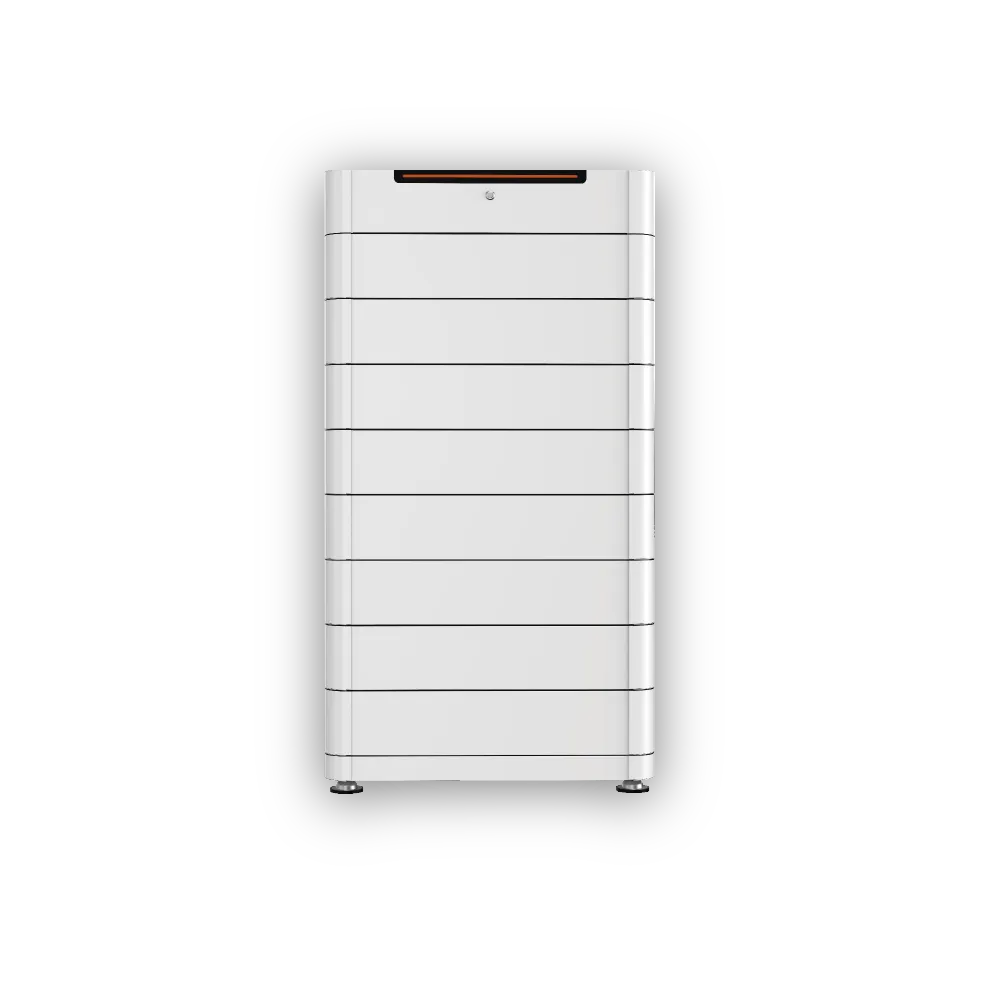
Battery & BMS
The battery is responsible for storing electrical energy. The BMS continuously monitors SOC, voltage, current, and temperature and provides protection during the charging and discharging processes.
PCS / Hybrid Inverter
The PCS or Hybrid Inverter handles bidirectional power conversion between the battery and the AC system. During charging, it converts AC power to DC power and stores it in the battery; during discharging, it converts DC power from the battery to AC power to supply commercial loads or exchange energy with the grid. Depending on the project architecture, a C&I energy storage system can use a standalone PCS or a Hybrid Inverter that manages both the PV system and the battery.
The EMS automatically adjusts charging and discharging strategies based on commercial loads, PV generation, electricity rates, and battery SOC. Commercial BESS not only stores electricity but also schedules and utilizes it according to demand.
Why Are Businesses Investing in Commercial Battery Storage?
Commercial battery storage can help you reduce electricity costs, improve solar utilization, and minimize the impact of power outages or peak loads on your business.
① Peak Shaving
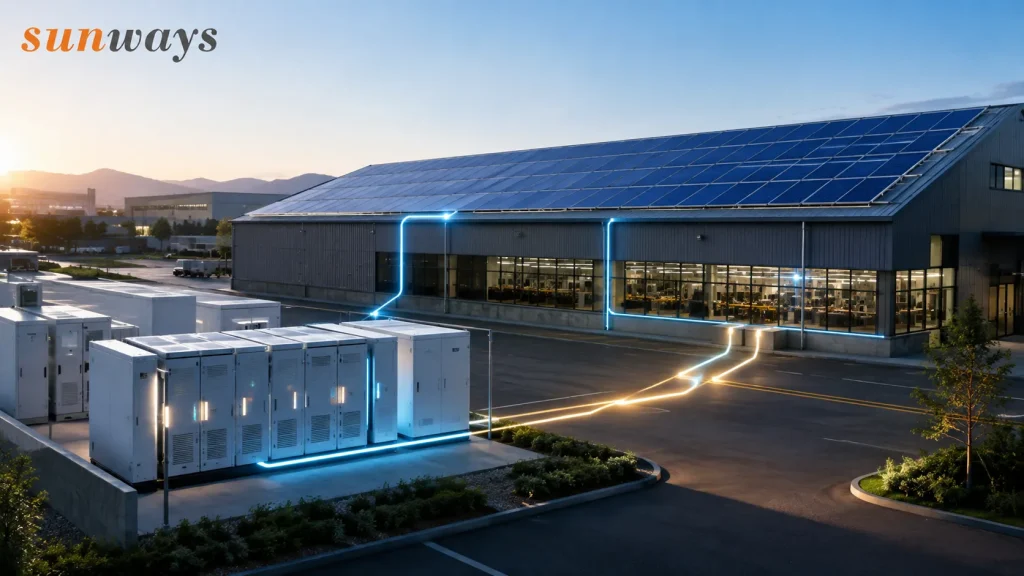
When a business’s load reaches its peak, the battery can release some power to reduce the peak power drawn from the grid, thereby alleviating peak demand pressure. The DOE also lists peak shaving as a typical application of BESS.
For example, if your load reaches 500 kW and you want to limit grid draw to 400 kW, the battery can supply approximately 100 kW during peak hours.
② Load Shifting & TOU Optimization
If your market uses time-of-use (TOU) pricing, the system can charge during off-peak hours when electricity rates are low and discharge during peak hours when rates are high, shifting part of the electricity demand to lower-cost periods. The economic viability of energy storage is therefore closely tied to the local electricity pricing structure and the business’s load curve.
③ Higher Solar Self-Consumption
For businesses that have already installed solar panels, commercial solar battery storage can store excess solar power generated during the day that cannot be immediately consumed, and supply it to the load in the evening, during peak hours, or when solar generation is insufficient, thereby reducing the need to purchase electricity from the grid. The IEA also notes that the combination of behind-the-meter energy storage and rooftop solar is becoming an important application for both businesses and households.
④ Backup Power & Business Continuity
In regions with grid instability or frequent power outages, battery energy storage systems can provide backup power for critical loads, minimizing the impact of outages on production, cooling, lighting, or IT equipment. Actual backup capacity depends on system power, storage capacity, critical loads, and the backup architecture—it cannot be determined solely by the battery’s kWh rating.
⑤ Smart Energy Management
When integrated with an EMS, commercial energy storage systems can automatically adjust charging and discharging based on load, electricity rates, PV generation, and battery SOC, and further participate in energy management applications such as Demand Response or VPP. The DOE notes that PV and batteries can also be aggregated as distributed resources into virtual power plants.
Commercial Solar Battery Storage & Applications
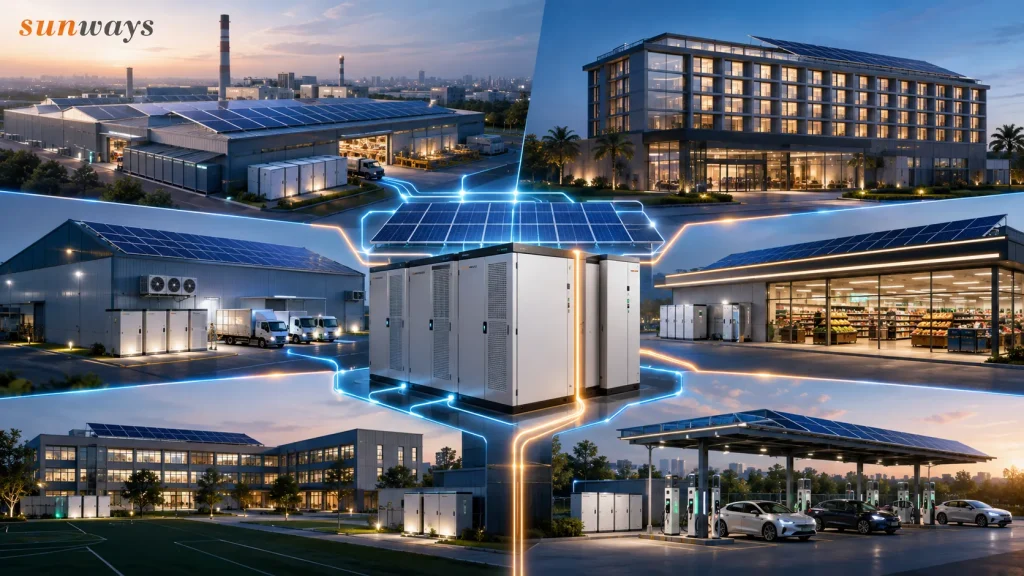
- Manufacturing & Factories — Ideal for factories with high loads and pronounced peaks; reduces peak grid draw and improves power supply reliability through peak shaving, solar self-consumption, and backup power.
- Warehouses & Cold Storage — Large rooftop areas are ideal for deploying solar panels, and solar energy storage systems can store excess electricity generated during the day to support critical loads such as refrigeration.
- Hotels & Commercial Buildings — With long-running loads such as air conditioning and lighting, these facilities can optimize electricity usage during high- and low-cost periods by combining TOU tariffs and EMS.
- Supermarkets & Retail — Refrigerated display cases, lighting, point-of-sale systems, and air conditioning require a continuous power supply; commercial battery storage can reduce peak loads and provide backup power for critical equipment.
- Schools, Hospitals & Public Facilities — Ideal for projects focused on both energy cost management and backup power, especially those with critical loads.
- EV Charging Sites — Simultaneous operation of multiple charging stations increases peak power demand; energy storage can be used for peak shaving, grid capacity support, and solar charging.
Commercial Battery Storage Sizing
kW vs. kWh: You Need Both
When selecting a commercial BESS, you must consider both kW and kWh:
| Parameter | What It Means | Why It Matters |
|---|---|---|
| kW — Power | The power the system can charge or discharge | Determines how much peak load can be reduced or how much load can be supported |
| kWh — Energy | The amount of electricity the system can store | Determines how long it can sustain power supply |
For example, a 100 kW / 200 kWh system can theoretically deliver a continuous output of 100 kW for approximately 2 hours. The DOE also notes that energy storage systems must be described in terms of both power and storage duration/capacity; kWh alone does not indicate how much power the system can deliver instantaneously.
What Data Do You Need Before Sizing?
Before determining the kW and kWh for commercial battery storage, you should first collect the following data. For peak shaving projects, the load profile is particularly important. The amount of demand charge that energy storage can save is significantly influenced by the customer’s load curve and rate structure.
| Input | What It Tells You |
|---|---|
| Load Profile | When electricity is used during the day and how the load varies |
| Peak Demand | How much peak power needs to be reduced |
| PV Generation | How much excess solar power is available for storage |
| Electricity Tariff | Which time periods are suitable for charging and discharging |
| Critical Load | Which equipment must be maintained during a power outage |
| Backup Duration | How long a continuous power supply is needed |
| Grid Limit | The maximum power the grid can provide or allow |
| Operating Goal | Peak Shaving, Backup, or Solar Storage |
Sizing for Peak Shaving
If your goal is Peak Shaving, first determine how much the peak load exceeds the target value, then assess how long that peak lasts.
For example, if a factory’s peak load is 500 kW and you want to limit grid draw to 400 kW, the battery will need to supplement approximately 100 kW. If the peak lasts 2 hours, theoretically, you’ll need about 200 kWh of storage capacity.
Sizing for Backup Power
If the primary use is for backup power, first identify which equipment must continue operating during a power outage and how long it needs to be supported.
For example, if the critical load is 80 kW and you want to provide backup for 2 hours, theoretically, you’ll need approximately 160 kWh of energy storage capacity. Additionally, the power of the PCS or hybrid inverter must be sufficient to support this 80 kW load.
Sizing for Solar Self-Consumption
If the goal is to increase solar self-consumption, first determine how much solar power is not consumed by the business in a timely manner each day. This excess electricity can be stored in the battery and supplied to the load at night or when solar generation is insufficient. The battery capacity should be determined based on the daily surplus solar power and subsequent electricity demand.
Don’t Stop at the Theoretical Number
Additional factors to consider:
- System Efficiency — Energy is lost during charging and discharging
- DoD — Usable battery capacity is not necessarily equal to rated capacity
- SOC Reserve — Backup systems may require a portion of the battery capacity to be reserved
- Battery Degradation — Battery capacity decreases over time
- PCS/Battery Limits — Power and charging/discharging capabilities must be matched
- Future Load Growth — Future capacity expansions or new loads, such as EV charging, should also be considered
What Does a Commercial Energy Storage System Cost—and What Determines the Payback?
Based on publicly available quotes for C&I projects from 2025–2026, the cost of a fully installed commercial energy storage system is typically around $280–$580/kWh. The larger the system, the lower the cost per kWh tends to be. For large-scale, standardized, containerized projects, the cost can drop to $180–$320/kWh.
The prices listed above represent the fully installed cost, which typically includes batteries, PCS, BMS/EMS, and project installation and integration. More detailed capacity-based references: 50–200 kWh at approximately $400–$480/kWh, 500–1,000 kWh at approximately $360–$440/kWh, and 1 MWh and above at approximately $320–$400/kWh.
What Determines the Cost?
The main factors affecting the cost of commercial energy storage systems include:
- Battery Capacity (kWh) — As capacity increases, the total investment rises, but the cost per kWh typically decreases.
- Power Rating (kW) — The higher the power rating of the PCS or hybrid inverter, the higher the equipment cost.
- System Integration — EMS, liquid cooling, fire suppression, transformers, and switchgear are all factored into project costs.
- Installation — Cabling, civil engineering, construction, and grid-connection work directly impact the final quote.
- Certification & Local Requirements — Grid-connection, safety, and certification requirements in different countries can also increase project costs.
What Determines ROI?
The return on investment for commercial battery storage primarily comes from peak shaving, time-of-use (TOU) savings, solar self-consumption, generator reduction, and avoided downtime. Therefore, for the same 200 kWh system, projects with significant load peaks, large peak-to-off-peak price differentials, or ample surplus solar power typically generate returns more easily than projects with stable loads.
How to Choose the Right Commercial Energy Storage System
1. Define the Application
First, clarify the intended use. Are you looking to shave peaks, store solar power, provide backup power, or use multiple functions simultaneously? Different applications will directly affect the required kW and kWh capacity of the energy storage system.
- Peak Shaving: Focus on how much peak power needs to be reduced and how long the peak lasts. For example, to reduce 100 kW for 2 hours, theoretically, you would need approximately 100 kW / 200 kWh.
- Solar Storage: Focus on how much excess solar power needs to be stored each day and how much can be consumed at night.
- Backup: The key factors are which critical loads need to be supported during a power outage and how many hours of backup are required.
- Mixed Use: If a single system is used for peak shaving, solar storage, and backup power simultaneously, a balance must be struck between capacity, power, and SOC reserve.
2. Determine kW and kWh
3. Choose the System Architecture
For new solar-plus-storage projects, consider a Hybrid Inverter; for retrofitting storage to an existing PV system, a PCS (Power Conversion System) + PV Inverter configuration is typically more suitable. The final choice should also take into account the project scale and backup requirements.
4. Evaluate the Battery
Focus on battery chemistry, cycle life, DoD, efficiency, and warranty.
LFP batteries are generally better suited for commercial and industrial energy storage due to their superior cycle life and thermal stability. DoD determines how much of the battery’s capacity is actually usable, while efficiency affects how much electricity can be recovered each day.
5. Check Safety and Protection
Verify that the system includes BMS protection, temperature management, fire suppression, emergency shutdown, and an appropriate IP rating. The BMS monitors the battery’s status and promptly addresses anomalies, while temperature management and fire suppression systems are designed to reduce the risk of overheating and thermal runaway. If the equipment is installed outdoors or in high-temperature, humid, or dusty environments, also confirm its operating temperature range and dust and water resistance.
6. Check EMS and Monitoring
The EMS can be thought of as the “control center” of the energy storage system. It automatically determines when to charge and when to discharge based on your load, electricity rates, PV generation, and remaining battery capacity. For example, it charges when electricity rates are low and discharges during peak hours to reduce demand; it prioritizes storing excess PV generation in the battery; and it can also reserve a portion of the energy for backup power during outages. In addition, the EMS should support remote monitoring and operations and maintenance, allowing you to easily view the system’s operating status, alerts, and historical data.
7. Evaluate the Manufacturer
Beyond equipment specifications, you should also assess whether the supplier can provide certifications, system selection guidance, compatibility assurance, warranty coverage, local service, and project experience. C&I energy storage systems are designed for long-term operation, so after-sales and technical support are equally important.
Why Sunways?
Sunways’ product portfolio covers hybrid inverters, energy storage batteries, energy management, and monitoring, offering a comprehensive C&I configuration approach that spans solar power generation, energy storage, and energy management. For different projects, you can select the appropriate system architecture based on whether the project is new construction or retrofit, as well as PV capacity, load, and backup requirements—rather than being limited to a single battery solution.
Commercial Energy Storage System FAQs
Q1. What is a commercial energy storage system?
A commercial energy storage system is an energy storage system designed for commercial and industrial users. It can store electricity from solar panels or the grid and charge or discharge based on load and electricity rates, serving to reduce peak demand, increase the self-consumption rate of solar power, lower electricity bills, and provide backup power.
Q2. What is the difference between a commercial BESS and a solar energy storage system?
A commercial BESS refers to a battery-based energy storage system for commercial and industrial applications that can be charged from the grid or a PV system. A solar energy storage system places greater emphasis on integration with PV systems, storing excess solar energy generated during the day for use when needed.
Q3. What are the main types of energy storage?
Common energy storage technologies can be divided into three categories: electrochemical storage, mechanical storage, and thermal storage. Commercial energy storage systems currently rely primarily on electrochemical storage, with lithium-ion batteries—particularly LFP batteries—being widely used in commercial and industrial applications.
Q4. How much does a commercial energy storage system cost?
A fully installed commercial energy storage system typically costs approximately $280–$580/kWh. The unit cost for small-scale systems is generally higher, while large containerized systems exceeding 1 MWh can drop to about $180–$320/kWh.
Q5. What are the disadvantages of battery energy storage systems?
The main disadvantages of battery energy storage systems include high upfront investment, battery degradation over time, energy losses during charging and discharging, and the need for robust temperature control and fire safety designs.
Determining whether a project is worth the investment: If your business has a significant difference between peak and off-peak electricity rates, has a surplus of solar power during the day, has high peak loads, or would suffer significant losses due to power outages, energy storage typically generates a return on investment more easily. When evaluating a project, you should total the annual peak shaving, time-of-use (TOU) savings, solar self-consumption, and backup savings, then compare these figures with the system investment, O&M costs, and battery degradation costs to calculate the estimated payback period and ROI.
Q6. Can a commercial energy storage system work with existing solar PV?
Yes. Energy storage can typically be retrofitted to existing solar PV systems. Existing PV inverter projects often use an AC-coupled configuration, connecting the battery via a standalone PCS; for new projects, a hybrid inverter or other solar-plus-storage architecture can be selected based on the system design.
Not Sure What Size Your Project Needs?
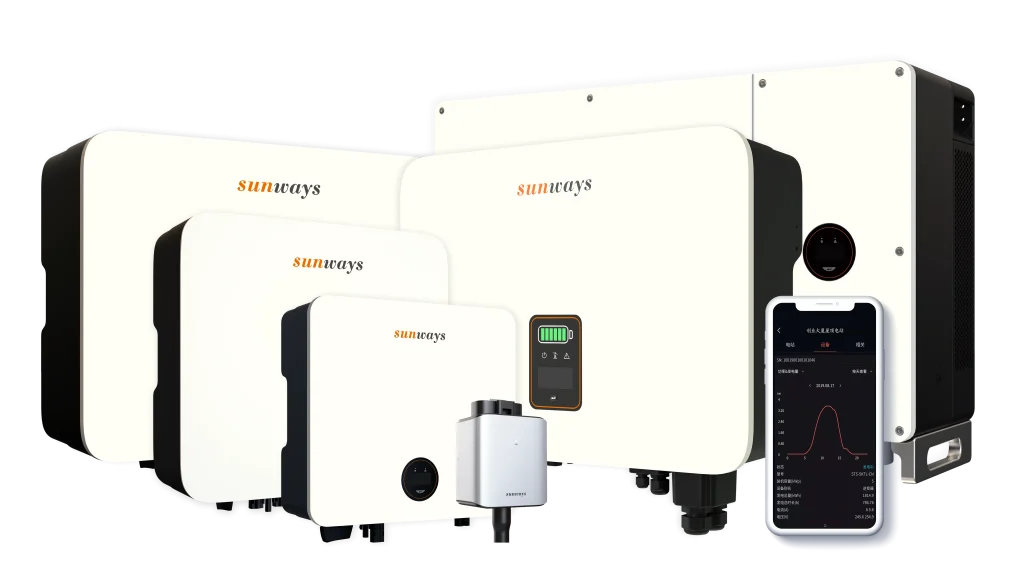
Please provide us with your load profile, PV capacity, electricity rate structure, and backup power requirements. Sunways can help you evaluate the appropriate system power, energy storage capacity, and system architecture based on your project’s specific needs, helping you avoid under- or over-capacity.
Reference
Start Your Project