
Solar Battery Storage in Iraq: How Sunways’ First 8kW Project Keeps Power On
| Project | Details |
|---|---|
| Location | Soran Independent Administration, Iraq |
| Application | Residential ESS |
| PV Capacity | 8kW |
| Hybrid Inverter | Sunways STH-8KTL-LS |
| Battery | Sunways STE-NS16 |
| Battery Capacity | 16.4kWh Nominal / 14.8kWh Usable |
| System Architecture | Single-phase Low-voltage Hybrid |
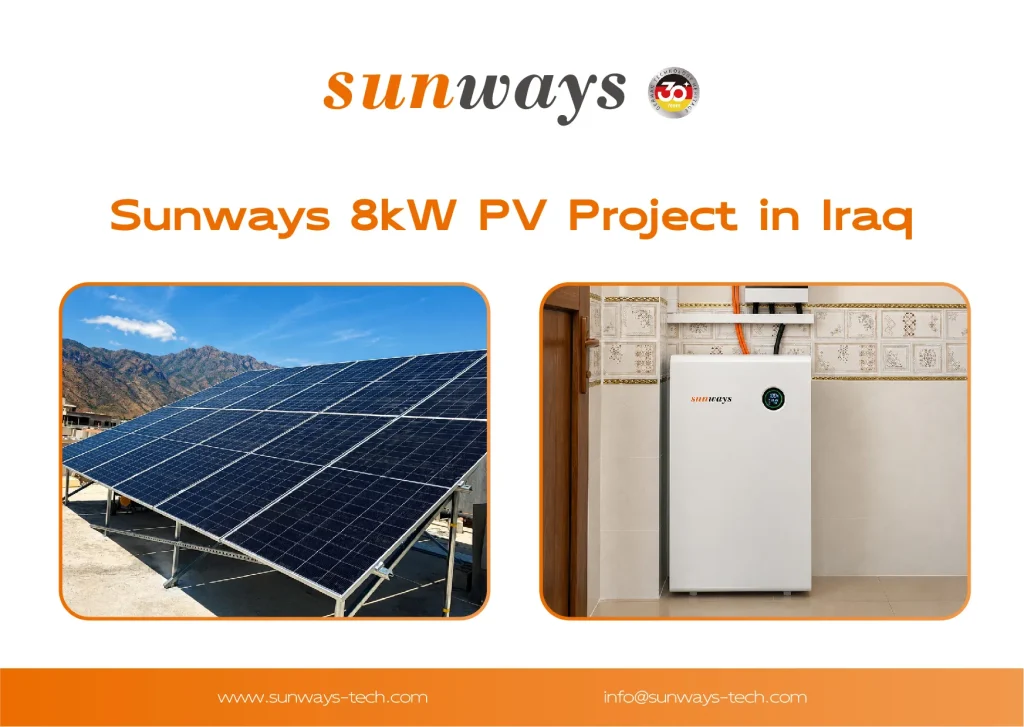
Sunways’ First Solar Battery Storage Project in Iraq
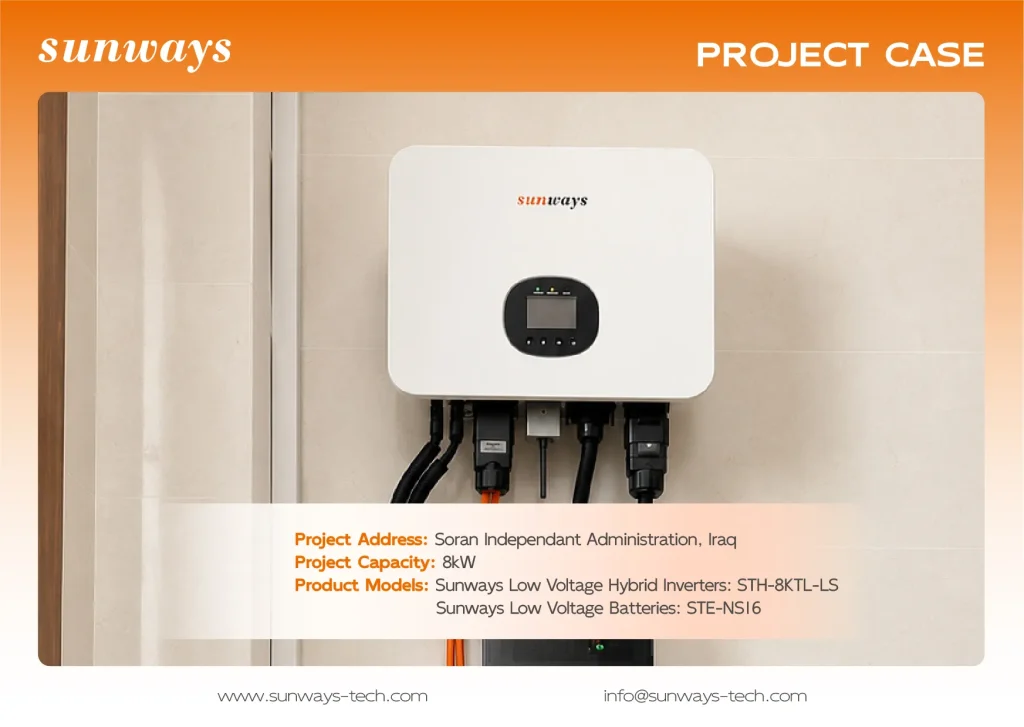
Sunways’ first solar battery storage project in Iraq has officially gone into operation in the Soran Independent Administration. This is a low-voltage residential energy storage system consisting of an 8 kW solar PV array, an STH-8KTL-LS single-phase low-voltage hybrid inverter, and an STE-NS16 low-voltage battery. For you, the value of this system lies not only in generating solar power during the day but, more importantly, in storing a portion of that electricity in the battery to provide more stable energy support for nighttime use and during grid outages.
Project Facts
The STH-8KTL-LS has a rated output power of 8 kW, utilizes a 40–60 V low-voltage battery platform, and supports a maximum PV input of 12 kW and dual MPPT, making it suitable for residential solar + storage applications.
The accompanying STE-NS16 uses a 51.2V 320Ah LiFePO4 battery with a nominal capacity of 16.4kWh, a usable capacity of 14.8kWh, and a maximum charge/discharge current of 200A.
This is also the most noteworthy aspect of this Iraq project: the 8 kW system handles the home’s instantaneous power demand, while the 16.4 kWh battery stores solar energy for when it’s truly needed. Ultimately, the system’s true value will be determined by how well it addresses local grid instability in Iraq, nighttime electricity consumption, and backup power needs during outages.
Why Solar Battery Storage Matters in Iraq
For Iraqi households, the value of solar plus battery goes beyond simply reducing reliance on the grid; it provides an additional layer of controllable power security during periods of high temperatures, peak electricity demand, and power outages. Installing solar alone can address daytime power generation, but if you also need electricity at night and backup during grid outages, battery storage is the key.
1. Grid Instability Makes Backup More Important
Iraq’s power grid has long faced the problem of supply capacity failing to keep up with peak demand, and extensive use of air conditioning in the summer further drives up electricity demand. The IEA notes that power shortages and summer blackouts have consistently been major challenges for Iraq’s power system.
This risk is not merely a theoretical concern. On August 11, 2025, temperatures nearing 50°C in Iraq caused two transmission lines to shut down, triggering a nationwide blackout; the grid instantly lost over 6,000 MW of capacity.
For residential users, this underscores the immediate value of home battery backup in Iraq: during grid outages, the battery can continue to supply power to pre-designated critical loads.
2. Extreme Heat Increases Power Demand
Extreme heat during Iraq’s summers not only increases cooling loads—such as those from air conditioners—but also places greater strain on the entire power system. IEA data shows that in 2022, temperatures in some parts of Iraq exceeded 51°C, causing grid failures, and summer power outages continue to occur.
Therefore, when selecting solar energy storage in Iraq, one must not only consider inverter power and battery capacity but also pay attention to the equipment’s operating temperature, cooling design, and actual installation environment.
3. Solar Alone Cannot Cover Every Hour
Solar PV primarily generates electricity when the sun is shining. At night, or when solar generation falls below load demand, solar power alone cannot store excess daytime electricity for later use.
Battery storage addresses precisely this time gap: storing excess solar energy during the day and releasing it at night or when needed. Energy storage allows electricity generated by solar panels to continue being used after sunset.
If the system also incorporates an appropriate backup design, the solar-plus-battery setup can continue to support critical loads during grid outages.
For Iraqi households, the value of solar lies not only in generating electricity—it lies in storing that energy for the hours when the grid cannot provide it.
How the 8kW Solar + 16kWh Battery Storage System Works in Iraq
This 8kW solar system in Iraq employs a typical residential low-voltage solar-storage architecture: Solar PV → STH-8KTL-LS ↔ STE-NS16 → Home Loads / Grid
Simply put, the Solar PV generates electricity, the Hybrid Inverter converts and dispatches the power, and the Battery stores solar energy that isn’t immediately used.
8kW Solar PV — Generates Electricity
The project features an 8kW PV array, which is primarily responsible for generating solar energy during the day. The electricity generated by the PV array first enters the hybrid inverter, which then distributes it based on current household electricity consumption, battery status, and grid conditions.
Here, 8kW refers to power—that is, the PV system’s capacity to generate electricity under specific conditions—and does not indicate a fixed daily output of 8kWh.
STH-8KTL-LS — Converts and Manages the Power
The STH-8KTL-LS is the energy management core of this system. With a rated output power of 8 kW, it converts the DC power generated by the solar PV into AC power suitable for residential use, while managing the flow of electricity between the solar array, battery, grid, and home loads.
This model utilizes a 40–60V low-voltage battery platform, has a maximum PV input power of 12 kW, and is equipped with two MPPT controllers, making it compatible with various residential PV string configurations.
STE-NS16 — Stores Solar Energy for Later
The STE-NS16, which is paired with the system, is a 51.2V low-voltage LiFePO4 battery with a nominal capacity of 16.4 kWh, utilizing a 51.2V / 320Ah configuration. Its maximum charge and discharge current is 200A.
Here, 16.4 kWh refers to energy capacity—that is, how much electricity the battery can store—rather than the power it can output.
- 8 kW: Represents the amount of power the system can handle.
- 16.4 kWh: Represents the amount of energy the battery can store.
An 8 kW PV system does not necessarily require a 16 kWh battery. The actual battery capacity must be determined based on the household’s daily consumption, nighttime load, backup load, and required backup time.
How the Solar Battery System Works During the Day, at Night and During an Outage
The core of this solar battery system in Iraq isn’t simply “solar power generation + battery storage,” but rather enabling the solar system, battery, and grid to work together based on the time of day and power supply conditions.
During the Day — Use Solar First
In a typical self-consumption setup, solar PV during the day is used first to meet home loads.
If solar generation exceeds the current load demand, the excess electricity can be used for battery charging. This way, you don’t have to use all your solar energy during the day.
Typical Energy Flow: Solar PV → Home Loads → Battery
The focus of this operating mode is to maximize solar self-consumption by saving excess daytime solar energy for later use.
At Night — Use Stored Solar Energy
After the sun sets, the solar PV system stops generating electricity. At this point, the battery can discharge the energy stored during the day to power home loads. When the battery reaches a preset minimum SOC, the system draws power from the grid according to the operating settings.
Battery → Hybrid Inverter → Home Loads
Therefore, the battery does more than simply “store electricity”; it transfers solar energy from daytime to nighttime.
During a Grid Outage — Switch to Backup Power
The true value of home battery backup in Iraq is demonstrated during a grid outage.
The Sunways STH-3~8KTL-LS features a dedicated backup loads output architecture. The official datasheet states that this series can switch to off-grid mode in less than 10 ms. After a grid failure, the hybrid inverter isolates itself from the public grid, and the battery, along with any available solar PV power at that time, continues to supply power to the backup loads.
Energy Flow During a Grid Outage: Solar PV + Battery → STH-8KTL-LS → Backup Loads
For markets like Iraq, where grid reliability is low, this is more important than simply pursuing higher solar generation. It’s not enough to just generate power; you must also ensure that power remains available when the grid goes down.
Why the STH-8KTL-LS Fits This Residential Project
For this residential project in Iraq, the advantage of the STH-8KTL-LS lies not in the number of specifications, but in the fact that several key specifications precisely meet local needs: 8 kW residential power output, low-voltage batteries, backup power, rapid switching, and a protection and heat dissipation design better suited for outdoor environments.
a. 8 kW Output Matches the Project Scale
This system is configured with an 8 kW PV array, so the STH-8KTL-LS with a rated output of 8 kW was selected, clearly matching the power requirements for residential applications. This model also supports a maximum 12 kW PV input, two MPPT channels, and a maximum single-channel PV input current of 20 A, leaving room for future PV string design.
b. 40–60V Low-Voltage Battery Platform
The STH-8KTL-LS features a 40–60V battery voltage range and belongs to Sunways’ single-phase low-voltage hybrid series.
This shares the same low-voltage system architecture as the 51.2V STE-NS16 used in this project. For residential energy storage projects like yours, ensuring true compatibility between the inverter and the battery is more important than simply comparing battery capacities.
c. Fast Backup for Grid Outages
In Iraq, backup power is not an optional feature but a practical necessity. The Sunways STH-3~8KTL-LS supports independent backup loads and can switch to off-grid mode in less than 10 ms. This series also supports inductive and capacitive backup loads that can instantly reach twice the rated current.
This means that, when the system is configured correctly, critical loads such as lighting, network equipment, and refrigerators can be restored to backup power more quickly.
d. IP66 Protection for Dust and Outdoor Conditions
The STH low-voltage hybrid platform features IP66 protection. IP66 means the equipment is completely dust-tight and can withstand powerful water jets from any direction. It is well-suited for installation environments with high dust levels. However, please note: IP66 does not imply “high-temperature resistance.” High-temperature performance should be assessed based on the operating temperature and cooling design, not the IP rating.
e. Cooling Matters in Iraq’s Heat
For 6–8 kW single-phase low-voltage hybrid inverters, Sunways employs Active Cooling / Forced Fan Cooling and uses an IP68-rated Smart Fan. This is a cooling solution ideally suited for dusty areas and desert environments.
These specifications directly address several of the most practical concerns for residential energy storage systems: whether the system can handle the load, whether it can be paired with a battery, whether it can switch over quickly during a power outage, and whether the equipment can adapt to the local installation environment.
What Does a 16kWh Battery Add to an 8kW Solar System?
The most important function of a 16kWh battery is to store solar energy generated during the day for use at night or during a grid outage. For this residential project in Iraq, the STE-NS16 provides 16.4kWh of nominal energy and 14.8kWh of usable energy. This directly determines how much electricity the system can store and how long it can sustain backup loads after a power outage.
16.4 kWh Is Energy, Not Power
The most common source of confusion here is the distinction between kW and kWh. An 8 kW inverter indicates the system’s power handling capacity. A 16.4 kWh battery indicates how much energy the battery can store. Therefore, a 16.4 kWh battery does not mean it can continuously output 16.4 kW.
The STE-NS16 uses a 51.2V / 320Ah LiFePO4 architecture, with a maximum charge/discharge current of 200A and supports a 15.4kW / 10s peak output power. Its round-trip efficiency is ≥97.5%, and its cycle life exceeds 6,000 cycles.
How Long Can a 16kWh Battery Last?
You can start by using a simple formula to estimate: Backup Time ≈ Usable Battery Energy ÷ Average Load
Taking the STE-NS16’s 14.8kWh Usable Energy as an example:
| Average Backup Load | Theoretical Backup Time |
|---|---|
| 2 kW | ≈ 7.4 hours |
| 4 kW | ≈ 3.7 hours |
| 6 kW | ≈ 2.5 hours |
For example, if you only keep your refrigerator, lighting, network equipment, and some basic loads running during a power outage—keeping the average power consumption around 2 kW—then 14.8 kWh of usable energy could theoretically last for about 7.4 hours. However, this is only a sizing reference. Actual backup time is usually shorter, as factors such as inverter conversion loss, SOC reserve, battery temperature, BMS limitations, and load variations must also be taken into account.
What This Solar Battery System Delivers for the Home
① Backup When the Grid Goes Down
In the event of a grid outage, the battery can continue to power pre-configured backup loads through the hybrid inverter. You can prioritize critical loads such as refrigerators, lighting, Wi-Fi, and security devices, rather than letting your household’s electricity depend entirely on whether the grid is operational.
② Use More Solar at Home
During the day, when solar generation exceeds the current load, excess electricity can be stored in the battery. At night, this energy can then be released. This improves solar utilization in solar self-consumption scenarios, ensuring that more of the electricity generated by your rooftop panels is actually used within your home, rather than only being consumed at the time of generation.
③ Less Dependence on Grid Availability
Solar + Battery does not completely disconnect a home from the grid, but it reduces your reliance on the grid for a continuous and stable power supply. This is especially true in areas where grid outages occur frequently.
How to Choose a Residential Solar Battery System?
When choosing a residential solar battery system in Iraq, the most common mistake is to first decide on “an 8 kW inverter and a 16 kWh battery” and then try to match that to your household electricity usage.
A more reasonable approach is as follows:
| What to Check | Why It Matters |
|---|---|
| Grid Type | Single-phase or three-phase—determines the inverter architecture |
| Peak Load | Determines the instantaneous power the inverter must handle |
| Daily Electricity Use | Helps determine PV and battery capacity |
| Roof / PV Capacity | Determines how much solar PV can actually be installed |
| Backup Loads | Identifies which devices must continue operating during a power outage |
| Required Backup Time | Directly affects the battery’s kWh requirement |
| Battery Power | Determines how much load the battery can support simultaneously |
| Local Requirements | Confirms grid connection, installation, and protection requirements |
FAQs
Q1. Can a Solar Battery System Work During a Power Outage in Iraq?
Yes, but the system must use a hybrid inverter that supports backup/off-grid operation and be configured with an appropriate battery. After a grid outage, the system must first be isolated from the public grid, and then the battery and available solar PV will power the backup loads.
Taking the Sunways STH-8KTL-LS used in this project as an example, this series supports backup output and can switch to off-grid mode within 10 ms. The actual load capacity depends on the inverter’s backup output, battery power, and the startup power of the loads.
Q2. Is a 16 kWh Battery Enough for a Home?
It may be sufficient, but the key factor is not the size of your home, but rather your backup load and required backup time. The STE-NS16 used in this project provides 16.4 kWh of nominal energy and 14.8 kWh of usable energy.
For example, with 14.8 kWh of usable energy and an average load of 2 kW, the theoretical backup time is approximately 7.4 hours. The actual duration will also be affected by SOC reserve, conversion losses, and load variations.
Q3. Does an 8 kW Solar System Need a 16 kWh Battery?
Not necessarily; an 8 kW PV system does not necessarily require a 16 kWh battery. The “kW” in PV refers to power generation capacity, while the “kWh” in a battery refers to energy storage capacity; the two cannot be matched simply based on a fixed ratio.
More reasonable battery sizing should be determined based on your daily electricity consumption, nighttime load, backup load, and required backup time.
Q4. Can This Solar Battery System Be Expanded Later?
Expansion is possible, but you cannot simply add more solar panels or batteries by default. Before expanding, you need to reconfirm the hybrid inverter’s Max PV Input, MPPT, Battery Voltage/Current, BMS Compatibility, and Load Limits.
If your electricity consumption increases in the future, you should first determine whether you want to expand PV generation, battery capacity, or output power. The expansion methods for these three options differ.
Planning a Solar Battery Storage Project in Iraq?
If you’re planning a residential solar + battery project in Iraq, don’t just copy a standard configuration. Sunways can help you select the most suitable solar inverter and battery configuration based on your project data.
Reference
International Energy Agency (IEA) —National Climate Resilience Assessment for Iraq
U.S. Department of Energy —Solar Integration: Solar Energy and Storage Basics
Related Projects
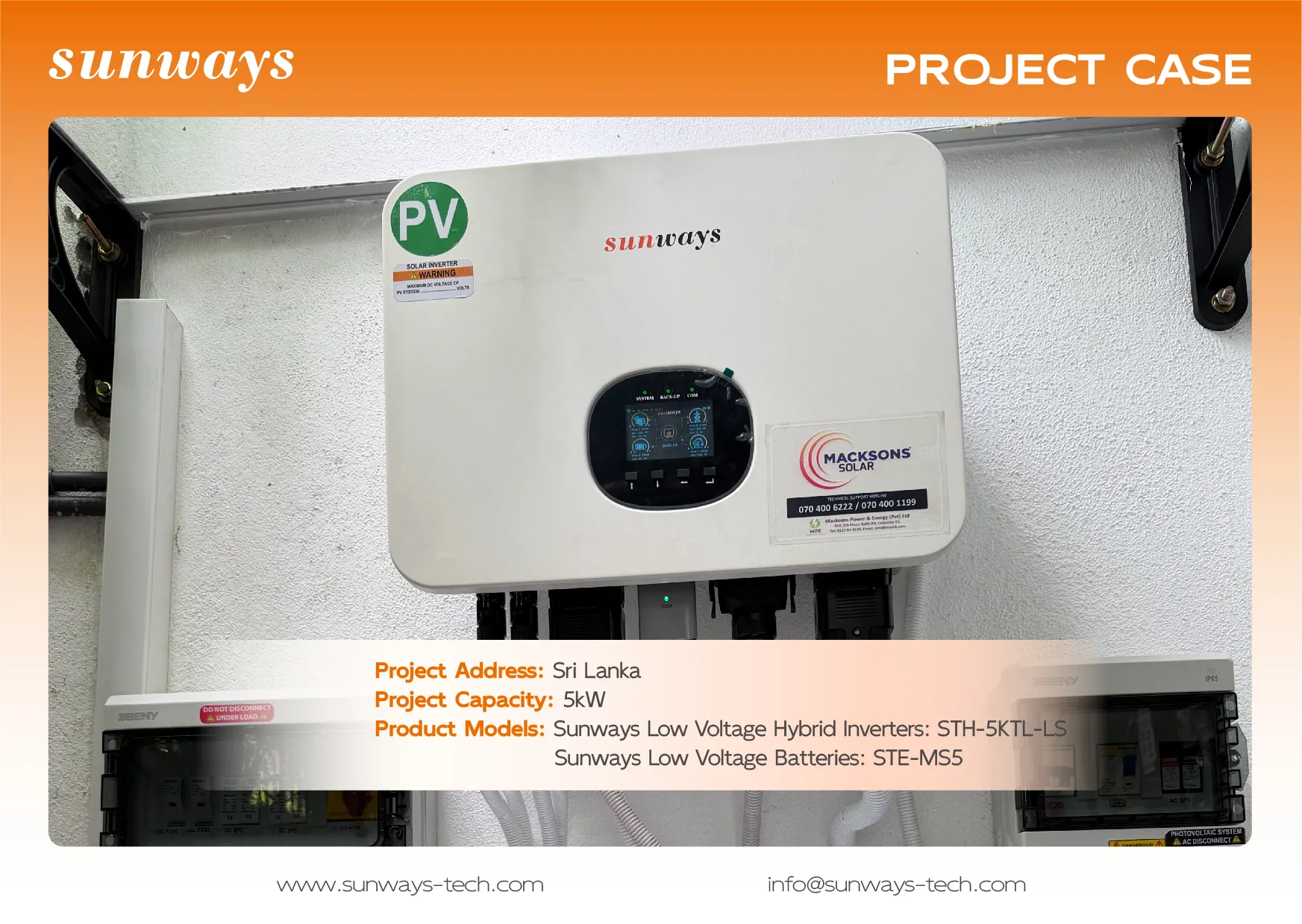
When the Grid Is Unpredictable: Sunways 5kW Residential Hybrid Solar Project in Sri Lanka
Discover how a Sri Lankan home uses a Sunways 5kW hybrid inverter and 5kWh battery to store solar energy and maintain backup power during grid outages.
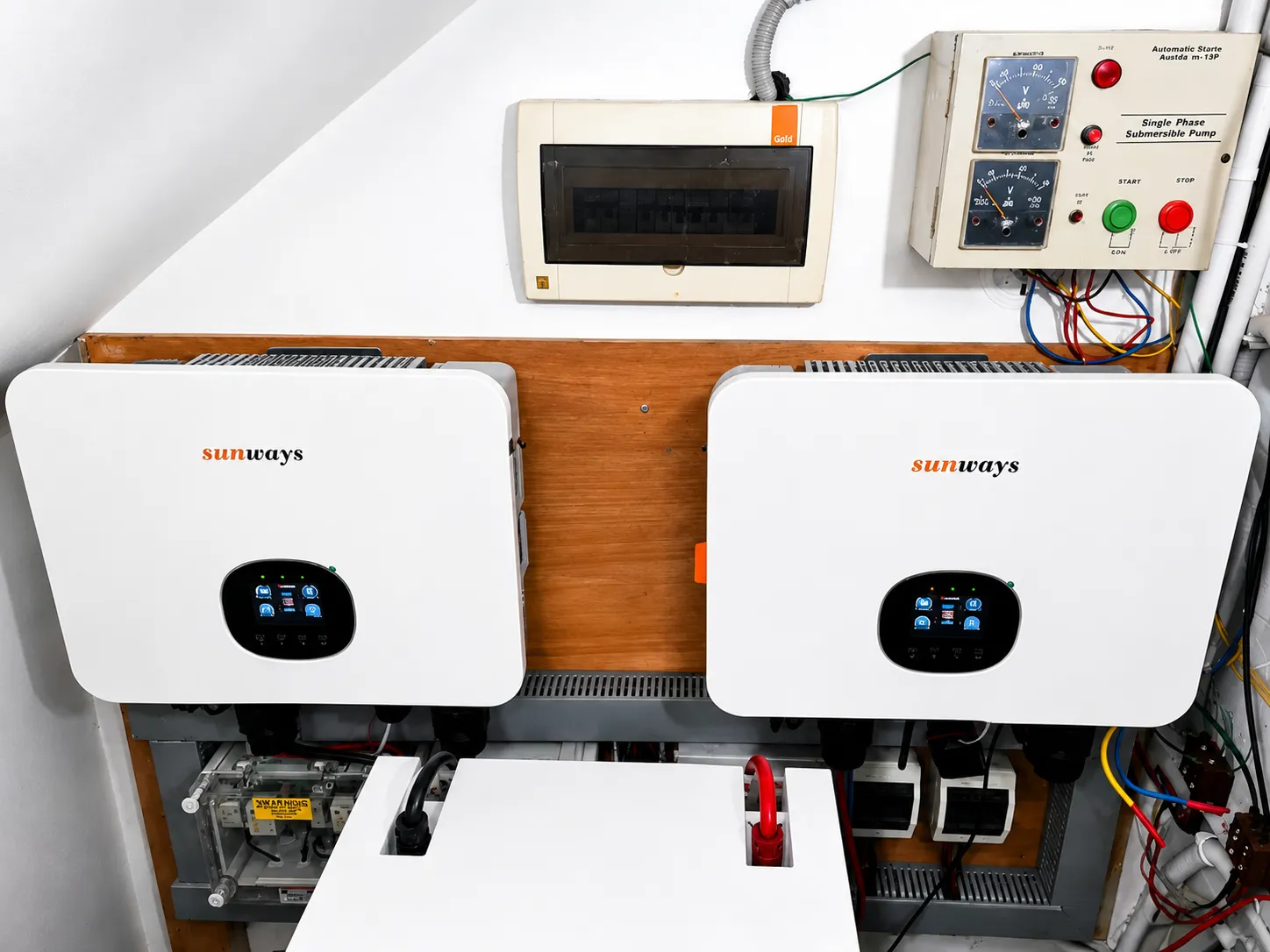
Qamar Hospital Hybrid Energy Storage Project
Discover how Sunways 8kW hybrid inverters and battery storage provide reliable backup power for Qamar Hospital in Uttar Pradesh, India.