Hybrid Inverter Price 2026: What Are You Really Paying For?
Table of Contents
How Much Does a Hybrid Inverter Cost in 2026?
In 2026, the retail price of a standard residential hybrid inverter with a power rating of 3–10 kW is typically around US$1,500–3,000. Of these, 3–5 kW models generally fall at the lower end of the price range, whilst 10 kW models typically cost US$2,500–3,000 or more. Prices may exceed this range for three-phase models, high-end brands, or products with enhanced backup power and battery management capabilities.
It should be noted that these are reference prices for the mid-range residential market; they do not represent a globally standardised price nor are they official quotations from Sunways. Actual prices are influenced by factors such as country, sales channel, phase configuration, battery voltage, backup power performance, local certifications, taxes and duties, and warranty terms. There are also significant variations in open-market quotations: products sold directly by manufacturers may be significantly below this range, whilst some high-end 5 kW hybrid inverters on the US market are already priced above US$3,000.
2026 Hybrid Inverter Price Overview
| Power and Type | Reference Price for Inverter Unit | Common Applications | Key Price Variables |
|---|---|---|---|
| 3–5 kW single-phase | US$1,500–2,500 | Small to medium-sized residential properties | Battery configuration, backup power output, brand and certification |
| 5–6 kW mid-range models | US$1,700–2,400 | Standard residential solar-storage systems | MPPT, battery charge/discharge capacity, monitoring and warranty |
| 8–10 kW residential | US$2,500–3,000 and above | Large residential properties, heat pumps, air conditioning or EV charging | Single-phase/three-phase, peak power, backup capacity |
| 12–20 kW three-phase | Please enquire for market pricing | Detached houses, small shops and light commercial premises | Three-phase output, battery expansion, parallel operation and local certification |
| 30 kW and above | Quotations based on project configuration | Commercial and industrial energy storage projects | HV architecture, EMS, project design and delivery terms |
Pricing Notes:
- The above figures are US dollar market reference prices as of August 2026, intended primarily to illustrate the pricing logic across different power ranges; they do not constitute a formal sales quotation from Sunways.
- The prices listed above typically represent the hybrid inverter unit itself only and generally do not include:
- External batteries;
- Photovoltaic modules;
- Smart meters and current transformers (CTs);
- Backup Box or other backup power accessories;
- Protection and communication equipment;
- Installation and commissioning;
- Taxes, transport and licensing fees.
Batteries are usually sold separately and can significantly increase the final budget for the entire PV-storage system. Therefore, searches for “hybrid inverter price” and “hybrid inverter with battery price” should not be confused.
What Is Included in a Hybrid Inverter Price?
Most published hybrid inverter prices refer only to the inverter unit itself and do not include batteries, photovoltaic modules or installation.
The price of the inverter unit typically covers the internal power conversion, MPPT, battery communication, energy management and protection functions. However, you will need to check the specific quotation to see whether smart meters, current transformers (CTs), communication modules and emergency power transfer equipment are included.
a. What Does the Inverter Price Usually Include?
Quotations for the inverter unit itself typically include the following:
- Core hardware: Converts DC power from the photovoltaic system into AC power for use by domestic or commercial loads.
- MPPT control: Tracks the optimal operating point of the photovoltaic array to maximise the utilisation of photovoltaic power generation.
- Battery management interface: Communicates with the BMS of compatible batteries to control charging and discharging.
- Energy management functions: Coordinates the flow of electricity between the PV system, batteries, the grid and loads.
- Basic protection functions: Such as overvoltage, short-circuit, reverse connection, overtemperature and anti-islanding protection.
- Local display or monitoring support: View operational data via a screen, app or monitoring platform.
- Standard product documentation and basic warranty: Specific details and duration depend on the manufacturer and the market in which the product is sold.
For example, Sunways product data sheets list MPPT, battery communication, backup output and communication methods separately. Some 4G communication features are optional. Communication capabilities are supported by the product, but the relevant modules may need to be purchased separately.
b. Five Common Types of Hybrid Inverter Quotations
| Quotation type | Typically includes | Typically excludes or requires confirmation |
|---|---|---|
| Inverter-only | Inverter unit, built-in functions, standard documentation | Batteries, modules, external accessories and installation |
| Inverter package | Inverter and selected accessories | Batteries, modules and installation |
| Inverter + battery | Inverter, battery modules, BMS and some cabling | Photovoltaic modules, electrical distribution modifications and some installation costs |
| Complete system | Modules, inverter, battery and major system accessories | Taxes, permits and grid connection fees may be charged separately |
| Installed system | Equipment, system design, installation, commissioning and handover | Long-term maintenance and extended warranty subject to contract terms |
Some suppliers refer to a ‘complete system’ as merely a complete photovoltaic system, which does not include a battery. Only when a quotation explicitly states the battery brand, model, quantity and capacity can it be regarded as a genuine hybrid inverter with battery price.
c. What Is Commonly Charged Separately?
The following items are most commonly omitted from low-cost quotations. When comparing quotations, you should verify each item individually:
- Batteries and backup power equipment:
Batteries, BMS, battery racks, connection cables, backup boxes, ATS (automatic transfer switches) and standalone backup power distribution panels are typically charged separately. Not all hybrid inverters can supply power directly to loads following a power cut. In addition to asking ‘Does it support backup?’, you should also confirm what additional equipment is required to implement backup power. Batteries, in particular, must not be overlooked. EnergySage’s 2026 US market data shows that the average cost of a residential battery is approximately $1,128/kWh, with a 13.5 kWh system averaging around $15,647 – and these are pre-subsidy prices. - Metering and communication equipment: Smart meters, CTs (current transformers), Wi-Fi, LAN or 4G communication modules, data loggers and third-party energy management platform services may not be included in the base price of the inverter.
- Electrical and installation costs: AC and DC cables, circuit breakers, isolating switches, surge protection devices, distribution boxes, main distribution board upgrades, system design, on-site installation, commissioning and acceptance are typically charged separately.
- Taxes, duties and project costs: Taxes, duties, transport, insurance, import charges, installation permits, grid connection applications, extended warranties and ongoing maintenance may all be included in the final budget.
How Do 5kW, 10kW and Three-Phase Hybrid Inverter Prices Compare?
To put it simply, the total price of a 5kW hybrid inverter is usually the lowest; 10kW models are more expensive, but the cost per unit of power may be lower; three-phase models are primarily more expensive due to their three-phase control, grid-connection adaptability and backup power design. You should not choose a model based solely on the principle that ‘the higher the power, the better’. The power rating, phase configuration, battery capacity and backup performance must all be matched to your actual load.
Below are the reference prices for inverter units in the residential and small commercial markets for 2026:
| Product Type | Reference Price | Common Applications |
|---|---|---|
| 5kW hybrid inverter | US$1,200–2,500 | Standard residential properties, basic backup power |
| 10kW hybrid inverter | US$1,800–3,500 and above | Large residential properties, high-power loads, small commercial premises |
| 5–10kW three-phase hybrid inverter | US$2,000–4,500 and above | Three-phase residential properties, villas, shops and light commercial premises |
These prices are mid-range retail reference figures; they are not global averages and do not include batteries or installation. Prices vary significantly across open markets. For example, in an Australian comparison table updated in April 2026, the recommended retail prices for some 5–10kW hybrid inverters were approximately AUD 1,700–3,630, inclusive of GST; whilst in the US retail market, some high-end 5kW and 10kW models were priced at approximately US$2,530–3,900.
① 5kW Hybrid Inverter Price
A 5kW hybrid inverter is typically suitable for a standard residential property. It can power everyday loads such as lighting, a fridge, a television, network equipment and some air conditioning units. The 5kW figure refers to power and does not directly determine how much battery capacity is required. Battery capacity is expressed in kWh and depends primarily on the load and the required backup time.
For example, if you wish to maintain 2 kW of critical loads for 4 hours during a power cut: required electricity = load power × operating time: 2 kW × 4 h = 8 kWh
This means you will need at least approximately 8 kWh of available electricity. Taking into account conversion losses and battery reserve capacity, the actual rated capacity is usually even greater. Therefore, a 5 kW inverter does not necessarily mean it must be paired with a 5 kWh battery.
② 10kW Hybrid Inverter Price
A 10kW hybrid inverter is better suited to large residential properties, detached houses and small commercial settings. You may be using multiple air conditioners, heat pumps, pumps or EV charging points simultaneously, so you will require higher continuous output and battery charge/discharge capacity.
For example, a 7 kW EV charging point operating at full capacity may already utilise the majority of a 10 kW inverter’s output. If air conditioners, heat pumps and other household appliances are running simultaneously, even a 10 kW inverter may not provide sufficient headroom.
The total price of a 10 kW model is usually higher than that of a 5 kW model, but the cost per unit of power may be lower. For example:
Price per kW = Inverter price / Rated AC output power
If a 5 kW inverter is priced at US$1,800, the cost per kW is US$360; if a 10 kW inverter is priced at US$2,700, the cost per kW is US$270.
In this example, the total price of the 10 kW model is 50 per cent higher, but the cost per kW is 25 per cent lower. However, this does not mean you should blindly opt for the 10 kW model. If your household load and local grid connection capacity do not require it, a larger model will simply increase your budget.
③ Three-Phase Hybrid Inverter Price
Three-phase hybrid inverters are typically used in three-phase residential properties, villas, shops, clinics, restaurants and small-scale commercial and industrial projects. Their value lies not in ‘looking more professional’, but in their ability to match a three-phase grid and three-phase loads.
Three-phase models are generally more expensive than single-phase models of the same power rating, but this cannot be determined by a fixed percentage. Brand, power rating, battery configuration, local certifications and sales channels can all affect the price difference.
It is particularly important to note that a 10kW three-phase inverter does not mean that any single phase can continuously output 10kW. The total power usually needs to be distributed across the three phases; specific limitations must be checked in the product data sheet.
Taking Sunways products as an example, for the same 5 kW power rating, there is both the single-phase low-voltage STH‑5KTL‑LS and the three-phase low-voltage STH‑5KTL‑LT. Whilst both have the same power rating, their phase configuration, system design and application conditions differ; therefore, a comparison based solely on price is not appropriate.
④ 5 kW vs 10 kW vs Three-Phase Hybrid
| Comparison Criteria | 5kW single-phase | 10kW single-phase/split-phase | 5–10kW three-phase |
|---|---|---|---|
| Typical Applications | Standard residential properties | Large residential properties, small commercial premises | Three-phase residential and commercial premises |
| Common Loads | Basic household appliances, some air conditioning units | Heat pumps, EVs, multiple air conditioning units | Three-phase equipment, pumps and commercial loads |
| PV Input Requirements | Moderate | Higher | Depends on power rating and MPPT design |
| Battery Charging/Discharging | Suitable for basic energy storage | Typically requires higher power | Must accommodate both battery architecture and three-phase loads |
| Backup Focus | Total power of critical loads | Continuous output and peak capacity | Output per phase and phase imbalance capability |
| Expansion Requirements | General residential expansion | Additional batteries or new loads | Parallel connection, EMS and project-level expansion |
| Installation Complexity | Relatively low | Depends on output and backup design | Typically higher |
| Key Selection Risks | Insufficient power | Blindly increasing power based on unit price | Ignoring per-phase output and local grid connection requirements |
Not sure whether you need 5kW or 10kW? Ask Sunways
Please provide your country, grid phase configuration, household peak load, backup load, battery capacity and future electricity consumption plans. Sunways can help you determine the appropriate power rating and product configuration, avoiding both under-specification and paying extra for capacity you won’t use.
What Makes One Hybrid Inverter Cost More Than Another?
Prices for hybrid inverters of the same power rating vary, and are primarily determined by the following factors:
- Power and overload capacity: The higher the continuous output and peak capacity, the higher the hardware costs tend to be.
- Phase configuration: Three-phase models involve more complex control, load balancing and grid-connection design.
- LV or HV: Battery voltage affects current, cabling, protection and overall system costs; there is no absolute advantage or disadvantage.
- PV input: More MPPT channels, higher input current and a wider voltage range can enhance the flexibility of rooftop designs.
- Battery capacity: Higher charge and discharge power means faster charging and stronger backup power output.
- Backup performance: Rapid switchover, peak output and black start capability increase costs.
- Protection and certification: IP ratings, AFCI, back-feed protection and local certifications reduce installation and grid connection risks.
- Warranty and service: Monitoring, remote diagnostics, spare parts and local support are also factored into long-term costs.
Which Hybrid Inverter Is Right for Your Home?
If the grid is stable, you do not need a battery or backup power in the event of a power cut, and a grid-tied inverter is usually the more economical option. A hybrid inverter is only worth purchasing if you need to store solar power, increase your self-consumption rate, or maintain critical loads during a power cut.
Answer These Five Questions First
What Is Your Household Peak Load?
Calculate the maximum power drawn when appliances such as air conditioning, heat pumps, water pumps, electric water heaters and EV chargers are all running simultaneously. Do not select an inverter based on the size of your home or the power rating of a single appliance.
Also check your PV capacity. A typical DC/AC ratio for residential systems is approximately 1.2–1.3. For example, a 6 kW inverter can usually support a PV array of around 7.2–7.8 kWp, though the final configuration will depend on local grid connection regulations and product limitations.
Is Your Grid Single-Phase or Three-Phase?
The inverter must match your home’s electrical supply. Standard single-phase homes usually opt for single-phase models; three-phase homes, detached houses or high-power households should prioritise three-phase models. For three-phase products, you should also check the output per phase, the system’s ability to handle three-phase imbalance, and whether the backup system supports three-phase loads.
Which Loads Must Run During an Outage?
Identify the appliances that must remain operational during a power cut, such as the fridge, lighting, network equipment, water pumps or certain air conditioning units.
How Much Battery Capacity Do You Need?
Inverter power is expressed in kW, whilst battery capacity is expressed in kWh. Battery capacity should be calculated based on the Backup’s load and runtime, whilst taking into account conversion losses, usable capacity and discharge limits.
Will Your Electricity Demand Grow?
If you plan to add an EV charging point, a heat pump, additional air conditioning units or batteries in the future, you should allow for a reasonable margin in advance.
Quick Selection Guide
| User Scenario | Priorities |
|---|---|
| Standard single-phase residential property | 3–8 kW single-phase hybrid inverter |
| Three-phase residential property or villa | Three-phase hybrid inverter |
| Frequent power cuts | Switching time, backup power and peak output |
| Future addition of EVs or heat pumps | Output headroom and battery charge/discharge capacity |
| Existing PV system | Compatibility with retrofitting of existing modules, inverters and batteries |
| Phased battery purchase | Battery input, BMS compatibility and expansion limitations |
| Multi-orientation or partially shaded roof | More independent MPPT units and suitable voltage range |
Which Sunways Solution Fits Your Home?
| Sunways Product Range | Suitable Applications | Key Selection Criteria |
|---|---|---|
| STH‑3~8KTL‑LS | Single-phase low-voltage residential energy storage | 3–8 kW, 40–60 V batteries, residential backup |
| STH‑5~20KTL‑LT | Three-phase low-voltage residential, detached houses and small commercial | Three-phase loads, 40–60V batteries, future power expansion |
| Sunways High-Voltage Hybrid Series | Residential systems utilising HV batteries or higher power | Battery voltage, charge/discharge power and complete system design |
Why Do Hybrid Inverter Prices Differ by Country?
It is quite normal for the same hybrid inverter model to be priced differently in different countries. You cannot simply compare prices by converting currencies. Exchange rates, taxes, certification, logistics, installation and after-sales service all affect the final price. More importantly, quotations from different countries may not even be based on the same criteria.
What Affects the Final Price?
- Exchange rates: Importers typically price products based on the exchange rate at the time of restocking. When currencies such as the INR, PKR, LKR or BDT fluctuate, local retail prices will change even if the ex-works price remains unchanged.
- Customs duties and VAT: Import duties, VAT or other local taxes are directly factored into the retail price. For example, the standard VAT rates in Italy, Poland and Spain are 22 per cent, 23 per cent and 21 per cent respectively.
- Certification and grid connection requirements: Different markets may require different grid connection certifications, protection settings and test reports. Compliance costs are reflected in product and project quotations.
- Channel tiers: Manufacturers, importers, distributors and installers all offer different services. The longer the supply chain, the higher the price tends to be, though local stock availability and after-sales support may also be more comprehensive.
- Logistics and stock: Sea freight, insurance, port charges, local transport and stock turnover periods all affect the price.
- Installation labour: Similar inverter prices do not necessarily imply similar installation costs. Cable laying, distribution board upgrades, commissioning and licensing fees depend on local labour rates and construction regulations.
What Should You Compare in Each Market?
| Market | Currency | Recommended Comparison Focus | Key Price Variables |
|---|---|---|---|
| India | INR | 5kW/10kW, single-phase or three-phase, LV/HV | Taxes, distribution channels, certification, local services |
| Pakistan | PKR | Low-voltage batteries, backup power capacity, battery compatibility | Exchange rates, import costs, stock and logistics |
| Sri Lanka | LKR | Residential power ratings, backup power configurations, grid connection requirements | Exchange rates, import costs, installation and after-sales service |
| Bangladesh | BDT | MPPT, hybrid IPS, power cut backup | Distribution channels, stock, batteries and warranties |
| Italy | EUR | Three-phase, LV/HV batteries, grid connection certification | VAT, installation labour, local compliance |
| Poland | PLN | Three-phase systems, battery architecture, heating loads | VAT, EUR/PLN exchange rate, installation and service |
| Spain | EUR | Single-phase/three-phase, residential energy storage, backup power requirements | VAT, grid connection requirements, installation and logistics |
Hybrid Inverter Price FAQs: What to Ask Before You Buy
Q1. How Much Does a Hybrid Inverter Cost?
In 2026, the list price for residential hybrid inverters in the 3–10 kW range is typically around $1,500–$3,000. This is not a standardised global price and generally excludes the battery and installation. The final hybrid inverter cost also depends on power rating, phase configuration, LV/HV architecture, backup power capabilities, local taxes and certification requirements.
Q2. Does the Hybrid Inverter Price Include a Battery?
It is not usually included. Most hybrid inverter prices refer to the inverter unit itself, and may sometimes include the electricity meter, current transformers (CTs) or communication modules. Batteries, BMS, backup boxes, protection devices and installation costs are usually quoted separately. When you see a ‘hybrid inverter with battery price’, you should also confirm whether the battery capacity, usable capacity, warranty and installation are included.
Q3. What Is the Price Difference Between a 5kW and 10kW Hybrid Inverter?
A 10kW model is generally more expensive than a 5kW one, but the price does not simply double. Based on the 2026 reference ranges mentioned earlier in this article, a 5kW model costs approximately $1,200–$2,300, whilst a 10kW model costs approximately $1,800–$3,500. There is some overlap between the two ranges, as phase configuration, battery voltage, charge/discharge capacity and backup power output also influence the price.
Q4. Is a three-phase hybrid inverter more expensive?
When brands, power ratings and features are comparable, three-phase models are generally more expensive. They need to manage three-phase output, phase imbalance, three-phase emergency power and more complex grid-connection requirements. However, if your home is already connected to a three-phase supply, choosing a cheaper single-phase model may result in load restrictions or additional retrofitting costs.
Q5. Is a Low-Voltage or High-Voltage Hybrid Inverter Cheaper?
There is no definitive answer. LV systems are common in residential and retrofit projects, and offer greater flexibility in battery selection, though they typically have higher current ratings for the same power output. HV systems can reduce transmission currents at high power levels but require a matching high-voltage battery pack. You should compare the total system cost, including the inverter, battery, cabling, protection and installation.
Q6. Can a Hybrid Inverter Operate Without a Battery?
Some hybrid inverters can operate in grid-connected mode without a battery, but not all models support this. Even if operation is possible, functions such as backup power during power cuts, night-time power supply and energy transfer may not be available. Before purchasing, you should check the specific model’s battery-free operating mode and backup conditions.
Q7. Can I Add More Battery Capacity Later?
Yes, but you must comply with the manufacturer’s restrictions. Any additional batteries must be compatible in terms of voltage range, battery type, maximum charge and discharge currents, BMS communication protocol and firmware version. You must also confirm the permitted number of batteries that can be connected in parallel. Taking the Sunways STH‑5~20KTL‑LT as an example, its dual independent battery inputs offer greater design flexibility for phased expansion, but configuration must still adhere to the compatibility list.
Get the Right Sunways Hybrid Inverter Quote
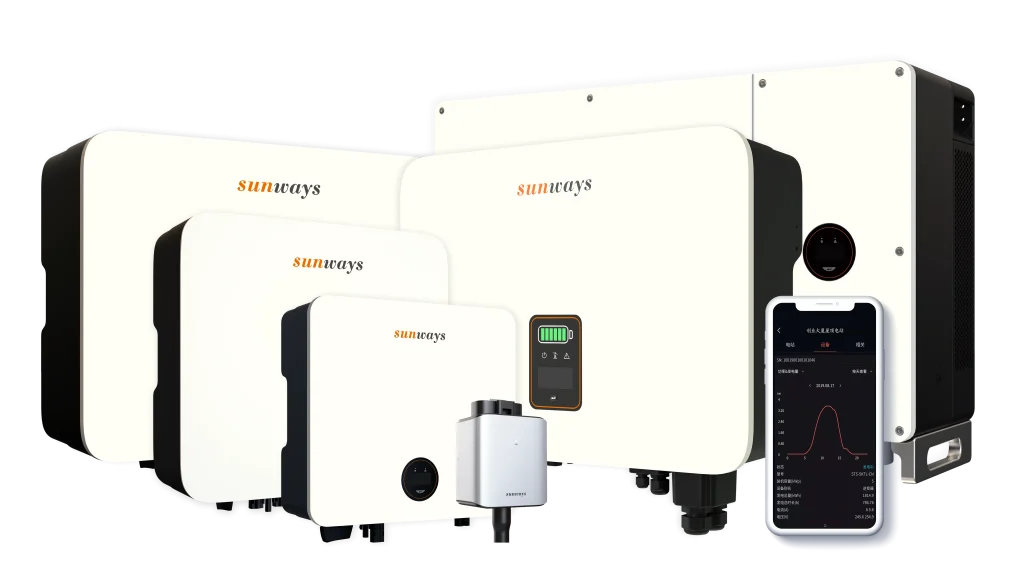
Tell us your market, phase type, power requirement, battery plan and backup loads. Sunways will help identify a suitable configuration and quotation route.
Reference
Start Your Project