5kW Hybrid Solar Inverter: Sizing and Battery Choices
Table of Contents
When selecting a 5kW hybrid solar inverter, start by answering two questions: which electrical appliances do you want to run simultaneously, and which of these do you need to keep running during a power cut? If the operating and start-up requirements of these appliances fall within the system’s capacity limits, then 5kW is the appropriate capacity for this scenario; if the total load required to run simultaneously exceeds the upper limit, you should either reduce the number of appliances running at the same time or consider other capacities.
A hybrid inverter is responsible for coordinating power supply from the solar panels, the battery and the mains grid. You can break down the selection process into three parts: the inverter determines the output capacity; the battery must provide the corresponding power and energy storage; and the electrical distribution design determines which circuits receive backup power. By checking these aspects separately, you will avoid the misconception that ‘purchasing a 5kW inverter’ means ‘the entire house can be used simultaneously, and backup power is available for a whole night’.
Does a 5kW Inverter Match Your Simultaneous Loads?
If you wish to use lighting, fans, a fridge, a television, a computer and a router simultaneously, you can start by checking the 5kW package; if you also need to run the air conditioning, boil water and use an electric water heater at the same time, you must add up the power ratings—you cannot simply judge based on ‘how many household appliances there are’. What determines whether the power is sufficient is the total wattage required by these devices when running simultaneously, as well as the short-term demand during start-up.
What a 5kW Inverter Can Run
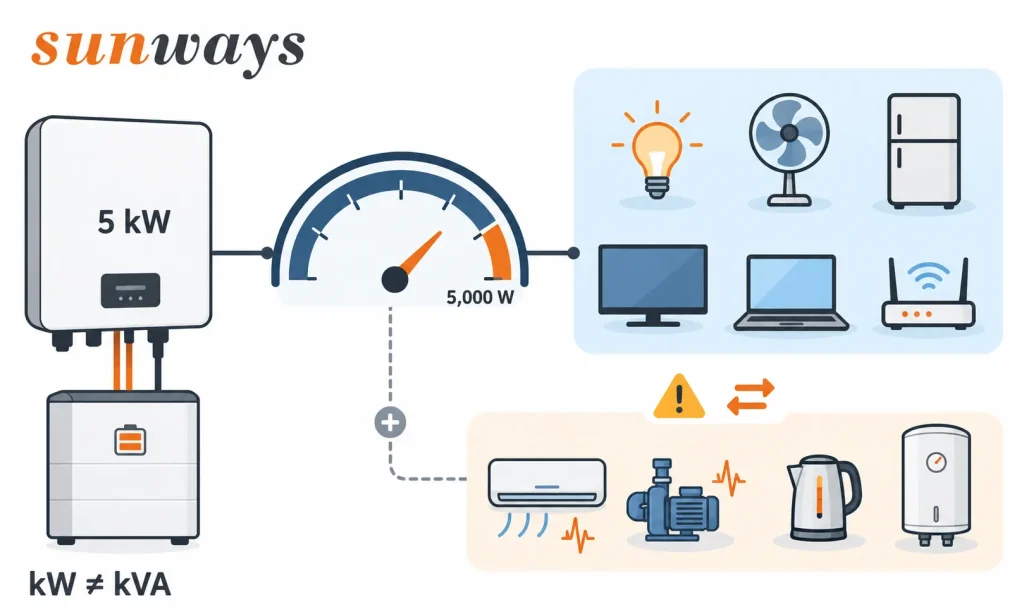
- Rated output: The grid-tied and standby rated outputs for the Sunways STH-5KTL-LS and STH-5KTL-LT are both 5,000W. This is the rated value under specified operating conditions; during a power cut, a power source such as a battery is also required to support the required power.
- Daily base load: Lighting, fans, fridges, televisions, computers and routers can be grouped together for calculation purposes. Provided the total operating power falls within the available on-site output range and the start-up requirements of appliances such as fridges are met, this group of appliances can be powered simultaneously.
- Motorised equipment such as air conditioning: When adding air conditioning or water pumps to the base load, verify their electrical input power and start-up requirements. Do not rely solely on cooling capacity labels such as ‘1.5-tonne air conditioner’, nor assume that any air conditioner can be powered.
- High-power appliances such as electric water heaters and kettles: First, check whether adding them would exceed the power limit. If so, implement time-shifted usage, reduce the number of appliances running simultaneously, or consider a solution with greater capacity.
When reading specifications, please distinguish between kW (kilowatts, active power) and kVA (kilovolt-amperes, apparent power). 5 kW represents 5,000 W of active power; kVA is another capacity metric that must be verified, and the two cannot be directly interchanged.
Add Up the Appliances You Will Use Together
The most straightforward way to assess this is to add up the power ratings of appliances in a real-world usage scenario. The table below provides a hypothetical calculation example; it does not represent typical appliance power ratings or Sunways load-bearing tests. Please substitute the input power of your own appliances.
| Appliances running simultaneously | Assumed total operating power | How to assess |
|---|---|---|
| Base load 700W + air conditioning 1,500W | 2,200W | Below the 5,000W rated capacity; next, check the start-up capacity. |
| The above combination + electric kettle 2,000W | 4,200W | Still below the rated capacity; confirm that the available on-site output can cover this combination. |
| Plus electric water heater 2,000W | 6,200W | Exceeds the rated capacity. This combination exceeds the 5kW continuous supply rating; switch off some appliances or reassess the required system capacity. |
Calculation example: Power values are assumptions for illustration, not typical appliance ratings or Sunways load-test results. Use your appliances’ actual input power when assessing your system.
You do not need to calculate the total power consumption of all appliances in the entire house first. By first calculating the combinations required for ‘evening cooking’ or ‘essential operation during a power cut’, you can determine which appliances can be used simultaneously and which need to be staggered.
Make the Decision in Three Checks
- Add operating power: Check the ‘input power’ or ‘rated input power’ on the nameplate or instruction manual, and add up the figures for the appliances to be run simultaneously. The cooling capacity of an air conditioner cannot be used as a substitute for input power; for appliances where operating power varies with operating conditions, also verify the maximum operating input that may be reached.
- Check start-up requirements: Provide the installer with the full model numbers of your fridge, air conditioner and water pump to confirm that, when these are started up alongside other running appliances, the total load remains within the inverter and battery’s permitted short-term power supply limits.
- Confirm available on-site output: Ask the installer to specify, based on your battery configuration, installation temperature and number of power phases, whether this set of loads can operate simultaneously; For three-phase systems, the load on each phase must also be checked; do not rely solely on the total power rating of the unit.
If the total operating power exceeds 5,000W, first reduce the number of simultaneous loads or consider alternative capacities; if it does not exceed this limit, proceed to the start-up and on-site power supply checks. Only when all three criteria are met can it be determined that the 5kW solution is suitable for this application.
Which Loads Need Backup and Which Can Stay on the Grid?
Prioritise backup power for equipment that cannot be shut down during a power cut, whilst leaving high-power equipment that can wait connected to the mains. This reduces the instantaneous load on the backup power supply and preserves battery power for lighting, communications and essential domestic appliances. Circuits left connected to the mains will not automatically receive power during a power cut simply because you have installed a hybrid inverter.
For example, you might first include lighting, routers and refrigerators on the list of equipment to be powered by the backup system, whilst placing electric water heaters or other electrically heated appliances that can be deferred on the list of equipment to be switched off during a power cut. If a water pump is essential for the water supply, it should be included as an essential load, and its start-up capability should be verified separately; start-up requirements must not be overlooked simply because the pump normally operates for short periods.
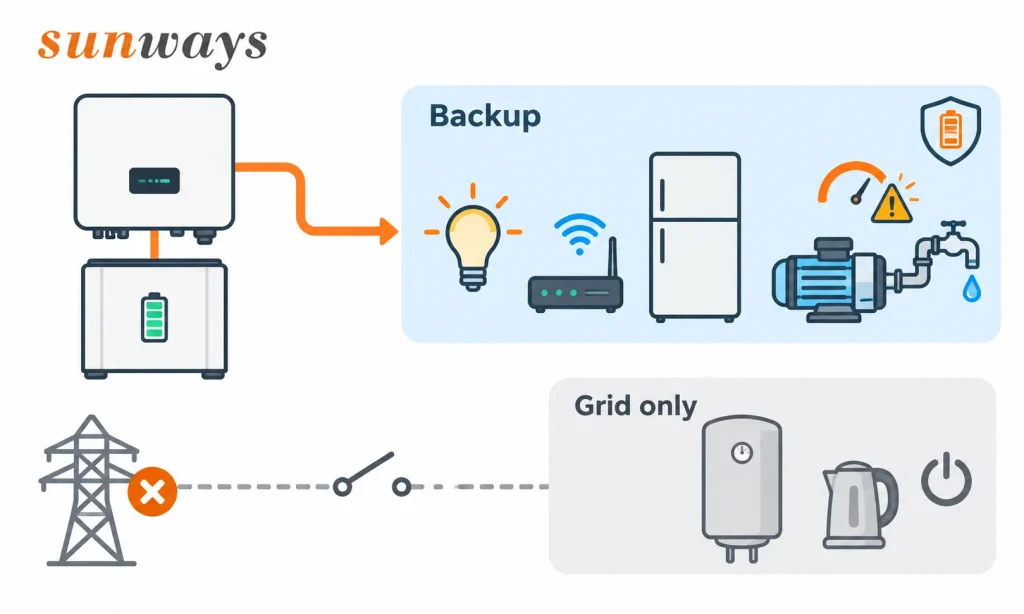
Divide your equipment into three groups and provide these to the installer, requesting that they be assigned to specific circuits:
- Must operate during a power cut: Include these in the backup power design, specifying which devices are permitted to be switched on simultaneously.
- Can be paused or used during off-peak periods: Specify that these should be switched off during a power cut, or used only after other major loads have been taken off the system.
- No backup power required: These should remain connected to the mains and not utilise battery power.
Subsequently, ask the installer to mark these three groups of circuits on the single-line diagram—a diagram showing power supply paths and protective devices using simplified circuit symbols—and to explain the switchover procedure following a power cut. During acceptance testing, check the circuits actually receiving power against the list; do not rely solely on the inverter display showing ‘battery operation’. For equipment that cannot tolerate any interruption in power supply, the requirement for continuous power supply must also be confirmed separately.
How Should Battery Power and Runtime Be Checked?
A battery must pass two tests simultaneously: its discharge power must be sufficient to drive the equipment, and its available charge must cover the target duration. If the power is insufficient, the battery may be unable to drive the load even if it stores a large amount of charge; conversely, if the power is sufficient but the charge is too low, the battery may be able to start the device but fail to last for the required duration.
Check Power Before Battery Size
First, check the maximum continuous power the battery is rated to deliver under the intended operating conditions, as well as the maximum short-term power it can deliver during start-up. The BMS (Battery Management System) is responsible for monitoring and protecting the battery, and may also limit charging and discharging based on temperature and remaining charge. Therefore, you should not select a product based solely on the capacity stated on the battery casing.
If the specifications provide voltage and current, you can first estimate the power using DC power ≈ voltage × current, and then factor in the conversion losses of the inverter. V (volts) is the unit of voltage, and A (amperes) is the unit of current. The following is merely an illustrative example based on specific conditions: assuming a battery pack has a voltage of 50 V under a certain operating condition and is permitted to discharge at a continuous rate of 60 A, it can provide a maximum of approximately 3,000 W DC power under those conditions. If your backup power equipment requires a continuous 3,500 W AC power output, this operating condition will not meet the demand; you cannot assume that the inverter will be able to handle the load simply because it is rated at 5 kW.
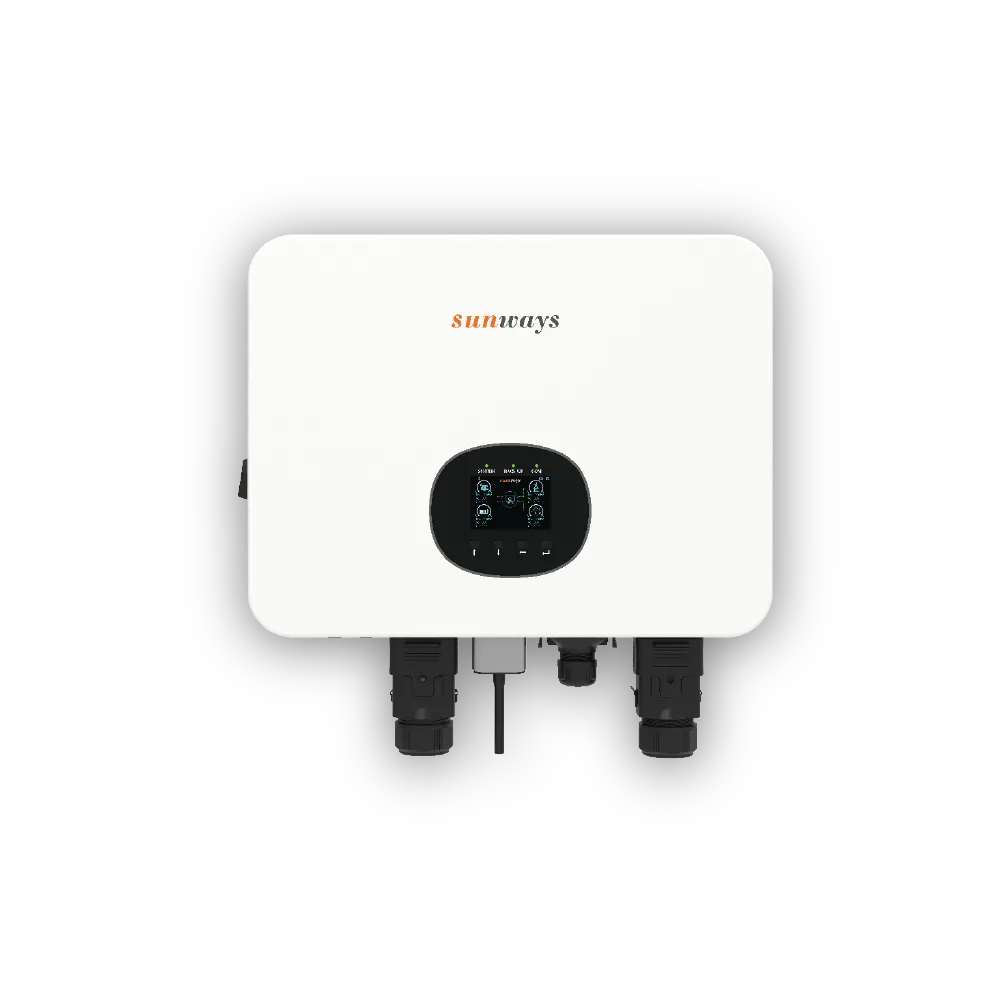

The Sunways STH-5KTL-LS and STH-5KTL-LT both have a battery voltage range of 40–60V and a maximum charge/discharge current of 120A. These figures are specifications on the inverter side; they do not represent the battery’s continuous discharge capacity, nor should the ‘maximum current’ be taken to mean a current that can be sustained under all conditions.
The approach is clear: if battery power is insufficient, first reduce the number of simultaneous loads, or select a compatible battery configuration with sufficient discharge capacity; do not simply increase the nominal capacity. Ask the supplier to specify the sustained and inrush loads that the proposed battery configuration can support within the target temperature and capacity ranges.
Turn Your Backup Target Into an Energy Requirement
kWh (kilowatt-hours) represents electrical energy; 1 kWh is commonly referred to as ‘one unit of electricity’. When determining backup capacity, calculate using the average load rather than multiplying the peak power drawn at the moment of equipment start-up by the total duration of the power cut.
Energy required by the load (kWh) = Average backup load (kW) × Target duration (h).
The following is again a calculation example, not a product endurance test: If your objective is to run an average load of 2 kW for 3 hours without supplementary photovoltaic power, the load will require 6 kWh. For the same 3-hour period, if the average load is reduced to 1 kW by switching off non-essential equipment, the power required drops to 3 kWh. Therefore, both streamlining the backup load and increasing battery capacity can be effective ways to improve runtime.
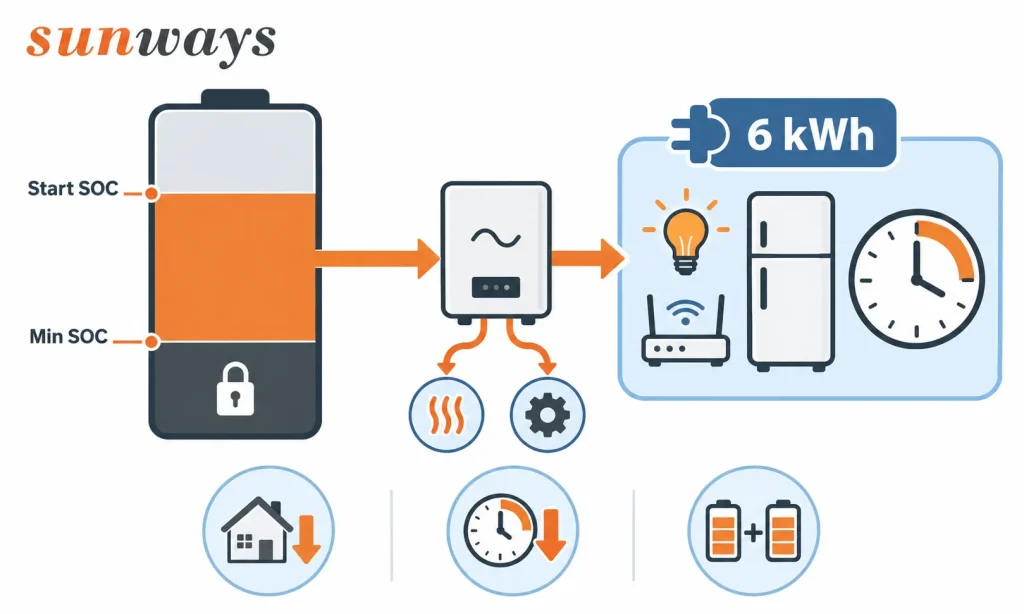
However, just because the load requires 6 kWh does not mean that purchasing a battery with a nominal capacity of 6 kWh will achieve the target. The range of unusable battery capacity, power supply losses and the system’s own power consumption must all be factored into the calculation. SOC (State of Charge) indicates the percentage of remaining charge; how much charge the battery has at the start of a power cut will also affect the result. You should request that the proposal specify: average load, target duration, initial and minimum SOC, and the required battery configuration. If the estimated duration is insufficient, you must explicitly choose to reduce the backup load, shorten the target duration, or increase the battery capacity to meet the requirements.
Confirm Compatibility Before Ordering
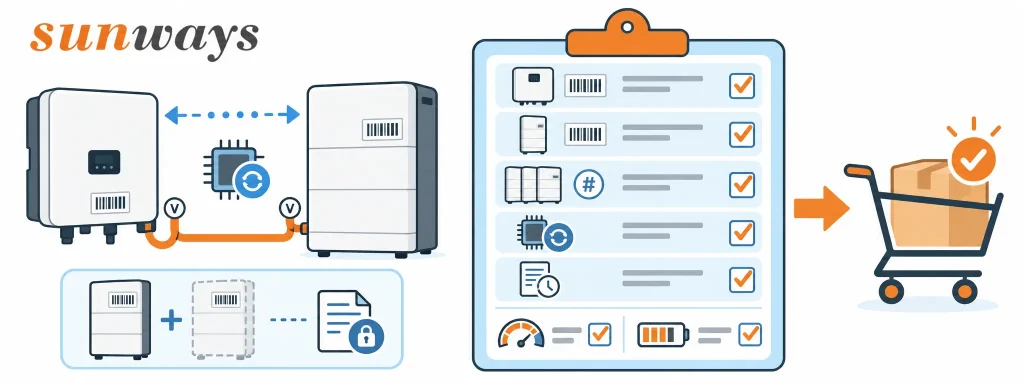
Matching voltages alone is not sufficient to guarantee that the inverter and battery will work together. For lithium-ion battery packs, you must also confirm the communication protocol—the rules governing the exchange of status and power limit information between the two devices—as well as the firmware version, i.e. the version of the device’s internal control software.
Before purchasing, finalise the configuration with a single line of information: full inverter model number + full battery model number + quantity + applicable firmware + compatibility document version. Only confirm the order once the compatibility of this combination, as well as the power and capacity requirements, have been verified. If you plan to add batteries at a later date, include the permitted models, quantities and conditions for expansion in the proposal; do not treat ‘can be added later’ as an unlimited commitment.
Which PV Input and Grid-Phase Checks Matter?
First, match the number of phases in the on-site power supply, then check the voltage, current and total power of the module strings. The fact that both are ‘5 kW’ does not prove that the two models are interchangeable. AC refers to alternating current, whilst DC refers to direct current; the direct current generated by photovoltaic modules and the alternating current used in the building must be verified separately against their corresponding parameters.
Choose the Correct Phase Version
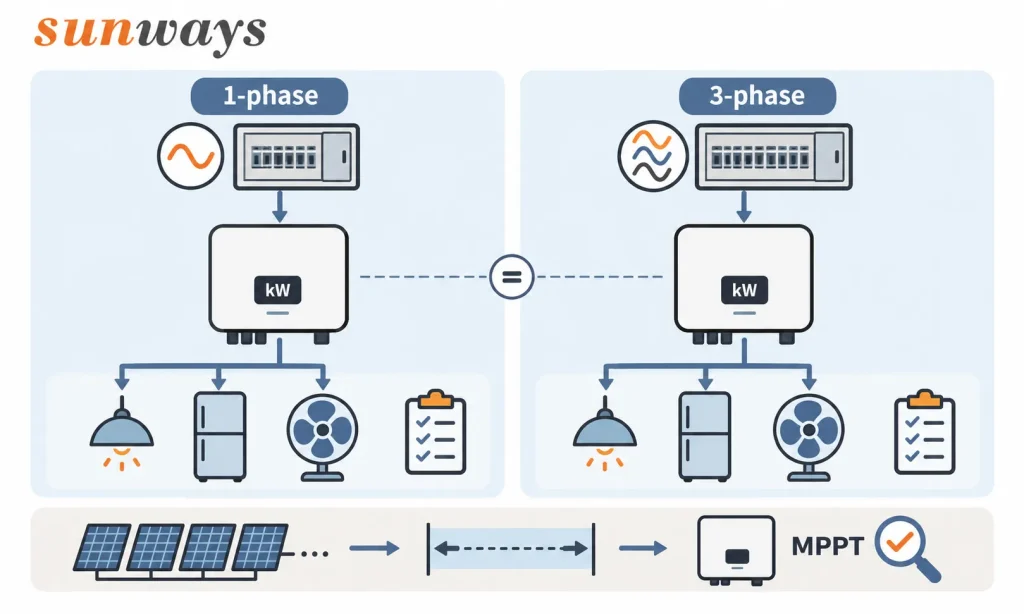
Whether to select single-phase or three-phase should be determined based on the on-site power supply and load configuration; it should not be guessed based on the size of the property. The two Sunways products below have the same rated power but differ in their wiring and input requirements. MPPT (Maximum Power Point Tracking) is a function of the inverter that regulates the operating state of the modules and identifies the optimal power generation point; its voltage range also serves as the basis for string selection.
| Verification Item | Sunways STH-5KTL-LS | Sunways STH-5KTL-LT |
|---|---|---|
| Grid-connected rated output power | 5,000 W | 5,000 W |
| AC rated output voltage / wiring configuration |
L/N/PE, 220/230 V Single-phase |
3L/N/PE, 380/400 V Three-phase |
| Maximum PV input power | 10,000 W | 10,000 W |
| Maximum DC input voltage | 600 V | 1,000 V |
| MPPT voltage range | 80–550 V | 160–850 V |
| Number of MPPT channels | 2 | 2 |
| Maximum input current per channel | 20/20 A | 20/20 A |
| Maximum short-circuit current per channel | 25/25 A | 30/30 A |
Source: Sunways Products Datasheet V1.2 20260717.pdf, physical pages 8 (STH-5KTL-LS) and 9 (STH-5KTL-LT). Current values are shown as MPPT 1 / MPPT 2.
In the table, ‘L’ denotes the phase conductor, ‘N’ denotes the neutral conductor, and ‘PE’ denotes the protective earth. First, ask the installer to clearly specify in the proposal the number of phases on site, the supply voltage and the phase on which the backup load is connected, then select the corresponding version. For three-phase installations, also verify the load limits for each phase and the conditions for unbalanced loads, i.e. the conditions applicable when the loads on different phases are unequal; even if the total power rating of the unit is suitable, this does not mean that the entire load can be concentrated on any single phase.
Check the PV String Against Every Input Limit
A string is a circuit formed by connecting modules in series according to the design. Even if the total wattage is within the upper limit—meaning only the power requirement has been met—exceeding voltage or current limits may still render the design invalid. Please ask the installer to submit the following three results using the actual module model and on-site temperature conditions:
- Maximum voltage: The open-circuit voltage of the modules at low temperatures—that is, the voltage when unloaded—will affect the maximum voltage of the entire string. Calculate this based on the module’s temperature coefficient—the rate at which voltage changes with temperature—and compare it with the inverter’s maximum DC input voltage.
- Operating and start-up conditions: Check whether the string’s operating voltage within the expected temperature range is compatible with the MPPT range, and check the start-up requirements separately. The maximum permissible voltage cannot be substituted for the normal operating range.
- Current for each circuit: Check the operating current and short-circuit current separately; the latter is the current rating under specific short-circuit conditions. The ‘20/20A’ in the table must be interpreted per circuit; the currents must not be combined and connected to a single circuit. The specific design must also comply with the relevant installation documentation.
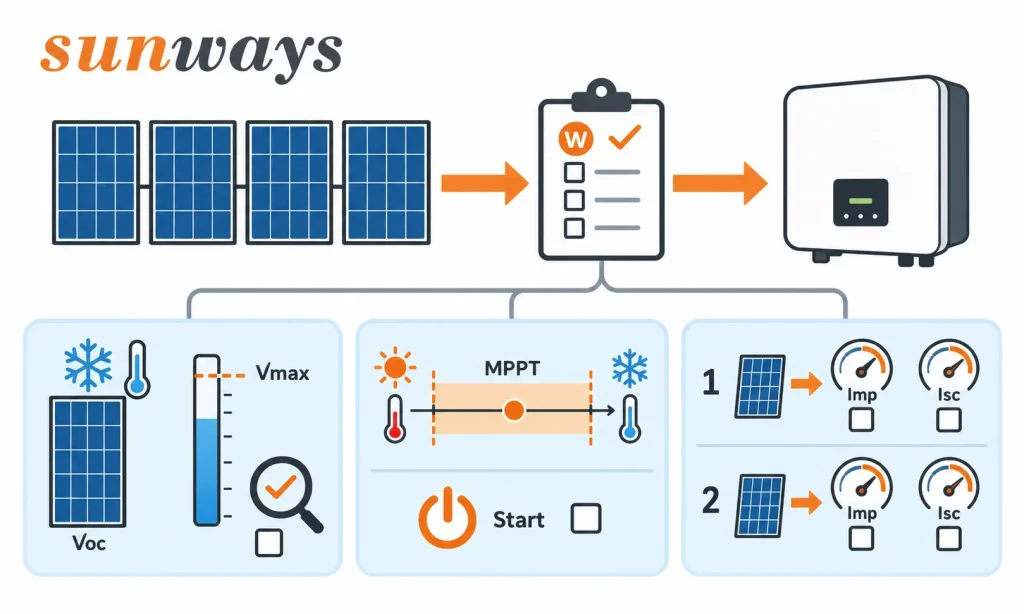
To give an illustrative example of a voltage calculation: if the open-circuit voltage of a string of modules at low temperatures reaches 650 V, this exceeds the 600 V upper limit of the STH-5KTL-LS, and the string cannot be connected according to the original string configuration. In this case, the number of modules in series should be recalculated or the design adjusted, rather than proceeding with the original string configuration simply because the total module power does not exceed 10,000W. Although the STH-5KTL-LT has a maximum DC input voltage of 1,000V, on-site conditions—such as three-phase power supply—must first be met; it must not be substituted solely for the sake of a higher voltage limit.
The procedure is as follows: if the number of phases does not match, select a different model first; if the string voltage or current does not meet requirements, revise the design first; only after all criteria have been met should the module configuration be finalised. The 10,000 W photovoltaic input limit for both models does not imply that the rated AC output becomes 10,000 W, nor does it mean that modules should be configured to the maximum limit for all projects. Finally, the connection and certification documentation required at the project site must be verified; documentation from one country cannot be directly used as the basis for connection in another.
When Would a Different Inverter Rating Be More Suitable?
- The capacity configuration should be adjusted when the number of devices that must operate simultaneously exceeds the available output, or when start-up requirements cannot be met; if demand is significantly lower and there are no plans for expansion, a smaller capacity may also be considered. Do not base your decision solely on the number of devices, and certainly do not adopt the principle that ‘bigger is always better’ as a basis for selection.
- Consider a larger capacity: large loads must operate simultaneously and cannot be accommodated by reducing the backup power range or through load shifting. The battery, number of phases and circuit design of the new solution must also meet these requirements.
- Retain 5 kW and adjust usage patterns: Excess demand stems from equipment such as electric heating that can be deferred. For example, specify that electric kettles and water heaters should not be used simultaneously during a power cut, rather than making a general request to ‘be mindful of electricity usage’.
- Consider a smaller capacity: If both current and confirmed future loads are low, a smaller model can still pass operational, start-up and PV input checks; compare the total installation costs thereafter.
If you are planning to install a heat pump or charging equipment, ask the installer to provide separate load calculations for ‘the current situation’ and ‘after the new equipment has been installed’. Increasing battery capacity does not raise the inverter’s AC rated power, nor does replacing the inverter with a larger model automatically compensate for insufficient battery discharge. If the future plan involves parallel operation, you will also need to obtain evidence that the specific model supports the corresponding configuration.
What Should a Complete Product and Installation Quote Include?
- A comprehensive quotation must clearly state ‘what is to be installed, which loads it can power, what installation work is included, and how acceptance will be carried out’. Simply listing the inverter model and total price is insufficient for comparing two proposals. You may request that all quoting parties specify, item by item, against the same checklist, whether each item is ‘included’, ‘excluded’ or ‘to be confirmed’:
- Equipment list: Full inverter model and applicable market version; Battery model, quantity, and definitions of rated and usable capacity; module model and quantity.
- Power Supply Objectives and Design: Simultaneously operating loads, start-up requirements, standby circuits, target duration and its calculation criteria, as well as battery compatibility and string calculation documents.
- Scope of Installation: Cable routes and lengths, protection and isolation devices, earthing, power distribution modifications, metering and communication components; specify which items require additional procurement or construction work.
- Commissioning and Acceptance: Documents required for grid connection, backup power verification under actual critical loads, monitoring settings, handover drawings and operating instructions.
- Costs and Services: Equipment, transport, installation and applicable taxes and duties; warranty and service obligations; and a clear specification of how additional costs will be calculated in the event of on-site changes.
For example, if one quotation includes modifications to the standby power circuit whilst another covers only the installation of inverters, the total prices cannot be directly compared, even if the capacity is the same. First, ask both suppliers to provide a complete list of the same equipment and scope of work before comparing prices. For battery configurations or acceptance criteria that remain undetermined, request written justification to be provided before the final configuration is confirmed; do not allow the phrase ‘standard installation’ to be used as a substitute for specific details.
FAQs
Q1. Can an inverter rating be inferred from the number of installed panels?
No. The number of modules must be combined with the rated power of each individual module to determine the array’s nominal DC power; this figure is not the same as the inverter’s rated AC power. You should check the inverter nameplate and the relevant model specifications, and request verification of the string voltage and current; you cannot determine the inverter capacity solely based on ‘how many modules are installed on the roof’.
Q2. Does a nominal rating guarantee that every appliance can start?
No, it does not. For equipment with motors or compressors, start-up requirements may differ from those during steady-state operation and are also influenced by the start-up method and other simultaneously operating loads. Provide the installer with the model of the equipment that is most difficult to start and ask them to verify that the start-up requirements are compatible with the short-term capacity of the inverter and battery; without concrete evidence, one should not rely solely on the rated power to determine whether start-up is possible.
Q3. Can summer heat affect the power available on site?
Yes, high temperatures may cause the inverter to limit its output, i.e. derate. For example, the reference documentation lists the operating ambient temperature for the STH-5KTL-LT as −25 to 60°C, and specifies that derating occurs at temperatures above 45°C; ‘permitted to operate at this temperature’ does not equate to ‘always able to operate at full power’. [^lt] If high temperatures are anticipated at the installation site, instruct the installer to verify the available output in accordance with the applicable documentation and to adjust the installation location or load configuration accordingly. This table does not provide a complete derating curve; therefore, one cannot independently calculate the power loss per degree of temperature increase.
Q4. Does a larger battery increase the inverter AC rating?
It does not alter the inverter’s own AC rated power. Increasing the battery capacity may extend the backup runtime; where compatibility and configuration rules permit, it may also improve the power supply capacity previously limited by the battery, though it cannot exceed the limitations of the inverter or other components of the system. Before expanding capacity, verify both the additional energy capacity and the permitted discharge power separately; do not treat the two as the same change.
Q5. Can one backup circuit serve every floor of a building?
Whether power can be supplied across floors depends on the actual power distribution design, rather than the number of floors itself. Power can be supplied to selected circuits on different floors via the backup power distribution system, but the load, wiring, protection and number of phases for each circuit must be designed and verified; this does not mean connecting all floors to a single branch circuit. Ask the installer to mark the coverage area on the diagram; do not rely solely on descriptions such as ‘supports whole-house backup power’ to make a judgement.
Q6. Does a rating label identify single-phase or three-phase supply?
The power rating ‘5kW’ alone does not indicate the number of phases. Information such as wiring and voltage specifications found on the complete rating plate and in the model documentation is required to make this determination. For example, the STH-5KTL-LS compared in this article is rated at L/N/PE, 220/230V, whilst the STH-5KTL-LT is rated at 3L/N/PE, 380/400V. When purchasing, retain the full model number and a photograph of the nameplate; do not simply specify the capacity on the order.
Q7. Can future load additions change the original capacity choice?
Yes, the key factors are whether the new equipment will operate simultaneously with existing high-load equipment, and whether it also requires a power reserve. Update the load scenario table before purchasing heat pumps, charging equipment or new production equipment; if the load is only occasionally added and can be shifted to off-peak periods, the approach may differ from that for equipment that must operate simultaneously, so there is no need to automatically assume that a larger inverter is required.
Explore Sunways Hybrid Inverters
Compile a list of your simultaneous load capacity, backup power circuits, number of power supply phases and battery requirements, then compare the suitable Sunways hybrid inverter models to determine the complete configuration.
Start Your Project