Solar Inverter Price: Is the Cheaper Quote Really Better?
Table of Contents
A lower quote for a solar inverter isn’t necessarily the better deal. A lower price is only meaningful when it meets the same power needs, includes the same scope of supply and installation, and offers comparable warranty and after-sales service terms. Otherwise, the money saved during the purchase may be offset by subsequent expenses for additional components, installation, or maintenance.
When you search for solar inverter price, the results you see may be either the price of a single inverter or a system quote that includes batteries and installation. Even if two products are labeled with the same power rating, you’ll need to further verify the rated AC output, number of phases, and feature set. If you want to maintain power during an outage, you’ll also need to confirm the backup power output capacity, battery compatibility, and whether the quote includes the necessary switching equipment and installation of the backup power circuit.
How Much Does a Solar Inverter Cost—and What Does the Price Cover?
| Type / Sample Quote | Rated AC Power / Number of Phases | Reference Price per Unit and Scope of Inclusion | Applicable Market / Source Date |
|---|---|---|---|
| Grid-Tied SolarMax SM-Enersolar-5k | 4.6 kW; page lists 230 V AC; number of phases not specified. Product title is labeled “5kW,” which differs from the specification table. | 85,000 PKR; it is unclear whether batteries or installation are included; taxes and shipping costs to be confirmed. |
Pakistan Solar Trade Retrieved on October 9, 2026 The page does not specify the price update date. |
| Hybrid SolarMax SM-5K-H1P | 5 kW rated AC/UPS output; number of phases not specified. | 130,000 PKR; it is unclear whether batteries or installation are included; taxes and shipping costs to be confirmed. |
Pakistan Solar Trade Retrieved on October 9, 2026 The page does not specify the price update date. |
| Off-grid SolarMax SM-G4 Plus-M-5K-48 | 5 kW rated output; 230 V AC listed on the page; number of phases not specified. | 80,000 PKR; not clear whether batteries or installation are included; taxes and shipping costs to be confirmed. |
Pakistan Solar Trade Retrieved on October 9, 2026 The page does not specify the price update date. |
When making your selection, you can first narrow down your options based on three criteria. If you have access to the utility grid and do not require energy storage or backup power during outages, start by evaluating a grid-tied solution; ask the supplier to itemize the costs for equipment, protective devices, installation, and grid-connection fees separately.
If you specifically require batteries or backup power, compare the total cost of hybrid solutions that meet these needs. At the same time, specify which devices must remain operational during a power outage, the total power required, and the desired duration of operation, and request that the quote include matching batteries, necessary metering and control equipment, and the installation of backup power circuits.
If there is no available utility grid on-site, request a quote for a complete off-grid power supply solution, incorporating the load, energy storage capacity, recharging conditions, and necessary backup power sources into the budget; do not base your decision solely on the unit price of the off-grid inverter.
On-Grid, Hybrid or Off-Grid: What Are You Paying Extra For?
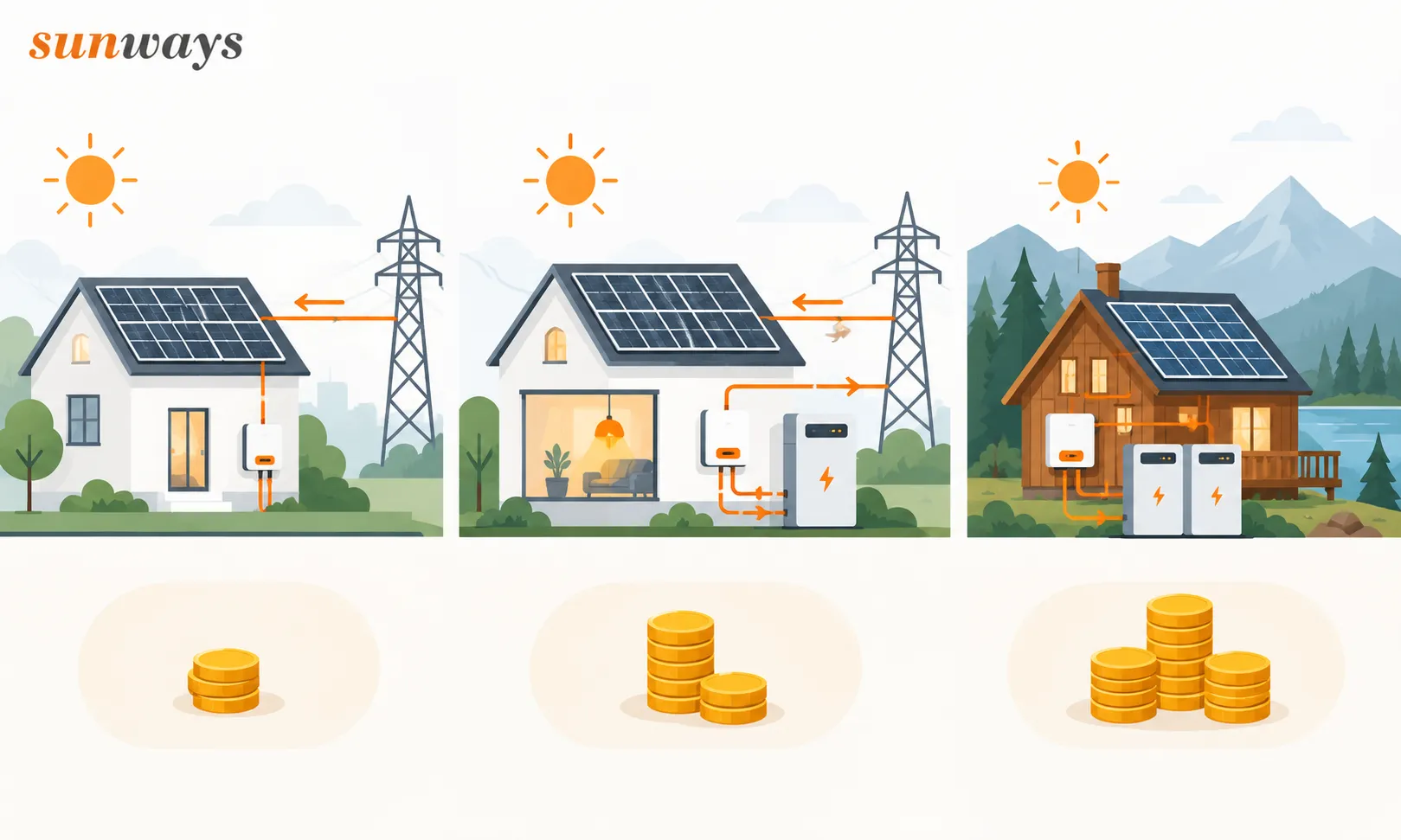
Whether the extra cost is worth it depends on whether it meets your actual needs. Grid-tied systems primarily rely on photovoltaic power in conjunction with the utility grid; hybrid systems add battery management and provide backup power depending on the configuration; off-grid systems, on the other hand, are designed to maintain power supply when there is no utility grid support.
Compare the Scope Before the Price
| Comparison Item | On-Grid | Hybrid | Off-Grid |
|---|---|---|---|
| Project Requirements | Accessible utility grid; desire to use solar power to meet part of electricity needs | Requires battery integration or a backup power system for outages | No accessible utility grid; requires independent power supply |
| Inverter Price Scope | Standard unit price typically does not include battery management or a complete backup power system | Support for batteries or backup power does not mean the quote includes batteries and all associated equipment | Unit price covers only part of the power supply system |
| Additional System Components | Installation, cabling, protective devices, and metering and control equipment configured as required by the project | Batteries, metering and control equipment, as well as the installation of switching devices and backup power circuits added as required by the design | PV, batteries, charge control, power distribution protection, and necessary backup power; integrated functions prevent duplicate purchases |
| Capabilities to Verify | Rated AC power, number of phases, PV input matching, and local grid-connection requirements | Battery compatibility, charge/discharge power, backup power output capacity, switching time, and power supply range | Daily electricity consumption, simultaneous operating power, motor startup requirements, and power supply capacity during periods of insufficient sunlight |
| Scenarios Suitable for Further Evaluation | No clear energy storage or backup power requirements; can serve as a baseline quotation | Clear energy storage, backup power, or plans to install batteries in the near future | Off-grid residences, farms, or remote sites; pricing should be based on a complete power supply system |
Here, AC refers to alternating current, which is the form of electricity used by most everyday appliances; phase refers to single-phase or three-phase power supply. You should ask the supplier to specify the rated AC output power and phase in the quote, and verify the on-site power supply conditions. Do not rely solely on the “5 kW” or “10 kW” in the product name, nor should you mistake the maximum connectable PV power for the rated AC output power.
a. On-Grid: Start with the Functions You Need
If your goal is to utilize daytime solar power generation and you have no specific energy storage or backup power requirements during outages, you can start by evaluating a grid-tied solution. Have the supplier confirm that the voltage and current of the solar panels match the inverter, and list the costs for installation, protection, and metering controls. If this configuration already meets your project objectives, you can use it as a baseline for comparing other solutions.
A standard, pure PV grid-tied system typically does not provide backup power during outages. If you have equipment that must remain operational, first specify the power requirements and the required runtime for these devices, then ask the supplier to provide a corresponding solution.
b. Is a Hybrid Inverter Worth the Extra Cost?
① Battery Storage: How Much Electricity Do You Need at Night?
If you want to save daytime solar power for nighttime use, first determine how much excess electricity you have during the day and how much you’ll need at night. Provide your supplier with time-of-use consumption records from your electricity meter or monitoring system to help determine the appropriate battery capacity. A higher-wattage inverter does not necessarily mean you need a larger battery.
② Backup Power: What Needs to Keep Running?
First, list the devices that must remain operational during a power outage—such as refrigerators, lighting, computers, or water pumps—and then have the supplier confirm whether they can power all of them simultaneously. Also, ask how long the power will be interrupted during the switchover and whether this will affect your equipment. Support for backup power does not mean it can power every appliance in your home.
Request that the quote list the costs for the battery, necessary switching equipment, and wiring modifications. Some features are built into the inverter, while others require additional equipment. Ask specifically, “After installation, which outlets and devices will have power during a blackout?” to ensure the quote is complete.
③ Future Expansion: Can You Add a Battery Later?
c. Off-Grid: What Does the Whole System Cost?
① Power and Energy: How Much and How Long?
② Recharging: What Happens on Cloudy Days?
Same Power Rating, Different Prices: Which Differences Matter?
Five Differences to Check Before You Compare Prices
| Difference | When It Affects Your Project | What Evidence Is Needed |
|---|---|---|
| Number of Phases and Connection Requirements | Whether the site has single-phase or three-phase power supply, as well as local connection regulations, will affect equipment selection | Official specification sheets, on-site power supply information, applicable grid-connection documents, and connection plans |
| PV Input and MPPT Matching | When PV panels are oriented in different directions, or when module voltage and current are high, it is necessary to verify whether they can be properly connected | Module and inverter specification sheets, module connection plan, voltage and current calculations |
| Battery and Backup Power Capability | Differences in functionality become directly valuable when energy storage is required, backup power during outages is needed, or a battery is to be installed in the near future | Battery compatibility list, backup power parameters, system wiring diagrams, and list of necessary accessories |
| Installation Environment and Monitoring Accessories | Outdoor, high-temperature, or dusty environments—or situations requiring remote monitoring of system operation—will influence the selection of equipment and accessories | Installation manuals, environmental suitability conditions, monitoring feature descriptions, and lists of accessories and associated fees |
| Warranty, Local Service, and Delivery Responsibilities | In the event of equipment failure or when support is needed for installation and commissioning, the scope of responsibility will affect subsequent expenses | Locally applicable warranty terms, service contacts, cost-sharing guidelines, and delivery contracts |
1. Phase and Grid Connection: Match Your Site
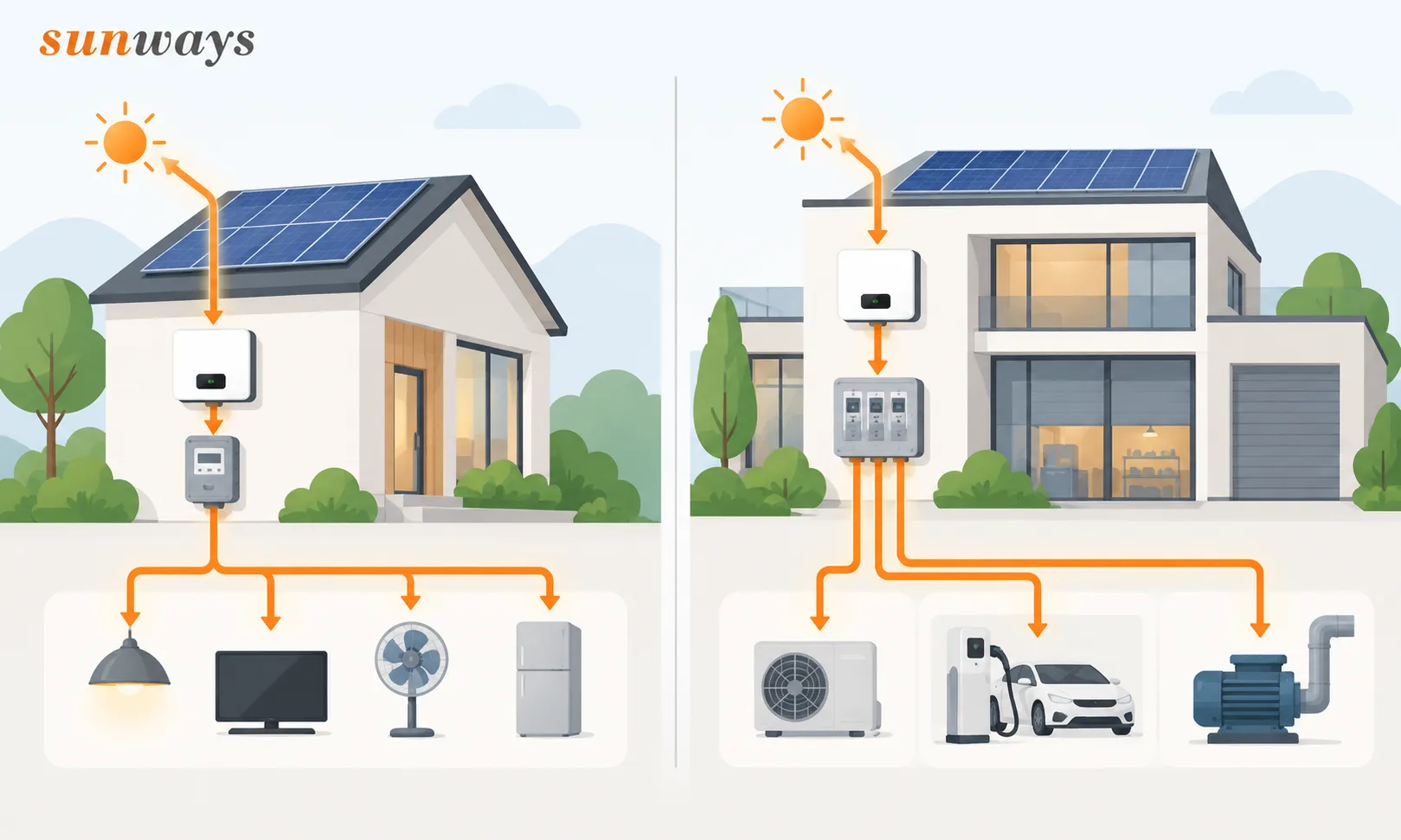
Single-phase and three-phase are different power supply configurations; selection should not be based solely on price. Before checking the three-phase solar inverter price, have your installer confirm the number of phases at your site, the grid connection voltage, and local grid-tie requirements. If there is three-phase equipment on-site that requires backup power, you should also verify separately whether the backup power supply supports this configuration.
Even if the total power of two units is the same, you must consider how that power is distributed across the phases. Especially when three-phase backup power is required, ask the supplier to specify how much load each phase can handle and what restrictions apply when power consumption is uneven across phases.
2. PV Input and MPPT: Match Your Solar Panels
PV stands for photovoltaic; MPPT stands for Maximum Power Point Tracking, which can be understood as a control function that helps solar panels find the optimal operating point as light conditions change. Multiple independent MPPTs allow different groups of solar panels to operate separately. For example, if part of a roof faces east and part faces west, it’s worth having a designer evaluate whether to use separate MPPT units. However, if the roof layout is simple, adding more MPPT units may not necessarily provide practical benefits.
You should also verify the allowable voltage and current for each circuit, as well as how the modules are connected in series or parallel. The number of interfaces does not necessarily equal the number of independent MPPT units. Ask the supplier to provide a module connection diagram specifying how many panels are connected to each circuit and the rationale behind the configuration.
3. Battery and Backup: Check More Than the Power Rating
The same rated power does not necessarily mean the battery’s charging and discharging capacity or the system’s output capacity during a power outage are the same. If you need backup power, ask the supplier to list the grid-connected output power, battery charging and discharging power, and backup output power separately. Then, based on the equipment that must remain operational, confirm whether the system can power all devices simultaneously and whether it meets the requirements when starting equipment such as water pumps.
Also verify which ancillary equipment is required for the backup power function. Some systems require additional switching and metering devices to detect power outages and switch to backup operation. Request that the quote clearly state whether these devices are included and which circuits will be connected to the backup power supply to avoid directly comparing the “base system price” with the “complete backup power solution price.”
When Is “Battery-Ready” Worth Paying For?
4. Installation and Monitoring: Check What Is Included
The installation environment affects equipment selection. The IP protection rating indicates the enclosure’s resistance to solid foreign objects and water ingress, but it does not, on its own, determine whether the equipment is suitable for all outdoor conditions. If you plan to install the equipment outdoors, inform the installer about the site’s exposure to sunlight, rain, dust, and ventilation, and then confirm the location according to the installation manual. In high-temperature environments, you should also check the derating conditions—that is, under what circumstances the device will reduce its output power.
Verify the scope of monitoring features included in the package. “Supports remote monitoring” does not mean that communication accessories, electricity meters, and network fees are all included. Ask the supplier to specify whether the system uses Wi-Fi, a wired network, or a mobile network; what accessories are required; and whether there are ongoing fees. If you want to view household electricity or battery data, also confirm whether these data points require additional metering equipment.
5. Warranty and Service: Know Who Pays and Who Responds
Inverter Price vs Total System Cost: What Is Missing from the Quote?
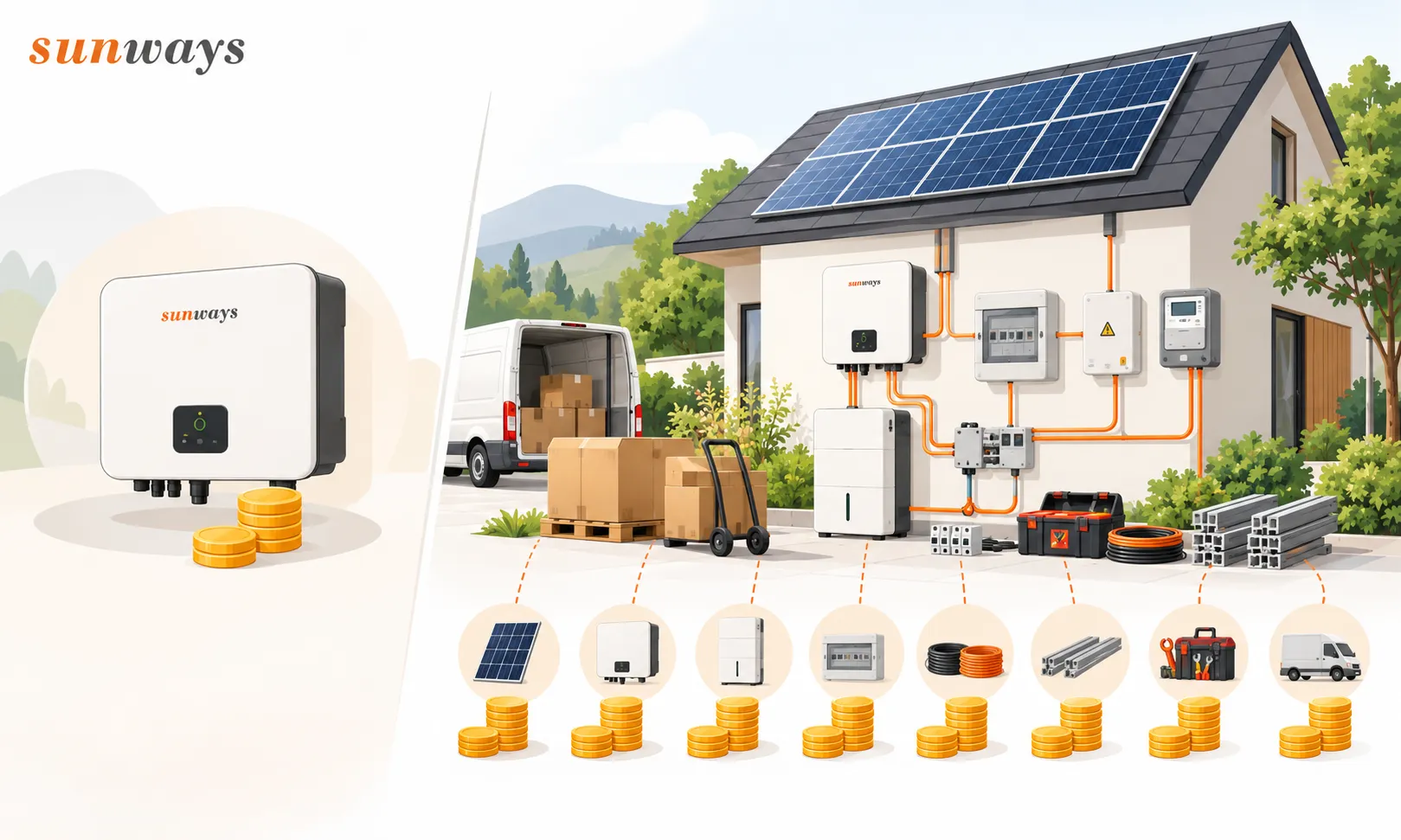
a. Inverter Only vs Inverter with Battery
Adding a Battery Does Not Complete a Backup System
If you’re comparing quotes with and without a battery, first clarify the purpose of adding the battery: is it to store excess daytime electricity for evening use, or to maintain power during a blackout? A backup power solution cannot simply be the unit price plus the cost of the battery. You also need to confirm which devices will be connected to the backup circuit and whether the system requires additional switching equipment, metering devices, or wiring work. Items that are already integrated or included in the package should be clearly marked to avoid duplicate charges.
b. What Installation Adds to the Budget
Electrical Work and Protection
Metering, Communication, and Backup Switching
Electric meters or current sensors are used to measure the flow of electricity, while communication accessories are used to transmit operational data; whether these need to be purchased separately depends on the specific system. If backup power is required, you should also confirm how the power-outage switching function will be implemented. Request that the supplier list the equipment models, quantities, and costs, and specify whether monitoring activation, network connectivity, and backup power circuit installation are included.
Installation, Testing, and Handover
Confirm whether labor costs include equipment installation, wiring, parameter configuration, and commissioning. Commissioning here refers to verifying that equipment connections, settings, and operation comply with the design specifications. If the quote promises backup power functionality, it should also specify how this will be verified and whether user manuals and handover records will be provided. Transportation, handling, necessary lifting operations, and any locally applicable application or acceptance fees should also be itemized according to the actual circumstances of the project.
c. Use an Itemized Quote to Identify Missing Costs
First, clarify whether you are installing a brand-new, complete solar system or replacing the inverter and adding batteries to your existing system. For a new installation, be sure to include solar panels and mounting brackets; for an upgrade project where you plan to continue using the existing equipment, specify “reuse existing equipment” and have the installer confirm whether it can still be used.
When comparing two quotes, ask the supplier to specify for each item whether it is included, billed separately, not applicable, or to be confirmed:
- Inverter: Specific model, quantity, and which accessories are included with the unit.
- Batteries and Accessories: Whether batteries are included, how many, their capacity, and whether all necessary connection accessories are provided.
- Backup Power During Outages: Which devices will remain operational during a power outage, and whether necessary switching equipment and wiring modifications are included.
- Electricity meters and monitoring: Whether equipment required for metering, grid connection, and monitoring is included, and whether there will be any subsequent charges.
- Cables and protective equipment: Which items need to be newly installed or replaced, and which can continue to be used.
- Installation and commissioning: Whether wiring, setup, operational checks, and verification of agreed-upon functions are included.
- Transportation and handling: Whether delivery to the installation site is included; who is responsible for unloading, moving, or hoisting; and whether there are additional charges.
- Taxes and Fees: Does the quote include taxes? If not, how much must be paid separately?
- Solar Panels and Mounting Systems: Are these included in new installations? For upgrades, will the existing configuration be retained?
- Other Necessary Expenses: Are there additional fees for applications, acceptance inspections, or extra construction work?
- Compare total prices only after confirming all necessary expenses. Do not assume unlisted costs are zero; do not double-count items already included in the package.
Which Inverter Setup Is Worth Paying For in Your Project?
First, rule out features you won’t need for now, then compare suitable options. Is this installation primarily for using solar power during the day, keeping critical equipment running during power outages, or preparing to add a battery in the near future? Once you have a clear goal, it will be easier for suppliers to recommend the right configuration.
Choose Based on Your Actual Needs
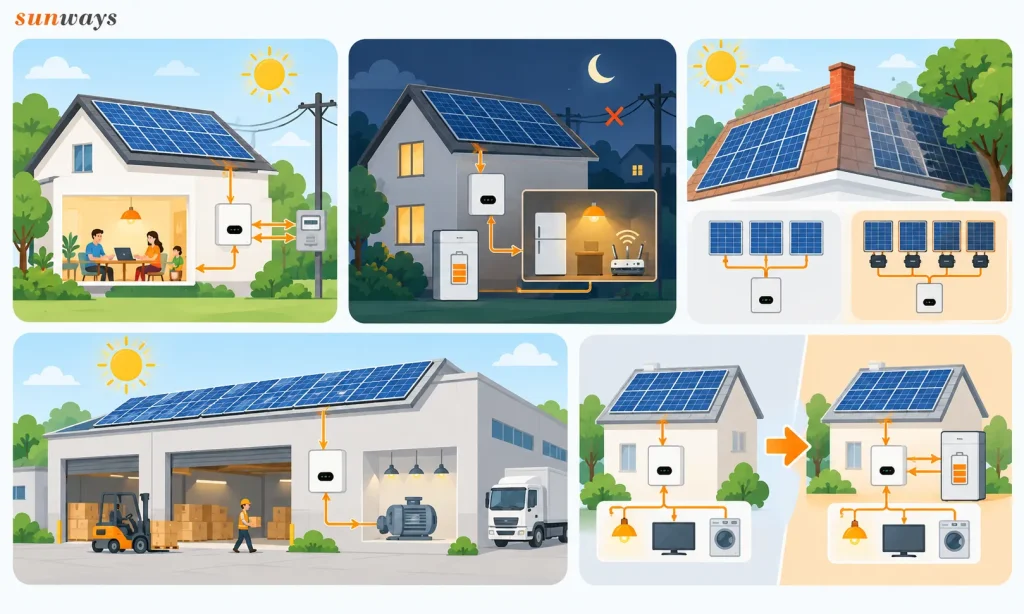
| Scenario | What to Prioritize | When an Immediate Upgrade Isn’t Necessary | What to Prepare Before Requesting a Quote |
|---|---|---|---|
| Residential daytime electricity use with no specific energy storage or backup power needs | A grid-tied solution that meets on-site connection and PV design requirements | Simply thinking that hybrid inverters offer more features, or that higher power is always better | Installation location, single-phase or three-phase power supply, planned solar panels, and electricity usage goals |
| Maintaining critical equipment during residential power outages | A backup power solution capable of powering specified equipment for the required duration | Purchasing a high-power inverter and large battery before clearly listing equipment and usage durations | Essential equipment, power requirements, whether they will be used simultaneously, and desired runtime |
| Plans to Add a Battery Soon | Two options: reserve battery connection capacity now or retrofit later | Installation timing is uncertain, or battery compatibility has not yet been confirmed | Installation timeline, energy storage purpose, compatible battery solutions, and retrofit cost estimate |
| Retail Space or Commercial Roof | Select a system based on business electricity consumption, the impact of power outages, and on-site power supply methods | Directly applying residential configurations, or assuming the entire premises requires backup power | Time-of-use electricity records, critical equipment and circuits, power supply conditions, maintenance requirements |
| No Access to the Public Grid | Complete off-grid power supply design | Do not assume long-term independent power supply simply because equipment is labeled “supports backup power” | Daily electricity consumption, equipment operating hours, local sunlight exposure, backup power sources, and maintenance conditions |
Daytime Home Use: Start with an On-Grid Setup
If you primarily want to use solar power during the day and have no requirements for energy storage or power during outages, you can start by evaluating a grid-tied solution. When comparing solar inverter prices for homes, have the installer select the power rating based on the solar panel configuration and on-site connection conditions—don’t simply choose a grid-tied inverter by adding up the power ratings of all your home appliances.
For example, if you’re often at home during the day and can schedule the use of appliances like air conditioners and washing machines to coincide with solar power generation, you can first check whether your power generation matches your electricity consumption. If the match is good and you have no other specific needs, there’s no need to purchase a hybrid system just for “more features.”
Home Backup: Pay for the Devices You Need to Keep On
When planning a home backup power system, first identify which devices cannot be shut off, then determine the appropriate inverter and battery sizes. Before comparing solar inverter costs for home backup, make a list of essential devices such as refrigerators, lighting, network equipment, or water pumps, noting which ones will run simultaneously and how long you want them to run. Have an engineer calculate the continuous power consumption, as well as the short-term power requirements when devices like water pumps start up.
The configuration requirements will differ significantly between a setup that only powers a refrigerator, lighting, and internet devices versus one that also runs an air conditioner and an electric water heater simultaneously. If your budget is limited, prioritize keeping critical appliances running and exclude non-essential high-power appliances from the backup system. Avoid purchasing a “large inverter + large battery” setup before your needs are clearly defined.
Adding a Battery Soon: Compare Both Upgrade Paths
Shops and Commercial Roofs: Follow Your Operating Hours
For shops and commercial roofs, start by examining electricity usage during business hours. When comparing commercial solar inverter costs, providing time-of-use consumption records—that is, electricity usage at different times of the day—is more helpful than simply providing monthly electricity bills. For locations with continuous daytime power needs, you can first evaluate whether the PV system can supply power directly; for locations requiring uninterrupted power, you should separately list the equipment that must remain operational.
For example, retail stores may prioritize keeping cash registers, internet connections, and some lighting operational, while refrigerated facilities need to focus on evaluating refrigeration equipment. Do not assume that the entire premises require backup power. Before checking three-phase solar inverter prices, have the installer confirm whether the site has three-phase power and what power requirements the critical equipment has; do not rely solely on the label “commercial project” to determine the number of phases and configuration.
No Grid Available: Plan for Daily Supply
When there is no public grid, you need a system that can consistently meet daily electricity needs—not just provide short-term emergency backup power. When requesting quotes, in addition to equipment capacity and runtime, specify local sunlight conditions, power requirements during prolonged periods of overcast weather, and whether a backup generator is available. Ask the designer to explain how the system handles power shortages and how the batteries are recharged.
For example, a remote residence requires electricity every day. In addition to verifying that the inverter can power the equipment, you must also calculate whether the consumed electricity can be replenished daily. If a piece of equipment only offers short-term backup power but lacks clear specifications for continuous off-grid operation, you should not select it based on that alone.
A Quote Compared Line by Line: Is the Lower Price Still Lower?
A lower equipment quote may not necessarily remain cheaper after adding the necessary items. The following hypothetical example illustrates the comparison method. All prices, configurations, and verification processes are for educational purposes only and do not represent Sunways quotes, local market conditions, or actual project records.
Start with the Same Project Requirements
Suppose a residential customer in Lahore, Pakistan, receives two quotes in October 2026. The home already has solar panels and mounting structures and is powered by a single-phase 230V system. The customer plans to replace the inverter and add a battery system to store some excess electricity during the day and continue using the refrigerator, lighting, router, and computer during power outages. Air conditioners and electric water heaters are not included in the backup power scope.
For comparison, both proposals were quoted based on a 5 kW hybrid inverter, a 10 kWh nominal-capacity battery, and backup power functionality for specified circuits. The user wants critical equipment to remain operational for 4 hours, but this is merely a design goal and cannot be guaranteed solely by the battery’s nominal capacity. Actual selection still requires calculating equipment power consumption, available battery capacity, losses, and the remaining power before a power outage.
What Did the Original Quotes Include?
The price for the inverter equipment in Quote A was 180,000 Pakistani Rupees (PKR), while in Quote B it was 210,000 PKR. Looking at the inverters alone, Quote A was 30,000 PKR cheaper. The cost of the batteries and connection accessories was 300,000 PKR in both quotes, so the initial “inverter + battery” totals were 480,000 PKR and 510,000 PKR, respectively.
However, neither of these amounts represents the final delivery price. In this example, Quote A requires the separate procurement of necessary backup power switching and metering equipment, whereas Quote B includes the corresponding equipment in its inverter supply package. Both quotes also need to account for protective equipment, installation, and other costs. The fact that equipment names and power ratings are identical does not necessarily mean the scope of supply is the same.
Bring Both Quotes to the Same Scope
This example further assumes that, following technical verification, both proposals meet the agreed-upon grid connection and backup power requirements; battery compatibility has been confirmed; and warranty and service terms are comparable. All necessary costs have also been clarified and included. The amounts in the table below are fictitious figures in PKR; taxes are listed separately and are provided solely to illustrate the calculation method—they do not represent local tax rates.
| Cost Item | Quote A | Quote B | Scope Description for This Example |
|---|---|---|---|
| 5kW Hybrid Inverter Supply Package | 180,000 | 210,000 | Package B includes the following necessary emergency power transfer and metering equipment |
| 10 kWh Battery and Connectivity Accessories | 300,000 | 300,000 | Assumes comparable available capacity, output capability, and warranty terms for both battery sets |
| Required Emergency Power Switching and Metering Equipment | 45,000 | Included | Option A requires separate purchase; Option B does not include duplicate pricing |
| Cables, power distribution, and protection equipment | 25,000 | 25,000 | Same scope of work for critical circuits |
| Installation, Electrical Work, and Commissioning | 35,000 | 35,000 | Both include removal of old inverters, installation, and agreed-upon functional testing |
| Transportation and Handling | 5,000 | 5,000 | Same scope of delivery and handling |
| Applicable Taxes and Fees | 20,000 | 20,000 | Assumed to be separately confirmed amounts; not calculated based on a uniform tax rate |
| PV Modules and Mounting Structures | N/A / Reuse existing | N/A / Reuse existing | Assumed to be confirmed for retention; no additional costs |
| Other Necessary Items | No additional costs | No additional costs | This example assumes all items have been verified individually; there are no pending verifications |
| Total Price for the Same Upgrade Scope | 610,000 | 595,000 | This is the total price for the inverter replacement and energy storage upgrade, not the total price for a brand-new PV system |
Is the Lower Price Still Lower?
In this example, Option A’s inverter is 30,000 PKR cheaper, but the total upgrade cost is actually 15,000 PKR higher than Option B’s. The reason is that Option A requires an additional 45,000 PKR for necessary supporting equipment, whereas Option B has already included this equipment in its package. Since all other costs are the same in this example, the initial price advantage has shifted.
Using the total cost of A’s complete upgrade as the baseline, the percentage by which B is lower than A is:
(610,000 – 595,000) ÷ 610,000 × 100% ≈ 2.46%.
Assuming that the two proposals are comparable in terms of functionality, warranty, and delivery conditions, Proposal B should be prioritized for further evaluation. This conclusion applies only to this specific example. If Proposal A’s ancillary equipment is already included, or if the total price remains lower after adding it and the requirements are met, then Proposal A should be evaluated further.
Before You Accept a Quote, Check These Six Things
1. Market, Date, and Delivery Terms
- Country and Currency: Confirm that the quote applies to the project location and use the same currency for comparison.
- Date and Validity Period: If a quote has expired or the dates differ significantly, ask the supplier to update it first.
- Delivery Terms: Specify the delivery location and whether pickup is from a warehouse or delivery to the installation site.
2. Equipment and Required Functions
- Equipment Information: List specific models, quantities, and whether the system is grid-connected, hybrid, or off-grid.
- Power and Phase: Verify the rated AC (alternating current) output power and ensure that single-phase or three-phase specifications meet on-site requirements.
- Required Functions: The two equipment models do not need to have identical specifications, but both should meet your actual needs.
- Avoid Confusion: The maximum connectable PV power is not the same as the inverter’s rated AC output power.
3. Battery and Backup Scope
- Battery Configuration: Confirm the model, quantity, actual usable capacity, and whether it is compatible with the inverter.
- Backup Power Scope: Clearly specify which devices will remain operational during a power outage and whether they can operate simultaneously.
- Runtime: Have the supplier explain the basis for their calculations; do not accept mere verbal assurances such as “it will last a few hours.”
- Supporting Equipment: List all necessary accessories; if there is no need for energy storage or backup power, indicate “N/A.”
4. Installation and Handover
- Division of Responsibilities: Clearly define who is responsible for design, wiring modifications, installation, commissioning, and acceptance testing.
- Installation Costs: Verify what work is included in the solar inverter installation cost and what requires additional payment.
- Scope of Modifications: If old equipment needs to be removed or backup power lines need to be modified, confirm whether these costs are included in the quote.
- Delivery Standards: Specify which functions must be tested upon completion and what delivery documentation will be provided.
5. Total Price and Unconfirmed Costs
- Total Cost: Confirm whether taxes, shipping, and necessary accessories are included.
- Optional Items: List required configurations and optional upgrades separately.
- Unknown Costs: “Not specified” does not mean “free”; items pending confirmation should not be calculated as zero.
- Avoid Duplication: Do not double-count items already included in a package; compare total prices only after all necessary costs have been confirmed.
6. Warranty and After-Sales Support
- Warranty Coverage: Confirm who is responsible for parts, labor, shipping, and installation/removal costs.
- Troubleshooting Contact: Specify who to contact and what information is required.
- Handling Process: Clearly outline how inspections, repairs, or replacements will be arranged.
- Written Commitments: Equipment delivery dates and after-sales response commitments must be documented; do not rely solely on verbal assurances.
- If details regarding the equipment, necessary accessories, or scope of services are unclear, obtain the missing information first before determining which proposal is more cost-effective. A lower-priced proposal that meets your needs, includes a complete breakdown of costs, and clearly defines after-sales responsibilities is worth further evaluation; a higher price alone does not prove that a proposal is superior.
Choose the Setup You Need—Then Get a Comparable Quote
A lower quote may be the better choice, provided it meets your needs, includes all costs, and clearly outlines installation and after-sales responsibilities. When comparing solar inverter prices, first confirm what the solution can deliver, then determine whether the price is reasonable. You can decide on your next steps based on the following three scenarios:
- No energy storage or backup power needs: Start by comparing grid-tied solutions that meet your site’s connection requirements and PV design specifications; there’s no need to pay for features you won’t use right away.
- If you definitely need a battery or backup power during outages: Compare comprehensive, compatible solutions to ensure that the battery, necessary accessories, and installation work collectively deliver the functionality you require.
- If site conditions or the scope of the quote are unclear: Ask the supplier to verify and provide additional written clarification before making a purchase. Do not assume that “to be confirmed” means “already included.”
- Project location: Country and city.
- Project type: Residential or commercial; new installation or retrofit of an existing system.
- Power supply and capacity: Whether connected to the public grid; single-phase or three-phase; Known PV or inverter capacity.
- Battery and backup power requirements: Whether batteries are needed now or in the future; which devices you wish to keep running during a power outage and for how long.
- Key objectives: Using solar power during the day, increasing self-consumption at night, ensuring power for critical equipment, or other specific needs.
Start Your Project